Machine translation of the 1948–1954 Italian original. The original text is authoritative.
BAROLO, GIULIA VITURNIA FRANCESCA, marchioness of. — Born in Vandea into the family of the minister Colbert, at his fief of Maulevrier, on 27 June 1785; died in Turin on 19 January 1864. During the Revolution, she was an exile in Germany and Holland with her father and family. Returning to France under Napoleon, and summoned by him to join his court, she there met the marquis Carlo Tancredi Falletti di Barolo, whom she married in 1807; at the Restoration she settled with him in Turin, in the ancestral palace of the B. (1814).
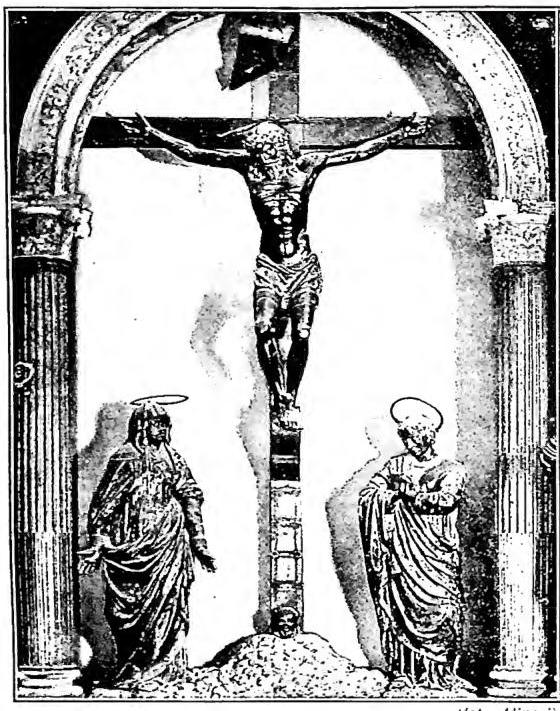
BARONCELLI, NICCOLÒ — Crucifixion — Ferrara, cathedral.Formed spiritually by the Lanteri (v.) and by St. Giuseppe Cafasso, with heroic activity and by lavishing her wealth, she implemented a grand plan of spiritual and corporal charity. Following the example of what Pastoret had done in Paris, whose asylums she had visited, she was led to establish in 1829, in her own palace in Turin, a nursery for boys and girls, which she entrusted first to secular teachers, then to the Sisters of St. Joseph, later replaced by the Sisters of St. Anne of Providence, founded by her herself in 1834. A second asylum was then established in 1835. Meanwhile, the marchioness had founded another series of works of a moral and social character: the « House of Refuge » (1825), where wayward girls were taken in with the aim of reforming their education and directing them toward the practice of a trade that would enable them to earn an honest living; the convent of the Magdalens, the Magdalene College, the Oblates of St. Mary Magdalene (1825–39); the Giulietta College, the St. Joseph Workshop, the Working-Class Family Association, the hospice for sick and rachitic children (1831–35); a complex of works consolidated after her death into the extensive surviving Opera pia B.
She also deserved credit for founding a house of the Religious of the Sacred Heart and for establishing the parish of St. Giulia in Turin. As is well known, she was Silvio Pellico’s maternal protector; and in her palace she created a distinguished center of austere intellectual life, also frequented by Cavour and the most influential people. She was also an uncommon writer, especially in the unpublished Journal d'une femme, in her letters, and in her memoirs, published in part by Pellico and Lanza (an excerpt from all these writings is: La marchesa di B., « Dalle memorie di una giovane signora », Alba 1942).
BIBL.: To this day there is no critical biography worthy of B. The following may serve as substitutes: V. P. Conte, Lettere inedite di A. Lamartine alla Marchesa di B., Turin 1826; S. Pellico, La Marchesa G. F. di B., nata Colbert, there 1864; T. Canonico, Sulla vita intima e sopra alcuni scritti inediti della March. G. F. di B.-Colbert, there 1864; A. de Melun, La Marquise de B. de vie et ses oeuvres, Paris 1869; 2nd ed. 1874; G. Lanza, La Marchesa di B., nata Colbert, Turin 1884; id., Lettere a Silvio Pellico della Marchesa G. di B., there 1886; id., Memorie, appunti e pensieri della Marchesa di B.-Colbert, there 1887; R. M. Borsarelli, La Marchesa di B. e le opere assistenziali in Piemonte nel Risorgimento, there 1930; A. Biancotti, La March. G. di B., there 1939. Tommaso Piatti–Nino Sammartano
Cite this article
“BAROLO, GIULIA VITURNIA FRANCESCA, MARCHESA DI.” Enciclopedia Cattolica, vol. II (1949), p. 525. Azione Romana digital edition, https://azioneromana.com/article/barolo-giulia-viturnia-francesca-marchesa-di.