Machine translation of the 1948–1954 Italian original. The original text is authoritative.
LUCAS CRANACH the Elder. — German painter, woodcut artist, and draftsman, born in Kronach (Franconia) in 1472, died in Weimar on 16 Oct. 1553, son of a painter named Hans C. His artistic training remains unclear: only after he was summoned to the court of Frederick of Saxony (1504) can the development of his activity be traced. Nevertheless, his work from 1500 to 1504 is the most interesting; his works from that period demonstrate his great temperament, making him a precursor of Altdorfer (q.v.), comparable as a passionate colorist to Grünewald himself (q.v.), founder of the so-called "Danube style" (see ALTDORFER), not without influences from Dürer (q.v.), but less classical than the latter.
Perhaps in 1498 he undertook a journey to Austria, truly significant for him and for the development of Danube painting; in 1503 he is recorded in Vienna. From this period date: the Crucifixion at the Schottenstift in Vienna (c. 1500); St. Jerome in the Vienna museum (1502); the Crucifixion at the Munich Pinakothek (1503); and Rest on the Flight into Egypt in Berlin (1504). From 1505 until his death he served as court painter to the Elector of Saxony, and in this capacity he remained almost always in Wittenberg. He ran a large workshop, from which hundreds of works emerged, sometimes altarpieces of Renaissance form but increasingly academic and cold. Though a friend of Luther (whose portrait he painted several times) and almost the official painter of the German Reformation—whose principles he followed even in the choice of religious subjects—he simultaneously worked for opponents of the Reformation, such as Cardinal Albrecht of Brandenburg. From 1520 onward he became
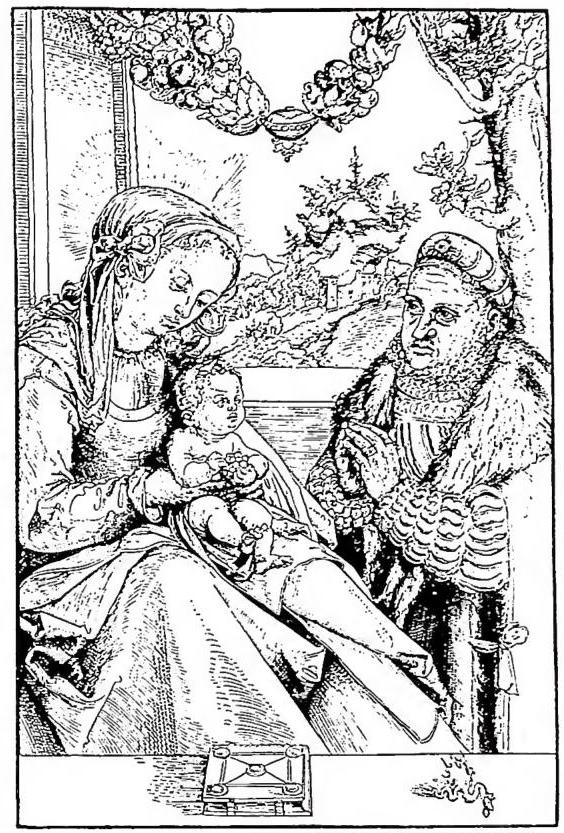
CRANACH, LUKAS – The Virgin and a Devout Man. Engraving. Berlin, Print and Drawing Cabinet.
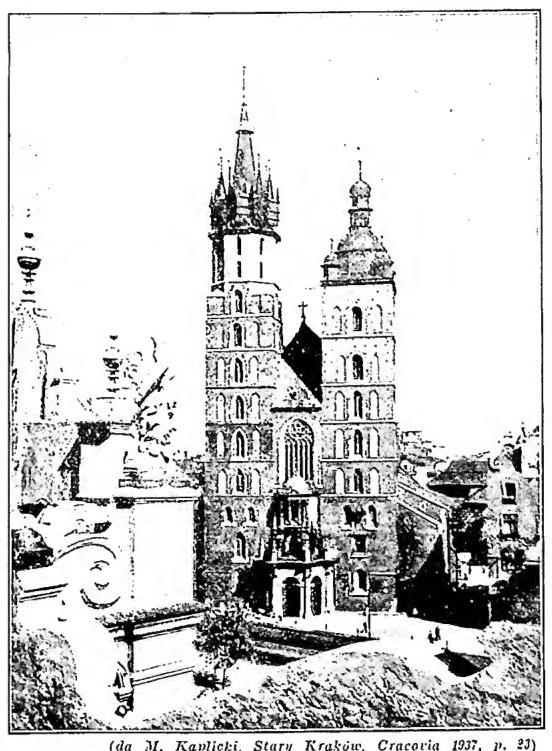
(from M. Kaplioki, Stary Kraków, Cracovia 1937, p. 33) CRACOW — Façade of the church of St Mary, founded in 1226, with later additions.It becomes increasingly difficult to distinguish between his production and that of his workshop. His activity at Wittenberg was interrupted by the following journeys: in 1508 to the Netherlands; in 1550–52 (with the imprisoned elector) to Augsburg and Innsbruck; in 1552 he returned to Weimar. Mature and late works: 1505 Torgauer Altar, Frankfurt; 1506 Altarpiece of St Catherine, Dresden (his most famous work); c. 1520–25 the Crucifix with Cardinal Brandenburg, Munich; 1534, altarpiece at Meissen; 1550 the Self-Portrait in the Uffizi, Florence, and an ever-growing number of portraits and mythological scenes. He was renowned as an engraver and woodcut artist (including coloured woodcuts with gold and silver); together with Dürer, he was among the collaborators for the Gebetbuch of Emperor Maximilian.
His sons were also painters: HANS C.: died young in 1537 in Italy. LUKAS C. the Younger, born at Wittenberg on 4 October 1515, died at Weimar on 21 January
1586. Both are entirely under their father’s influence and are difficult to distinguish from the other members of the workshop
See pl. XLVIII.
BIBL.: C. Schuchardt, C., Leipzig 1851; F. Flechsig, Cranachstudien, ibid. 1900; C. Dodgson, C., A Critical Bibliography, Paris 1900; H. Michaelsen, C., Leipzig 1902; H. Voss, Der Ursprung des Donaustils, ibid. 1906, passim; M. J. Friedlaender, s.V. in Thieme-Becker, VIII, pp. 5–58; C. Glaser, C., Leipzig 1923; M. J. Friedlaender and J. Rosenberg, Die Gemälde des C., Berlin 1932; W. L. Burke, C., in The Art Bulletin, 18 (1936), 125–33; T. L. Girshausen, Die Handzeichnungen C.'s, Frankfurt 1936; H. Lilienfein, C., Bielefeld 1942; H. Posse, C., Vienna 1942. Bernardo Degenhart
Cite this article
“CRANACH, LUKAS IL VECCHIO.” Enciclopedia Cattolica, vol. IV (1950), p. 475. Azione Romana digital edition, https://azioneromana.com/article/cranach-lukas-il-vecchio.