
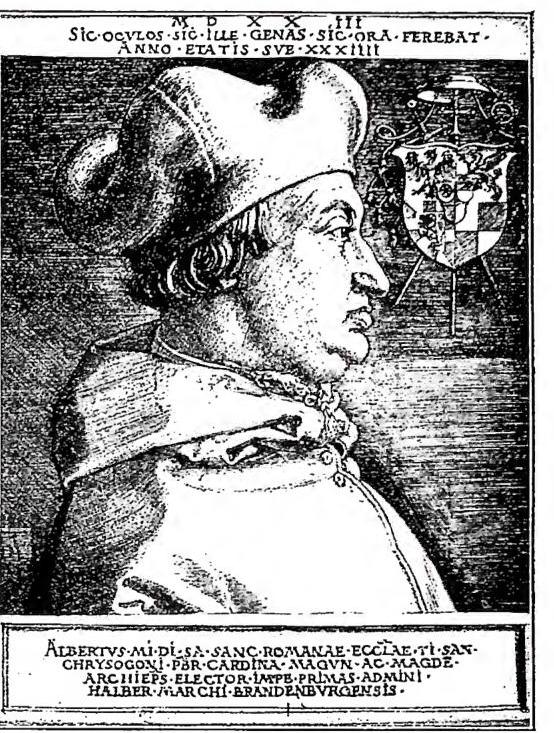
ALBERTO di BRANDEBURGO, archbishop of MAGONZA. — Born in June 1490, died at Aschaffenburg on 24 September 1545. Son of Giovanni IV, elector of Brandenburg; destined for an ecclesiastical career, he studied at Frankfurt on the Oder, where he met Ulrico di Hutten. From as early as 1509 he held a benefice in the cathedral of Magonza; in August 1513 he obtained the archbishopric of Magdeburgo and shortly afterward the administration of the bishopric of Halbertadt. When the electoral archbishopric of Magonza fell vacant, he was elected to this see on 9 March 1514 and was confirmed by the Pope on 18 August. But he did not intend to renounce the two sees previously obtained, and, in order to pay the Apostolic Chamber the taxes due on account of this accumulation of benefices, Leone X granted him permission to publish in those dioceses and in the electorate of Brandenburg the indulgence for the construction of St Peter’s, which had not yet been preached in those regions. The Dominican Giovanni Tetzel was entrusted with this preaching in 1517, and on this occasion Luther’s rebellion began. Of easy-going life and lax morals, A. was certainly not distinguished as a zealous bishop: nevertheless, on 24 March 1518 Leone X created him cardinal of S. Grisogono (a title which he later exchanged for S. Pietro in Vincoli), in order to have in him a defender of the faith in Germany. A., however, had no scruple about keeping Ulrico di Hutten, Capito, Hedius, and other well-known Lutherans in his entourage; on 21 December 1521 he also wrote to Luther, but the latter vainly urged him to take a wife and secularize his principality. Hence Luther’s anger against him in 1525; this, however, did not prevent A. from continuing thereafter to try to win him over to his side. A. proved very weak in defending Catholicism; he allowed heretical books to be printed and priests to marry. He displayed better dispositions in 1542–43, when he was in contact with Giovanni Morone, the papal nuncio, and with Blessed Pietro Fabro, but he vainly attempted to restore the city of Halle, where he resided, to Catholicism. He was a munificent patron of the arts and of humanistic studies. He was buried in the cathedral of Magonza.
Pio Paschini