
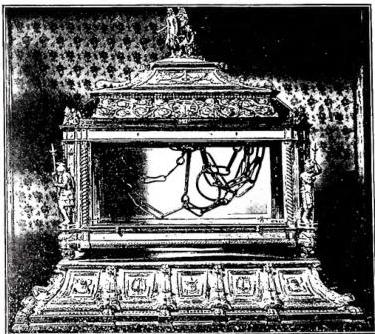
CHAINS OF SAINT PETER. - Those preserved in Rome in the basilica of St. Peter in Chains as relics of the Apostle's imprisonment. The church was entirely rebuilt by Sixtus III (432-40) and from that date it preserved and venerated these relics. Indeed, already in the first half of the 5th century Bishop Achilleus of Spoleto dedicated a church in which he says that, as in that of Rome, "Peter and his chains reign." Furthermore, in an apse of the Roman church there was the distich written in mosaic and which seems primitive: inlaesus olim servant haec tecta catenas vincula sacrata Petri ferrum pretiosus auro.
That the feast of the chains of St. Peter was always celebrated together with the dedication of the church seems to indicate that the repositio of those relics was originally carried out with the very foundation of this basilica. Moreover, already at the beginning of the 6th century the church appears designated ad vincula S. Petri in the most diverse documents; martyrologies and sacramentaries dating back to that century give under August 1 the notice that on that day the chains were kissed by the people. In 519 Justinian asked Pope Hormisdas for a particle de catenis sanctorum Apostolorum and after that time such requests multiplied. It was especially Gregory the Great who contributed greatly to spreading the cult of the chains, distributing many relics of them.
The chains of St. Peter are now two pieces, with oblong rings of similar workmanship, which seem to have belonged to a single chain, which at one end bound the neck with a broad ring and at the other bound the hands. There are various small imitations of them in circulation that are worn on the person and are indulgenced. The ancient sources often speak of only one chain, for example the Chronographia of Sigebert of Gembloux where it narrates the very famous miracle of the healing of a count possessed by a demon in the presence of the emperor Otto I in 969, through contact with the sacred chain (PL 160, 191).
The tradition of two chains of St. Peter, one Roman and the other preserved in Jerusalem, later brought to Rome by Eudoxia, daughter of Theodosius II, and which would have spontaneously united with the Roman one, began to appear only in the 8th century.
BIBL.: sources