
SACRAMENTARY. - A name which in the early Middle Ages designated the book containing the formulas used by the bishop or priest in the celebration of the Eucharist and the administration of the Sacraments: collect, oratio super oblata (secret), preface, canon, oratio ad complendum (postcommunion), oratio super populum.
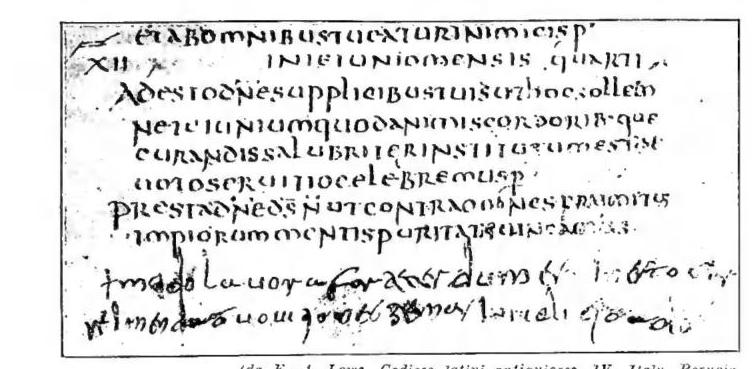
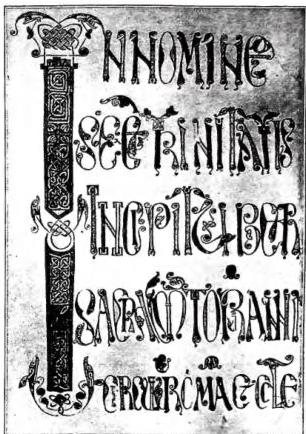
SACRAMENTARY - The so-called Leonine Sacramentary, "explicit" of the "postcommunio" of the 3rd Mass of Pentecost and the first two prayers of the Ember Days of Pentecost (ed. C. L. Feltoe, Cambridge 1896, pp. 27-28) - Verona, Biblioteca capitolare, cod. LXXXIV, f. 21° (second half of the 6th cent.).
SUMMARY:
I. Origins
II. The so-called Leonine Sacramentary
III. Gelasian Sacramentary
IV. Gregorian Sacramentary.1. ORIGINS
2. Nomenclature
The term derives from sacramentum, which in early Christian Latin has several meanings, but directly designates the Sacrament par excellence, the Eucharist. With the same meaning as sacramentum, mysterium is sometimes used, and this explains why one occasionally finds liber mysteriorum for liber sacramentorum. From sacramentum came sacramentarium and liber sacramentorum. The first title is the more common; the second is used by Pope Hadrian to Charlemagne (Jaffé-Wattenbach, I, p. 303). These terms, generic in themselves, corresponded perfectly to the volume's contents.3. The first eucological collection
In the early Christian assemblies there were no books of any kind, except the Old Testament, that is, Psalms, Law, Prophets. Later the Epistles of St. Paul, the Gospels, the Acts, and the other New Testament books were added. The synaxes began with a reading, at first continuous, then chosen according to circumstances or recurring feasts. At a certain point the reading was interrupted by the presiding minister who, under the promptings of inspiration, formulated a prayer of praise and thanksgiving to God, gathering the petitions of those present (I Cor. 14, 16; Justin, I Apol., chap. 67). The initial schema of this oratio must have been very simple. It derived directly from apostolic tradition, which in turn had drawn its fundamental elements from the Judaic environment. Such elements, enriched with Christian thought, developed gradually according to the talent, sensibility, and temperament of the celebrant.Alongside Holy Scripture, people thus began to fix the most frequent and beautiful eucological formulas, among which doxologies came first: the letter of St. Clement (d. 101 [?]; S. Colombo, SS. Patrum Apostolicorum opera, Rome 1938, pp. 135-41) certainly has a eucharistic inspiration; the prayer of St. Polycarp (d. 156; ibid., pp. 452-53) probably reflects the liturgical improvisation of the period. The works of the Fathers and ecclesiastical writers of the first centuries (Origen [d. 255], Novatian [d. 258?], St. Cyril of Jerusalem [d. 386], St. John Chrysostom [d. 407], St. Augustine [d. 430]), Gnostic writings, the apocryphal Acts of the Apostles, and even funerary inscriptions contain numerous liturgical eucharistic formulas, in all probability used or composed for ordinary synaxes (v. LIBRI LITURGICI).
The principle of a single formulary, drawn up for all Churches according to a common and traditional schema, had been an unyielding law in the first three centuries. In the 4th century, a singular phenomenon occurred throughout the West: almost suddenly the principle of uniqueness was abandoned, and every Mass of the Temporal and Sanctoral cycles was provided with its own proper formulary.
Some have seen this movement as a natural evolution. Around the invariable anaphora, a certain number of variable parts of an imprecise character would have gradually crystallized. In time, some fell into disuse, others were shifted, and the schema of the Roman Mass of the 5th century was formed (cf. A. Paredi, I Prefazi ambrosiani, Milan 1937, pp. 7-8). Other authors, however, believe that this was a true liturgical revolution accomplished in Rome between 380 and 420, presumably by the work of Pope Damasus (366-384; Bourque, op. cit. in bibl., p. 37), who, by assigning variable formulas to Masses, completed the work of restoration and embellishment of Christian cemeteries and the cult of the martyrs. Later generations would retain a vague memory of the Damasian reform while forgetting its precise object. To this would refer the liturgical activity that the sources of the 6th-7th centuries attribute to him (MGH, Gesta Pontificum Romanorum, I, pp. 83-84).
4. The libelli missarum
The sacramentary is a book composed of various libelli missarum, with which each Church was provided for the normal conduct of worship. Characteristic is the episode of Sidonius Apollinaris who, invited to celebrate on the occasion of a major feast, and having had his own libellus carried away, improvised with such eloquence that the faithful believed they were hearing an angel (St. Gregory of Tours, Historia Francorum, II, 22).The episode shows that the libellus was commonly used even for solemn Masses, and not only for private celebration, as some scholars have maintained (A. Ebner, Iter Italicum, Freiburg i. Br. 1896, p. 359). At first the libellus took the place of every other liturgical book, bringing together the formularies necessary for a given Church. Later, in the full period of the sacramentaries, the libelli replaced the sacramentaries for missionary or itinerant priests, containing the Ordinary, a certain number of votive and common Masses, and the ritual of certain Sacraments.
The first kind of libelli must have flourished particularly in Rome. The liturgical history of the Eternal City, down to the second half of the 4th century, shows that in the tituli only what would today be called the Temporal cycle was celebrated, and even that was quite reduced. The cult of the saints was exclusively local and took place around the tombs of the martyrs. For this reason the depositio martyrum and depositio episcoporum added the topographical indication to each feast. Outside of these feasts, the two documents mention only the Natale Domini, a feast common to all tituli, and the Natale Petri de cathedra, which for contemporaries needed no other specification. Finally, each titulus celebrated the Dedicatio. From this one can easily reconstruct what the libellus missarum of a titulus might have contained: an embryonic Temporal, one or two Masses of the Sanctoral, and some benedictiones. The libellus of a cemetery church included the Masses of the martyrs honored there.
The exception ended up becoming the rule during the 5th century. The sermones of St. Leo show a strong development in liturgical worship with the increasingly frequent participation of the pontiff. The custom became general that the same saint was celebrated simultaneously in all tituli. A book with identical Mass formularies for everyone became necessary. Thus one reaches the end of the 5th century, the era of the first great collections known under the name of sacramentaries, which supplanted the libelli.
II. THE SO-CALLED LEONINE S
5. The manuscript
The manuscript still preserved in the Chapter Library of Verona is in uncial letters and consists of 138 folios. The majority of scholars (Delisle, Thompson, Duchesne, Feltoe) date it to the beginning of the 7th century. E. A. Lowe specifies: second half of the 6th century (cf. Codices latini antiquiores, IV. Italy: Perugia-Verona, Oxford 1947, p. 32). Only the latter author states that it was executed at the school of Verona: others (Beer, Traube, Bishop, Cabrol) lean towards Spain, Africa, Bobbio, and Luxeuil.6. Content
The Leonine is a collection of about a thousand euchological formulas composed for the various needs of liturgical worship. Some are extremely elegant in concept and form, others mediocre and poor in thought. All are characteristic for their technical cursus. Out of 1030 endings, 927 metric cadences have been identified—an artistic particularity that tends to disappear in later s. Leonine formulas are found in other s.: thus the Gelasian has 107 of them, the Gregorian 118, the Missale Romanum 35.The formulas are grouped according to various liturgical occasions, but not without confusion. Each group (section) consists of collects, secrets, postcommunions, orations super populum; furthermore, one or two prefaces—a characteristic of the Leonine, which contains 167 of them. The sections are preceded by a title that seems to refer to the liturgical circumstance, or they are introduced by the simple phrase item alia (missa?). They are arranged according to the order of the civil year, that is, by months, which is entirely original since other s. have the traditional arrangement of the ecclesiastical year.
In the months poorer in liturgical occurrences, one might say that the compiler filled the gaps by inserting groups of masses for various circumstances, but in an arbitrary manner. This explains why in April formulas are found for the common of martyrs, for Eastertide, and for the dedication of churches; in July, orations and daytime, morning, and evening prayers; in September, prayers for the consecration of bishops, deacons, priests, and virgins. There are also orations and prefaces of a very polemical character, e.g., against false confessores mixed with true ones, against adversaries (subdoli operarii) against whom one must be on guard as against wolves.
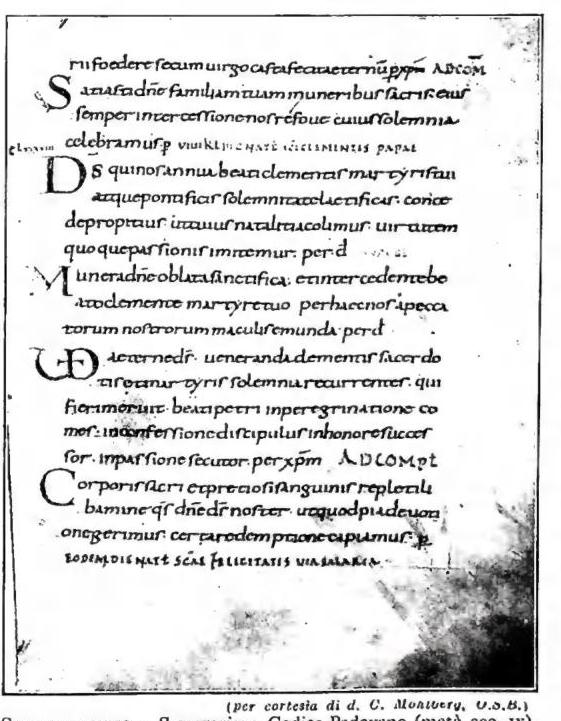
SACRAMENTARY - Gregorian S. Paduan Codex (mid-9th century). Mass in honor of St. Clement, later borrowed from the prototype (9th century) of the Glagolitic Missal of Kiev (11th century) - Padova, Biblioteca capitolare, cod. D. 47.
But this disorder, according to A. Chavasse (op. cit. in bibl.), is only apparent and conceals a real order, the perception of which singularly illuminates the composition and origin of the entire compilation. That is, the fact that the various libelli were not disassembled according to their content, but remained intact and juxtaposed, constitutes an excellent means today to identify them, date them, and assign their authorship to various authors.
7. Author and date
The aforementioned peculiarities clearly show that the Leonine is not an official liturgical book. Certainly it was never used at the altar. It is a private compilation, made by a private individual, for private purposes. A collection of materials of diverse origins and different eras. Innumerable hypotheses have been advanced regarding the author and the date of composition. Here are the main ones: a) author s. Leone Magno (440-61). This was the opinion of the first editors, followed by Quesnel, Tomasi, and in part by Probst. Certainly there is no lack of expressions that reflect the style and phrasing of s. Leone (C. Callewaert, St-Léon le Grand et les textes du Léonien, in Sacris erudiri, 1 [1948], pp. 35-122). b) Composition after Simplicio (468-83) and before Gelasio (492-96). Thus authors (Muratori in particular) who see a dependence of the Gelasian on the Leonine. c) M. Rule thinks that the Leonine had three different redactions: one under s. Leone (440-61), the second under Ilaro (461-68), the third under Simplicio (468-83). d) F. Probst places it between 483 and 492, with groups of earlier formularies (s. Leone and s. Damaso). For some prayers he admits that the author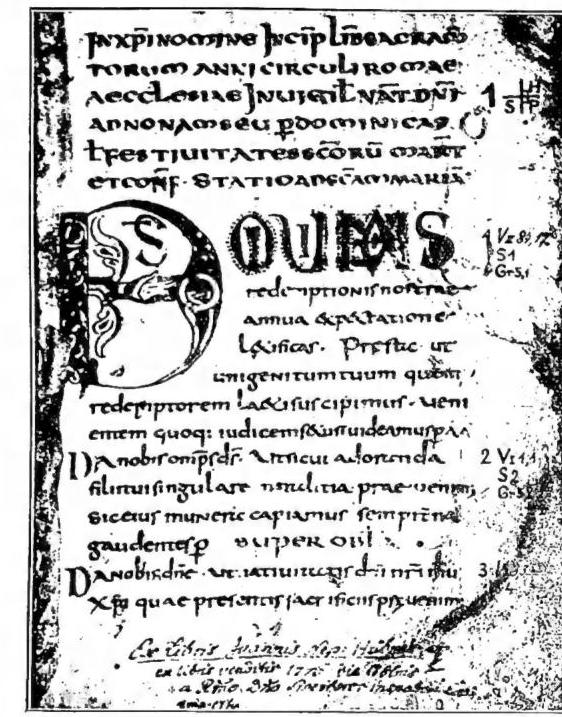
SACRAMENTARIO - S. di Praga. The Gelasian and Gregorian sources are fused according to a system different from that followed by the compiler of the 8th-century Gelasian. The marginal numbers were added on the phot. by d. A. Dold - Praga, Biblioteca capitolare, [cod. O. 83 (8th-9th cent.).
had transcribed separate libelli. e) B. Capelle and C. Coebergh (cited in the bibl.) see in several places the hand of Pope Gelasio. f) R. Buckwald makes St. Gregorio of Tours (6th cent.) its author and considers the Leonine the outline of the Gelasian. g) A. Chavasse (cited in the bibl.) assigns a good number of formularies to Pope Vigilio. h) L. Duchesne places it between 537 and 590, basing himself mainly on certain political events of that period. i) C. L. Feltoe, and after him E. Bourque, plausibly hold that the Verona manuscript is the archetype and the only copy that ever existed. Bourque's conclusions, generally accepted today, are: 1) The Leonine collection contains formularies ranging from 440 to 560, except for a few formularies that are perhaps older. 2) The Verona manuscript is the archetype: the character of the collection, the disorder, the false divisions, the transpositions, the marginal and textual notes denote a first-draft compilation; a copy would certainly have eliminated the grossest errors. 3) The Leonine appears to be a unicum, even though some isolated formulas (never an entire series) are found in other sacramentaries. The identical formulas are explained by the fact that the libelli used in Rome were not unknown to foreigners (pilgrims) and ended up being inserted into liturgical books. 4) The compiler's primary purpose was to make an abridged, selected collection, choosing among the saints venerated in Rome only the most representative. Something intermediate, therefore, between the libelli missarum and sacramentaries properly so called. A secondary purpose was reportedly to make the collection a source to draw upon later. Proof of this is found in the manuscript's use of abbreviations and Tironian notes. 5) The materials used are of purely Roman origin (the conjecture that the Leonine is of Ravennese origin, previously advanced by some scholars and recently proposed again with a wealth of detail by G. Lucchesi, Nuove note agiografiche ravennati, Ravenna 1943, p. 71 ff., has not found favor). The anonymous compiler who put them together had a great veneration for the Roman liturgy. Might one not think of one of those pilgrims of whom other works survive, such as epigraphic sylloges? 6) The Leonine is neither a sacramentary nor a pre-sacramentary, because it was composed after 560, when a sacramentary already existed in Rome. Yet with all its defects it is of immense value because it has preserved true jewels of the ancient Roman liturgy and constitutes the transitional stage between the libelli and the sacramentaries.
III. THE GELASIAN SACRAMENTARY
8. Content
The Gelasian is an official book, the first Roman sacramentary; Reg. lat. 316 is its most notable manuscript (v. MEROVINGICA SCRITTURA). It is divided into 3 books. Book I contains the Temporale, that is, the Masses from Christmas Eve to the octave of Pentecost, the rites of Ordination, of the catechumenate, of the blessing of oils, of the font, and of the consecration of virgins. Book II gathers the Masses of the Sanctorale from St. Felix the Confessor (Jan. 15) to St. Thomas (Dec. 21), eight sets of Masses in natal. plurimorum sanctorum, and 5 de adventum (!) Domini. In Book III are found 16 orationes et preces cum canone per dominicis diebus, the Canon, a collection of benedictiones super populum post communionem, votive Masses, various blessings (aquae spargendae in domo, aquae exorcizatae ad fulgura, pomorum, arboris), and several sets of prayers for the dead.9. Author and Date
Stripped of all the superstructures, mostly Gallican, of the 6th-8th centuries, Reg. lat. 316 essentially preserves the original sacramentary composed at the end of the 5th century. This is clear from historical data, lexical peculiarities, and content. Certain expressions such as consignatio, to indicate confirmation, the special Communion formula, the Hanc igitur without diesque nostros, the absence of a fixed number of Sundays after Epiphany and Pentecost, parallel expressions and analogies between the Gelasian and the Rule of St. Benedict (written probably between 535 and 547) are indications of a pre-Gregorian liturgy. Furthermore, the liturgy of the old Gelasian corresponds perfectly to the organization, discipline, and institutions in force in Rome in the 6th century. Thus, the Masses of the Lenten scrutinies, the three Masses of Holy Thursday, the missa in reconciliatione poenitentiae, the missa chrismatis, and the missa ad vesperum—reduced to a single Mass at the time of St. Gregory—the two prayers before the secret (the first suppressed in the 6th century), the five Advent Masses introduced in the second half of the 6th century.The additions or variations made to the old Gelasian
are: in Book I, Pre-Lent, some revisions of the penitential rites, the denuntiatio pro scrutinio on the Monday of the third week of Lent, some revision of the ordo baptismi of the Easter Vigil, in the ordination rite where there is a whole series of Gallican rubrics, and finally revisions of the missa chrismatist of Holy Thursday, the ordo for the blessing of the Easter candle, and the rite of the dedicatio ecclesiae. In Book II, which is the part that has remained purest, the sanctorale is almost intact: only the four feasts of the Virgin and the two feasts of the Holy Cross have been added. In Book III, the Canon has been inserted, which is the one reformed by St. Gregory, along with some blessing formulas.
These interpolations all have a Gallican character and were made on several occasions. A first revision can be placed around 550, that is, after the arrival of the sacramentary in Gaul. The Advent Masses and the rites of the Minor Orders date from that period. A second revision must have taken place after St. Gregory (590-604) and before Pope Sergius (687-701), when the Canon and the Marian and Cross feasts were introduced. A third revision occurred around 700, barely half a century before Reg. lat. 316 was written.
The Gelasian is a papal sacramentary. A careful examination of its content and sources traces its composition to the end of the 6th century. From the Liber Pontificalis (written around 530) we know that Gelasius (492-96) fecit... sacramentorum praefationes et orationes canto sermone (Lib. Pont., I, p. 255). This very likely refers to the systematic collection of liturgical formulas that Pope Gelasius compiled on the basis of the numerous libelli missarum of the Roman shrines and the Lateran collections, to which tradition and liturgical history have preserved, without falsehood, the name of its author.
10. The «Eighth-Century Gelasians»
Having entered Gaul shortly before the middle of the 6th century (Bourque, cit. in bibl. p. 199), the Gelasian Sacramentary spread widely there, supplanting the books of the old Gallican rite. However, the genuine Roman text had to undergo adaptations for the French Churches. Around 750, probably at the instigation of King Pepin, a syncretistic sacramentary was compiled, which took the Gelasian as its basis, but with the addition of elements drawn from the Gregorian, which had already penetrated France, and from other local sacramentaries. To this composite type of sacramentary, liturgists usually give, after Bishop, the name of «Eighth-Century Gelasians», while others prefer the designation «Old Gelasians» for the ancient ones and «Late Gelasians» for this new type, which continued to exist and be reproduced even after the 8th century.Connected to the Gelasian type is the Missale Francorum (Cod. Reg. Vat. 257), written near Liège at the end of the 7th century, edited by Tomasi (Opera, VI, pp. 341-68) and by Muratori (Lit. Rom. vet., II, pp. 661-758). Wilmart considers it to date from the beginning of the 8th century. Initially (6th century) it was a pontifical with the ordination rite; later, some Mass formularies and the pre-Gregorian Canon were added. Gallican elements are also not lacking.
IV. GREGORIAN SACRAMENTARY
I. Content. — This varies according to the different manuscripts, but substantially it has the following arrangement: the temporal and sanctoral cycles are fused together and begin with Christmas Eve. These are followed by the feasts of St. Stephen, St. John, the Holy Innocents, the Epiphany, the Purification (Feb. 2), the Annunciation (Mar. 25), the Sundays before Lent, the Sundays of Lent, Holy Week with certain blessings for catechumens, six lessons on Holy Saturday and the blessing of the font, the octave of Easter, the greater litanies on April 25, the Ascension, Pentecost with its octave, the Ember Days of the fourth month, the feast of St. John the Baptist, of the SS. Pie-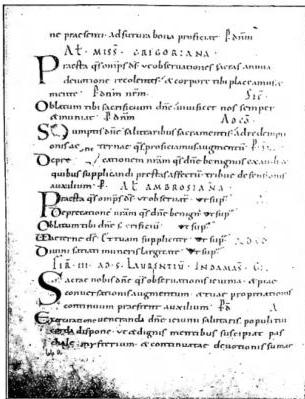
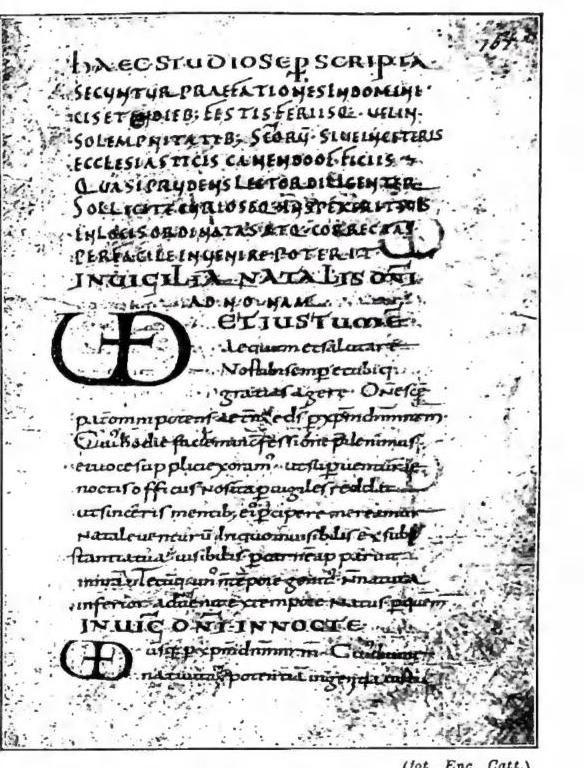
SACRAMENTARIUM - Sacramentarium triplex. Masses for Mondays and Tuesdays of the 4th week of Lent, with formulas derived from the Gregorian, Ambrosian, and Gelasian Sacramentaries — Zurich, City Library, C. 43 (1020-30).
tro and Paul, of St. Lawrence, the Assumption, the Nativity of the Virgin on Sept. 8, the Four Embertides of the seventh month, the four Sundays of Advent with the Four Embertides of the tenth month, prayers for dedication, ordination, anniversaries, and various prayers and blessings.
11. Author and Date
From the 9th century, tradition has been constant in considering the Gregorianum to be the work of St. Gregory (590-604). This authorship is now universally accepted, after the contrary theses of A. Gevaert and G. Eckhart were rejected.The oldest testimony dates back to the end of the 7th century. St. Aldhelm (d. 709), Bishop of Sherborne, who lived in Rome from 687 to 701, reports that St. Gregory placed the names of St. Agatha and St. Lucy near each other in the Canon (De laud. virg., 42: PL 39, 142). The Archbishop of York, Egbert, is even more explicit when in a writing of 735-36 he attributes the composition of an antiphonary and a missal to St. Gregory (PL 89, 441), which he saw at St. Peter's. Testimonies from subsequent centuries are abundant.
Internal criticism confirms these data, which are now established in history. The date of Easter on April 3 and Pentecost on May 22, and the general arrangement of the calendar year in the Gregorianum, ensure that the sacramentary was composed for the year 595. In that year, Gregory assembled in synod 23 bishops and 35 priests of the urban tituli where important liturgical reforms had been carried out.
12. Character
A simple comparison between the Gelasian and the Gregorian shows that the reform, while remaining in a perfectly Roman line, is profound and complete. It was not limited to the formal part of the missal, but extended to the schemas of the formularies and the substance of the formularies themselves. Probably, like Gelasius, the Pope had the libelli missarum of the various tituli collected and worked on them. One of the main concerns was to abbreviate and make a practical book. For this reason, he inserted the sanctoral into the temporal, significantly reduced the number of prefaces (267 in the Leonine, 54 in the Gelasian, 25 in the Paduensis, 10 in the Hadrianum), and of the festive embolisms of the Canon. St. Gregory did not hesitate to depart from tradition when the purpose he wished to achieve with his arrangement required II. Thus, in the series of the Lenten communio, he substituted five antiphons taken from the psalms with an equal number taken from the Gospel of the day, to emphasize the baptismal idea.He gave the super populum prayers the form of ordinary collects, modifying their original blessing character.
The feasts common to the Gelasian and the Gregorian are 35; those proper to the Gregorian are 28, about ten of which are the eponyms of Roman tituli; 15 feasts of the Gelasian are not found in the Gregorian.
The work of St. Gregory was therefore not a pure compilation. But the ideas and style of the great reformer are found throughout the whole as well as in certain formularies, e.g., in the Mass of St. Agatha, of Passion Friday, in the Christmas preface, in the communicantes of the Ascension and the Epiphany.
13. The Hadrianum
In the 7th-8th centuries, the original Gregorian (A) underwent additions, abridgments, and reworkings. Toward the end of the 8th century, Charlemagne (v.), with the intention of introducing the Roman liturgy throughout the Empire, asked Pope Hadrian (771-95) for a sacramentary that could serve as a norm. Between 784 and 791, the Pope sent him the Liber sacramentorum a sancto dispositus praedecestore nostro deifluo Gregorio papa. The codex remained as a typical exemplar in the Imperial Library of Aachen, and numerous copies of it were made (B). The new Hadrian-Gregorian, or more simply Frankish, sacramentary was introduced into Gaul, gradually replacing the pre-existing Gelasian and Gregorian sacramentaries. But the newcomer did not fully meet Gallican requirements. Therefore, the imperial advisor Alcuin (d. 804) extracted some formularies from the sacramentaries used up to that time, forming a supplement which he added to the manuscript that had come from Rome. He prefaced the supplement with a prologue (the «praefatiuncula»: Hucusque) in which Alcuin set forth the criteria used in the compilation. The Frankish sacramentary furnished with the Alcuinian supplement spread rapidly (C); however, some Churches, for greater convenience, composed their own supplements (D), while others, to make the book even more practical, began to write the formularies in the margins or to insert them into the text (E) until in the 10th century the insertion was complete, and the sacramentary with the supplement formed an organic whole (F).At this point (sporadically it had appeared as early as the 7th century) this latter type asserts itself. Readings and chants are added to the formulas for the celebrant's use, forming a composite book that combines completeness with practicality. It marks the decline, and then the definitive sunset, of the sacramentary, leaving a clear path in the 12th century for the plenary missal, the precursor of our Missale romanum (
V. MESSALE)
See pl. XCVI.Hadrianum without supplem.: Cambrai, ms. 164 (9th cent.), ed. H. Lietzmann (Münster in V. 1928). C) Hadrianum with regular suppl.: Vat. Ottob. 313, Reg. 337 (9th cent.), served as the basis for the ed. of Muratori and Wilson; Paris, Bibliot. naz. 12050 (9th cent.), ed. U. Ménard, Paris 1641, reproduced in PL 78, 26-240. Cologne, Bibliot. capitolare 137 (11th cent.), ed. G. Pamelius, Cologne 1571. D) Hadrianum with irregular suppl.: Mainz, Bibliot. del Seminario (9th cent.), ed. A. Dold, Beuron 1919. Verona, Bibliot. capitolare, cod. LXXXVI (81) and XCI (86) (9th cent.). E) Hadrianum with incipient fusion: Florence, Bibliot. naz. XXXVI, 13 (10th cent.), Ivrea, Bibliot. capitolare, 86 (Missal of Varmondo, late 10th cent.), cf. L. Magnani, Le miniature del s. d'Ivrea, Città del Vaticano 1934. Bibliot. Vatic. 3806 (10th cent.), ed. A. Rocca, 1596. F) Hadrianum with complete fusion: Bibliot. Vatic. 4770 (10th-11th cent.), Montecassino, cod. 339 (11th cent.), Bibliot. Vatic. 3548 (11th cent.), collated with the S. Fuldense (10th cent.), Milan, Bibliot. Ambros. D. 84 (10th cent.); it is a plenary missal. 3. Studies. Bourque (cited above), pp. 299-304; F. Cabrol, Grégorien (Sacramentaire), in DACL. VI, coll. 1776-96 (with extensive bibl. up to 1925); H. Lietzmann, Auf dem Wege zum Urgregorianum, in Jahrb. für Liturniewirschsch., 9 (1929), pp. 132-38; H. Schmidt, De lectionibus variantibus in formulis identicis Sacramentariorum Leoniani, Gelusiani et Gregoriani, in Sacris erudiri, 4 (1932), pp. 103-73. Annibale Bugnini