
ASCENSIONE - I. NELLA S. SCRITTURA. - Dopo essere apparso ripetutamente durante quaranta giorni, Gesù risorto comparve un'ultima volta agli apostoli
Various non-Catholics have supposed that the account of the A. was an interpolation; but objective textual criticism recognizes the genuineness of the twofold Lucan text in the form preserved by the Eastern recension (all the manuscripts of the 4th and 5th cent.). Even in the form called Western (Codex Bezae), which harmonizes the two accounts of Luke, the historical fact is clearly affirmed. Literary criticism, which discovers in the account the unmistakable footprint of the Lucan style, and historical criticism, which finds the fact affirmed or presupposed in the early apostolic catechesis, confirm its reality. Attempts to see in it a myth, arising in various evolutionary phases, shatter against the established fact of the antiquity of the Atti (years 62-63).
In the New Testament itself, the apostles Paul, Peter, and John presuppose or attest the reality of the A. or of the presence of Christ's glorified humanity in heaven (I Thess. 1, 10; Eph. 1, 20-22; 4, 10; 6, 9; especially Hebr. 9, 24 [and 7, 27; 8, 1; 10, 12; etc.]; I Pt. 3, 22; I Io. 2, 1). The testimonies are more than sufficient to compensate for the silence of Matthew, who preferred to close his Gospel with the apparition in Galilee of Jesus sending the apostles to evangelize the world.
V. Larrañaga, L'Ascension de N
S. dans le N. T., trad. franc. di G. Cazaux, Roma 1938 (capitale lavoro esegetico-critico).
Pietro De Ambroggi
II. NELLA LITURGIA. - The feast of the A. is celebrated on the Thursday following the fifth Sunday after Easter, at a distance of forty days from it, in conformity with the narrative of the event left to us by the Acts. In ancient Roman liturgical monuments, such as the Leonine, Gelasian, and Gregorian Sacramentaries, it is called Ascensa, and in the Mozarabic, Gallican, and Ambrosian liturgies, Ascensio, a designation that later remained in the Roman liturgy. Its first mention is found in Eusebius of Caesarea (De solemn. paschali, chap. 5), who calls it most solemn. At the end of the 4th cent. it is also recorded in the Peregrinatio Aetheriae, according to which it was celebrated in Jerusalem fifty days after the Resurrection, that is, on the afternoon of Pentecost. But by the 8th cent. this Church too adopted the custom of Rome. In the Middle Ages it was accompanied by certain symbolic ceremonies, and in some countries somewhat singular yet meaningful customs still survive today. The paschal candle is extinguished after the Gospel of the Mass, to signify that the risen Christ has ascended into Heaven.
BIBL. F. Cabrol, s. V. in DACL, I, II, coll. 2934-43; F. G. Holweck, Cal. liturg. festorum Dei et Dei Matris Mariae, Filadelfia 1925, p. 170.
Mauro Ingusanez
III. IN ARCHAEOLOGY. - The composition of the scene of the A. was inspired by the texts of the Gospels and the Acts of the Apostles, as well as by apocryphal monuments, such as the Gospels of Nicodemus and Peter, in addition to the so-called Ascension of Isaiah. A determining element was also the liturgical spread of the solemnity of the A. in the Christian world, starting Jerusalem (v.) through the initiative of the matron Poemenia, before the year 378, on the summit of the Mount of Olives, at the spot where the Lord ascended into Heaven.
Ancient Christian iconography created two distinct types of the A.: the first, of Eastern origin, represents the divine glorification of Christ, the Rex gloriae (Ps. 23): the Lord ascends into Heaven within a mandorla, supported by angels; the second, of Western origin, is more realistic and exalts the Son of Man: the Lord ascends into Heaven from the Mount of Olives aided by the divine hand.
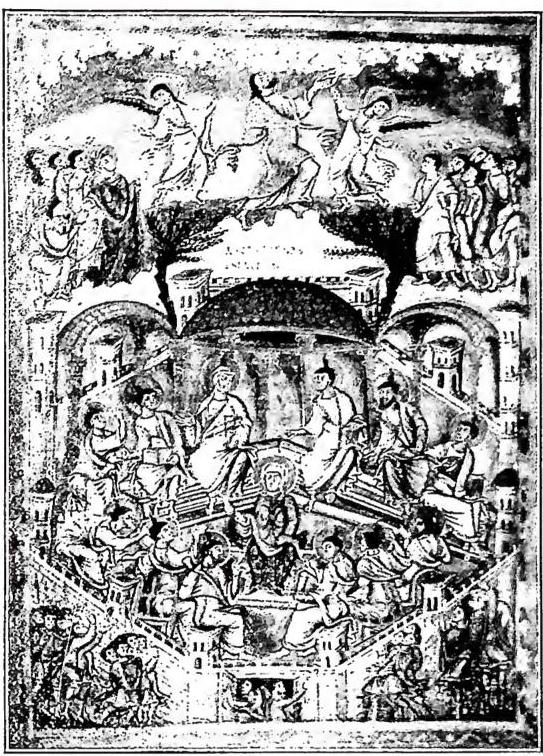
The first originates in Palestine, probably as decoration for the very basilica of the A. in Jerusalem, because the most characteristic examples are provided by a flask (v.) from Monza and one from Bobbio of undoubtedly Palestinian origin, reproducing subjects copied from representations existing in Palestinian sacred buildings. Other examples of the same type are provided by the encolpion of the Royal Library at Windsor and by the reliquary box coming from the Sancta Sanctorum, now in the Museo Sacro of the Vatican Library. Related to the Palestinian type are: the one developed in Syria, the archetype of which is offered by the Syriac manuscript written in 586 by the monk Rabula of the monastery of St. John of Zagba in Mesopotamia, since 1497 in the Laurentian Library in Florence (cod. Plut. I, 56); the silver plate of Perm (Siberia); the Syriac manuscript of the Bibliothèque Nationale in Paris; the Armenian type, represented by the Gospel book of Queen Mike (today at San Lazzaro, no. 1144); the Egyptian type with the fresco of chapel no. 42 in Bawit.
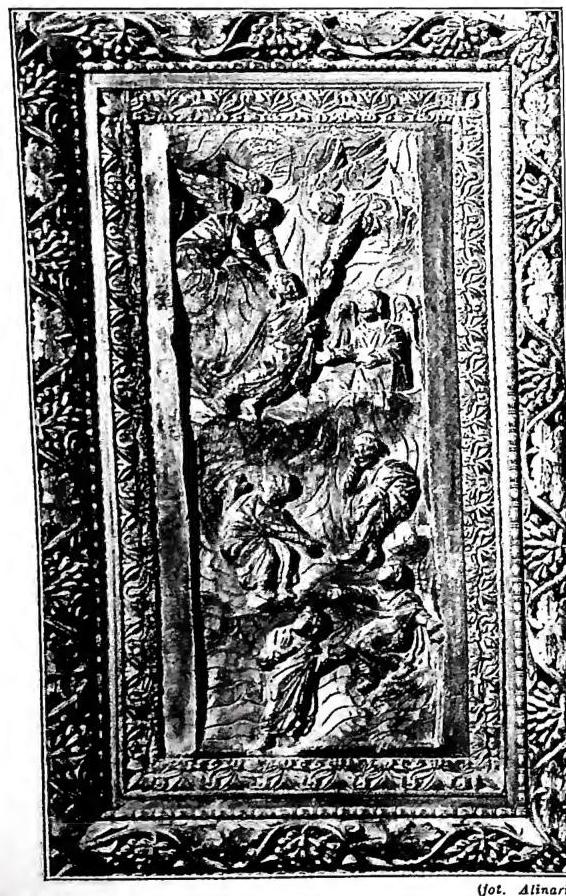
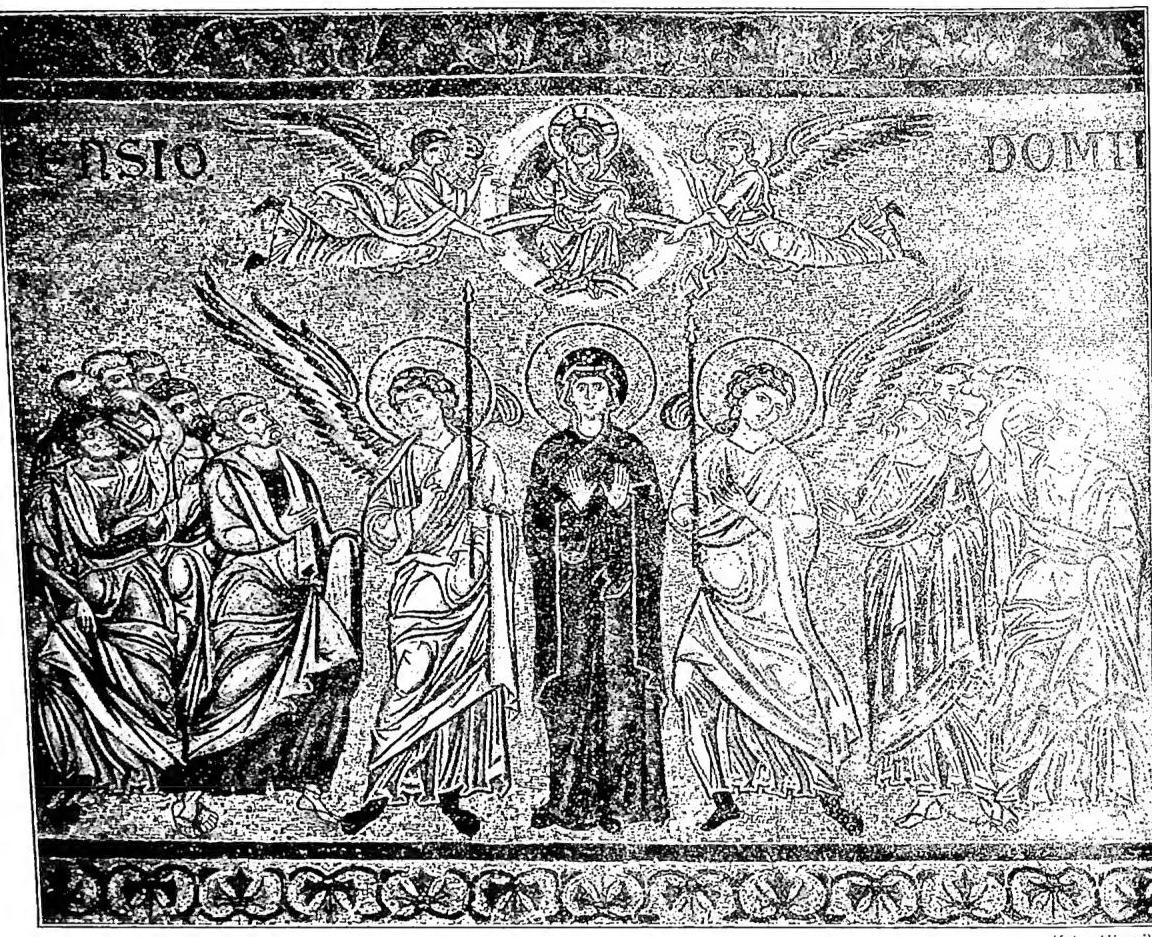
Also connected to the Eastern type are both the panel with the A. on the door of Santa Sabina and the A. in the subterranean church of San Clemente, both in Rome, as well as those of Monreale and the ciborium of San Marco in Venice. In all these representations the Lord is always accompanied by an entourage of angels, according to the text of the Gospel of St. John (1, 51) and the homily of St. John Chrysostom (de Ascensione: PG 50, 449).
The second type, Western, is depicted in the 4th-century ivory of the Bayerisches Nationalmuseum in Munich; analogous representations are found on a sarcophagus from Servanne (Wilpert, Sarcofagi, p. 336 and pl. XV); on an ivory in the Free Public Museum of Liverpool, in the diptych of the South Kensington Museum in London, etc. Certainly the scene of the A. spread very early in the West as well, because it was represented at the beginning of the 5th century in the basilica of Zaragoza in Spain, as attested by tetrastich no. 44 of Prudentius's Dittochoeum.
IV. IN ICONOGRAPHY
While in the 10th and 11th centuries Western representations of the A. appear increasingly rich in Eastern elements, already around 1000 (Missal of Robert of Jumièges, Rouen) a completely new theme began to be introduced, which prevailed north of the Alps until the late Gothic period: of the figure of Jesus risen into the air, only the feet and the hem of the garment remain visible. For the definitive development of the subject, three Italian masterpieces finally mark the stages: Giotto's fresco in the Arena Chapel in Padua, that of Melozzo da Forlì (Rome, Quirinale), and that of Correggio in the dome of the Cathedral of Parma, where the glory of Jesus, thanks to the grandiose rotational movement of the entire composition, assumes the utmost figurative vigor.V. IN POPULAR TRADITIONS
In popular life, the feast of the A. had very great importance in the past, whereas today, perhaps more than for other feasts, the character of its manifestations is fading and being lost. It gave rise to a series of practices, rites, and beliefs, whose inspiring background stems from this being a solemn day of purification and blessing; a day, therefore, awaited with anxiety by those afflicted with serious illnesses, and also considered of happy omen.The majority of popular customs are connected with the va-
The same miraculous faculties attributed to herbs, plants, and fruits are believed by the people to be possessed by the Ascension egg, which is jealously guarded. The belief in the extraordinary healing efficacy of the Ascension egg for every form of disease, even for the most resistant to any treatment, has given rise to a very widespread proverb, which we often find recalled in the comedies of the 1500s: "Not even the Ascension egg would cure (or save) him." In Romagna the peasants believed that this egg had the power to locate drowned persons, deluding themselves that, if left to the current, it would stop at the spot where the drowned person was located.
In certain Italian cities, the feast of the Ascension had, in past
(photo Alinari)
A Firenze ha luogo ancor oggi, per l'A., la famosa «festa del grillo».