
BÄWÎT. — Locality in Middle Egypt where the ruins were discovered of one of the most important monasteries of the early Middle Ages, that of Apa Apollo (cf. W. E. Crum, Der hl. Apollo und das Kloster von Bawît, in Zeitschr. für ägypt. Sprache, 40 [1902-1903], pp. 60-62; J. Clédat, in Comptes Rendus de l'Acad. des Inscr. et Belles Lettres, 45 [1902], pp. 525-46), who died in 395, a monastery mentioned by Palladius and Rufinus. It was a double monastery, that is, it also contained a women's coenobium dedicated to Ama Rachel. It lasted until around the beginning of the tenth century, when it was destroyed by the Muslims, who plundered it and took some of its sculptures to decorate the mosque of the nearby village of Dašlût. At the centre of the monastery stood two churches, almost identical in plan, richly decorated with sculptures, which are the most interesting among those left to us by the Christian art of Middle Egypt (cf. E. Chassinat, Fouilles à Bawît, Cairo 1911,
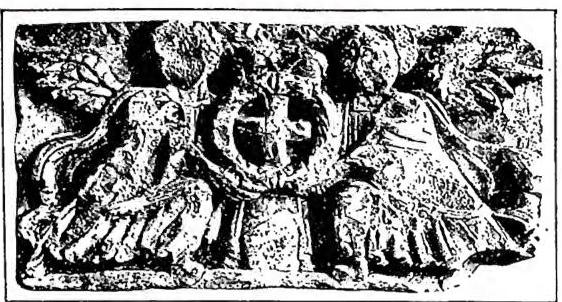
BĂWĪT — Central part of a frieze from the South church (eleventh or twelfth century).
Paris, Musée du Louvre.
vol. of plates without text). Of far greater importance, however, are the many paintings that decorated the halls and chapels, and sometimes even the cells of the monastery—paintings that represent not only Christian subjects, but also others drawn from the Old Testament (especially the story of David) and from ancient mythology, such as the myth of Orpheus. Other paintings have entirely profane subjects, such as two hunting scenes. Painted or graffiti inscriptions are innumerable, and are rich in information both about worship and about the organization of the monastery.
Ugo Monneret de Villard