
AKHMIM (Aḥmīm). — City of Middle Egypt, with a high percentage of Coptic population, situated on the site of ancient Panopolis, sacred to the cult of Min-Pan. From the name of the deity came the Coptic name of the place, Šmin, and from this the Arabic Akhmim. In Coptic tradition the city is famous for its cheerful population, fond of pleasures and attached, until a late period, to the ancient Egyptian religion transformed in the Hellenic manner. The statue of Pan, described by Stephanus of Byzantium, was destroyed only in the time of Shenudi (4th century), who made several incursions into the city at the head of his monks in order to combat the pagans and overthrow the temples. The destruction of one of these, called Mētrōs, is attributed to s. Atanasius. Christianity was introduced into A. very early, and the father of coenobitism, Pachomius, founded three monasteries there. Two of its bishops took part in the Council of Nicaea and in that of Ephesus (E. Amélineau, La géographie de l'Égypte à l'époque copte, Paris 1893, pp. 18-22). In the city stands the Coptic church of the Virgin (al-Adra), not very ancient: it belongs to the type widely diffused in the late Middle Ages, with parallel naves formed by square bays covered with domes or cross vaults, and with three apsidal sanctuaries. The construction is entirely of brick (v. SOMMERVOGEL, CHARLES, Christian Antiquities in the Nile Valley, Oxford 1912, pp. 144-45).
Archaeologically, A. is highly important for its extensive necropolis, in which very numerous fragments of decorated textiles, as well as entire garments (tunics) with textile appliqués, have been found. The necropolis was discovered by G. Maspero, but unfortunately it was damaged by clandestine excavations carried out by the local inhabitants, while even those conducted by Europeans were not distinguished by their method, so that the elements that might have provided the exact chronology of the tombs were destroyed or were not collected. On the finds at A., see the works of R. Forrer, Die Gräber- und Textilfunde von Achmim-Panopolis, Strasbourg 1891; Römische und Byzantinische Seiden-Textilien aus dem Gräberfelde von Achmim-Panopolis, ibid. 1891; Mein Besuch in El Achmim, ibid. 1895. The chronology of the textiles of A. was established on the basis of the many specimens purchased by the Victoria and Albert Museum of London, and according to stylistic criteria by A. F. Kendrick, Catalogue of Textiles from Burying-grounds in Egypt, London 1920-22. The necropolis includes burials from all periods, from the Greco-Roman period through the Christian period of advanced date, and even into the Muslim period.
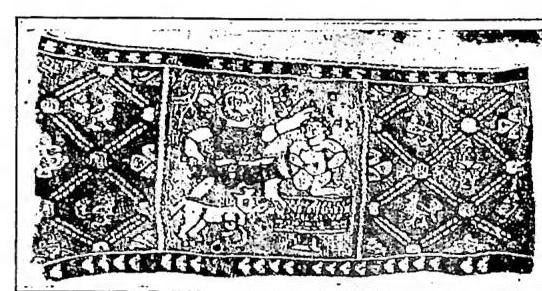
(from De Granaisen, Les caractérist, de l'art copte)