
LAZZARO di BETHANIA. – Brother of Marta (v.) and Maria, friend and table companion of Jesus (Io. 11, 5, 36; Mt. 21, 17; Mc. 11, 11), and raised from the dead by him. The resurrection of L. is narrated in considerable detail in Io. 11.
To the rationalists who claim to discern in this account a mere symbol of the sinner’s spiritual resurrection, one may point out the precision of these details which, in the evangelist’s intention, were meant to serve as means of verifying the historical truth of his account. Let us note the circumstances of place (in Bethania, approximately 15 stadia from Jerusalem: 11, 17), of time (dead for four days), the fear of the stench, the detailed description of the tomb and the burial cloths, the mention of friends and adversaries, and the consequences of hatred that arose among the latter, the Sadducean chief priests (who denied the resurrection), who later wanted to kill Jesus (Io. 11, 53) and L. himself (12, 10). Some details even seem counterproductive to John’s purpose, which is to demonstrate the divinity of Jesus. Why would he have invented his weeping and his human prayer?
To the objection drawn from the silence of the Synoptics, it may be observed that they had already sufficiently demonstrated that Jesus possessed the power to raise the dead (the daughter of Iaïro: Mc. 5, 21-34 and parallels; Mt. 11, 5; the son of the widow of Naim: Lc. 7, 22); in their compositional plan they intended to limit themselves to Jesus’ ministry in Galilee and Perea, reserving discussion of that carried out in Judea proper until after they had described Jesus’ triumphal entry into Jerusalem.
The objections that speak of an awakening from an apparent death (one need only think of the four days!), or of an amplification of the accounts concerning the beggar Lazarus (Lc. 16, 20-31) or Marta and Maria (Lc. 10, 38-42), have no substance.
The legend that L. evangelized Provence and was bishop of Marseille dates from the 11th–12th century. More credible are the Eastern accounts that locate L.’s relics at Kition (Larnaca, Cyprus). In the Roman Martyrology L. is commemorated on 17
December. In the Ambrosian rite, the fifth Sunday of Lent is called “of L.”
Pietro De Ambroggi
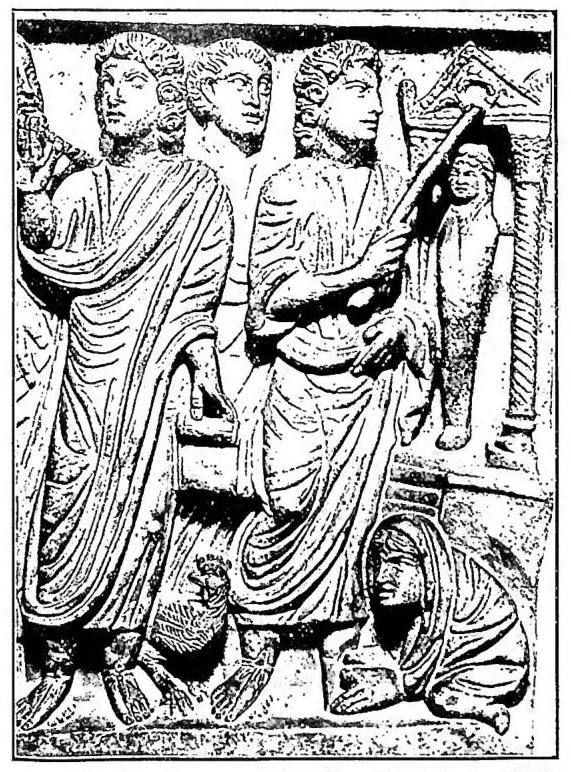
ICONOGRAPHY. — It soon drew from the Gospel of St John the representation of the miracle of the resurrection of L., to demonstrate faith in the omnipotence of Jesus Christ, in death, and in the certainty of the resurrection (I Cor. 15, 13 ff.). The frequency of this scene both in paintings and in cemetery sculpture truly attests to this certainty, in accordance with Tertullian’s expression, «fiducia christianorum resurrectio mortuorum» (De Resurr. carnis: PL 2, 841).
G. Wilpert listed more than 50 examples in paintings (Pitture, p. 208); there are at least as many examples on sarcophagi, both in Rome and at Ravenna, Terni, Auch, Arles, Cahors, Clermont-Ferrand, Le Mas d’Aire, Luci de Béarn, Tarascona, Barcelona, Saragossa, and Istambul.
In some sarcophagi intended to contain a deceased woman, the figure of L., according to Wilpert, acquired a feminine face (Sarcofagi, II, pp. 202-203 and pls. 139 and 212, 2).
The representation of the miracle was also scratched onto marble slabs bearing inscriptions (examples in O. Marucchi, I monumenti del Museo Pio-Lateranense, Milan 1910, pls. 35, 5; 57, 10, 15; G. Schneider-Graziosi, Il labaro costantiniano e la risurrezione di L. sopra due marmi del cimitero di Priscilla, in Nuovo bull. di arch. crist., 19 [1913], p. 137, fig. 3). The resurrection of L. is recalled by Damasus in the profession of faith dictated for his epitaph (A. Ferrua, Epigrammata Damasiana, n. 43, Vatican City 1942), and two hexameters from it were repeated in the epitaph of a Seberianus (O. Marucchi, op. cit., pl. 52, no. 37).
In non-cemetery art, the scene existed in biblical cycles, as attested by the distich composed by Prudentius for a basilica in Saragossa (PL 60, 106); and by the mosaic scene formerly existing in S. Martino in caelo aureo (493-526), now S. Apollinare Nuovo in Ravenna (Wilpert, Mosaiken, p. 798). It was also depicted on clay lamps, both at Carthage (A. Héron de Villefosse, Lampe chrétienne figurant la résurrection de L. trouvée à Carthage, in Bulletin de la Société des antiquaires de France, 1917, pp. 136-39) and at Alexandria in Egypt (R. Pagenstecher, Die Auferweckung des Lazarus auf einer römischen Lampe, in Bulletin de la Société archéol. d’Alexandrie, nuova serie, 2 [1909], pp. 267-72). The scene was also woven into textiles, as attested by St Asterius, bishop of Amasea (PG 40, 166); it is frequently found on gold-glass vessels (R. Garrucci, Storia dell'arte cristiana, Prato 1881, pls. 177, 6-8; 178, 3). It is also found on the fifth-century silver capsella of Brivio (Venturi, I, p. 521, fig. 450); on ivories, such as the fifth-century diptych of Palermo (Venturi, I, fig. 382); in the capsella of Brescia (J. Kollwitz, Die Lipsonothek von Brescia, Berlin 1933), and on the reverse of the diptych of Boethius in the same city (A. Muñoz, Le pitture del dittico di Boezio nel Museo cristiano di Brescia, in Nuovo bull. di arch. crist., 13 [1907], pp. 5-14); on an Evangelary cover in the Treasury of Milan Cathedral; in the ivory capsellae of the Museo civico of Bologna and Darmstadt (G. Stuhlfauth, Die altchristliche Elfenbeoplastik, Freiburg im Br. 1896, pp. 30 and 118); and on a small tablet in the Museum of Strasbourg (id., op. cit., p. 165). The scene is also found on a thin bronze sheet discovered at Vermand, near St-Quentin (A. Danicourt, Etude sur quelques antiquités trouvées en Picardie, in Revue archéol., 1 [1886], pp. 92-93).
In all the monuments mentioned, L.’s tomb is invariably represented by a Roman funerary monument with a roof and pediment. This form is also maintained in later frescoes, such as those in S. Giovanni a Porta Latina, and on the doors of Benevento, Pisa, and Monreale. In the purple codex of Rossano, however, L. emerges from a cave (A. Muñoz, Codex purpureus Rossanensis, Rome 1907, pl. 1). The scenes of the resurrection of L. seen in the Coptic Gospel derive from this type.
As has already been stated, the legend that Provence was evangelized by L. and his sisters Marta and Maddalena is no older than the 11th century and originated at the Abbey of Vézelay during the time of Abbot Goffredo. (L. Duchesne, Fastes épiscopaux de l'ancienne Gaule, I, 2nd ed., Paris 1907, pp. 321-59). The legend that L. was bishop of Marseille may have been facilitated by the tomb of Bishop Lazzaro of Aix in the 5th century, buried in the crypt of S. Vittore in Marseille (G. Morin, St Lazare et st Maximin, Paris 1897). But in reality St. Jerome attests that Paola saw near Bethany the sepulchrum Lazari (Ep. 108; PL 22, 887).
Adone lists him in his Martyrology on 17 September, without mentioning a place. A monk named Bernardo presents him as bishop of Ephesus for 40 years; in the Greek Synaxaria, on different days, there is a commemoration of the translation to Constantinople from Cyprus in the year 899, by order of the emperor Leone VI (H. Delehaye, Synaxarium Ecclesiae Constantinopol., cols. 144, 146, 544, 548, 658, 660; Saints de Chypre, in Anal. Boll., 26 [1907], pp. 257-58).
The cathedral of Autun, dedicated to S. Nazario until the beginning of the 12th century, changed its name to S. L. when, around 1147, it was believed to possess the relics of St. L., the resurrected one. Marseille, however, did not claim these relics, supposing that they had been brought to safety at Autun from the raids of the Saracens. Behind the altar of Autun Cathedral stood the monument erected by a monk named Martino during the time of Bishop Stefano II (1170-89), in the form of a small church in white, red, and black marble, with a small vaulted lower chamber containing at its center a sarcophagus bearing on its lid the inscription Lazare veni foras and the four statues of St. Pietro, St. Andrea, St. Marta, and St. Maddalena (fragments now in the Museum of Autun). - Vedi tav. LXIII.