
AMBROSIANA, LITURGIA.
- 1. S. AMBROGIO AND THE LITURGY. - “The distinctive character of the Ambrosian rite is precisely that of being the ancient Roman rite, so that it has the merit of attesting in our own day, in a living and lived form, the rite of the ancient Roman Church.” This definition, given by Pius XI, is essentially true in outlining the origin of the Ambrosian liturgy as a Roman liturgy, but it does not exclude the fact that many Eastern and Gallican influences contributed to the formation of the Ambrosian liturgy. The studies and discussions undertaken by F. Cabrol, H. Leclercq, G. Marin, A. Wilmart, G. Mabillon, L. Duchesne, C. Callewaert, A. M. Ceriani, and others concerning its origin lead to the following conclusion: the Ambrosian liturgy is composed of an essentially Roman nucleus, with Gallican, Eastern, and medieval infiltrations and superstructures extending to the sixteenth century, not all of which can easily be identified; nevertheless, they do not stifle its genuinely Latin character.
The name Ambrosian liturgy must not lead one to believe that St. Ambrogio was its inventor, or that he introduced such innovations as to justify an attribution of paternity. It was only after the Roman reform of St. Gregorio Magno that the distinction between the rite of Rome and the rite of Milan, previously not very marked, led to the classification of the latter under the name of Ambrosian liturgy. In reality, St. Ambrogio found in Milan a rite well ordered in traditional forms, with certain differences from the customs of Rome (for example, in fasting), which already indicate influences that did not come from Rome. The state in which St. Ambrogio found the liturgy in Milan, and what may be inferred from his works, had already been studied by M. Magistretti, whose work was in turn corrected and perfected by A. Paredie and E. Cattaneo; their conclusions are shorter but critically more secure. Since, however, St. Ambrogio is the only source for knowledge of the Ambrosian rite in the fourth century, and since the Milanese elevated the Saint to the dignity of Milan’s religious, moral, and civic representative, it is understandable that from the seventh century onward the liturgy, too, came to be called Ambrosian. In his works, however,
(fol. Ambrosiana Library)
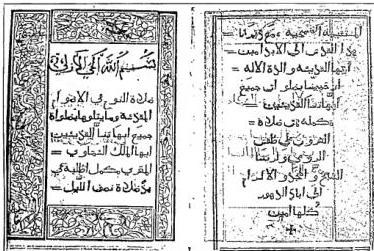
AMBROSIANA, BIBLIOTECA — Horologium breve. The first printing in Arabic characters. Fano, Gregorio de' Gregorio, 1514.
Leaving aside various disciplinary reforms of little importance, those so far established amount to three: the vigils, the antiphons, and the hymns. Chant may be added to these; for it we refer to the entry AMBROSIANO, CANTO.
a) The Vigil. — This is a nocturnal vigil begun on the evening preceding the feast. The first were Sunday vigils; the second, those of the dies natalis of the martyrs. These vigils, which, from the place of assembly (statio), were called vigiliae stationales, are distinguished from the daily vigils, probably of Alexandrian origin, which inaugurate the lucernaris (vespers) and nocturna (matins) offices.
S. Ambrogio found these vigils already in Milan and did nothing more than organize them better and establish rules for them, in order to remedy the sense of disorder and weariness that overcame the faithful during the long vigil. It was during one of these vigils (when Giustina was attempting to occupy the Basilica Porzia) that s. Ambrogio instituted antiphonal chant.
b) The Antiphon. — “Duobus choris alternatim concentibus quasi duo Seraphim... Apud Latinos autem primus idem beatissimus Ambrosius antiphonas constituit Graecorum exemplum imitatus” (Isidoro). Previously, the chanting of the psalms was performed, like that of the lessons, by a reader, and the people responded at the end with an acclamation (v. in the Jewish liturgy the conclusion of Psalm 105, or the whole of Psalm 135). This has remained in the l. a. in the Canticle of the Three Youths; in the Roman rite it has remained at the end of the procession on Palm Sunday and in the Improperia of Good Friday (to cite only a few examples). The innovation of s. Ambrogio consisted in having it sung as it is now, by two choirs that perform alternately a verse of the psalm. In the beautiful expression of the same holy Doctor (Explan. ps. XII, 1, 9), at first one person sang and everyone disturbed the others; later everyone sang and no one disturbed anyone. This innovation, which originated in Syria, subsequently passed to Antioch, Caesarea, and Milan (v. ANTIFONA).
It should be noted that, in order to make it accessible to the mass of the people, the melody of the psalms was simplified, while the antiphon retained its original melody.
c) The Hymn. — S. Ambrogio was a poet, but a popular poet, not in the sense of lyrical poverty attributed to this word, but in the sense of a composer capable of making himself understood by the people, for whom alone he wrote. The heretics Arius and Apollinaris had used hymns to propagate heresy. S. Ambrogio, in order to oppose new means of defense to heresy, created a new type of hymn (iambic dimeter in stanzas of four verses with a predominantly syllabic melody), so widely disseminated and enthusiastically accepted by the people that he was thereby accused of something like magic. From Milan his hymns spread to the Italian and Gallican Churches; they were imitated elsewhere, so that Rome too (the most reluctant to accept innovation) adopted them, calling every hymn composed according to the model of those of s. Ambrogio by the name Ambrosian. He thus remains the founder, in the West, of Christian lyrical poetry, which may be said to have arisen by chance during the famous siege of the Porzia. The hymn, however, is neither occasional nor improvised, but the fruit of lengthy study devoted to concentrating sublime truths in easy verses.
The eminently apostolic purpose—not merely literary, but practical and dogmatic—and the effect of instruction imparted in this manner are explained by s. Ambrogio himself in his exposition of Psalm 1 (Explan. psalm. XII, 1, 9). For the number of hymns composed by s. Ambrogio himself, V. AMBROGIO, santo.
2. MILANESE LITURGICAL BOOKS
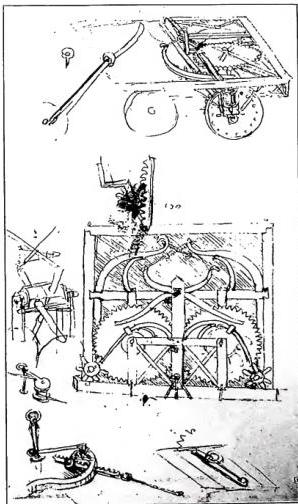
a) Missal. — The l. a. cannot cite documents earlier than the ninth century, the first of which is probably the one published by A. Wilmart under the title: Expositio Missae Canonicae. It is followed immediately by the Biasca Missal and the Bergamo Sacramentary of the tenth century. A. M. Ceriani published an Ambrosian Canon of the eleventh century. After these, we have many other manuscripts, up to the first incunabula of 1475. The official editions, on the other hand, so far number only nine, from 1594 to 1936. The first scholar of the Ambrosian Missal was Giovanni Bartolomeo De Guerci, with his Liber Celebrationis Missae Ambrosianae, from the early years of the thirteenth century. The most important critical edition isAMBROSIANA, BIBLIOTECA - Design for a self-propelled machine from Leonardo da Vinci’s Codex Atlanticus.
The Ambrosian Missal contains 236 prefaces. Another 77 may be added, no longer in use but preserved in ancient Ambrosian sacramentaries. The Roman Missal, on the other hand, which with the Leonine Sacramentary had 267, now has only 15.
b) Breviary. - In the Milanese rite, the book that first began to gather the material from which the other books were to arise and derive was called the Manuale. It was used especially not only for psalmody but also for public services. It contained various rubrics, the parts of the Mass belonging to the choir and, in some editions, also the Prayers, as well as the opening words of the readings for Mass and for the Office; even texts and rubrics for the administration of Baptism and Extreme Unction.
The oldest manuals that have come down to us date from the tenth century. The most important of the manuals is the Beroldus (named after its compiler, superintendent of the lights and lamps of Milan Cathedral) of the twelfth century. This manual includes rubrics, ceremonies, texts, a calendar, and the distribution of alms, as then used in Milan Cathedral. Around the sixteenth century, the manual eliminated everything that was not Office and assumed more exclusively the form of a breviary. The word breviary appears for the first time in 1443, and then in an incunabulum of 1475. Olrico Scaccabarozzi, who lived in the thirteenth century, contributed greatly to its formation as a composer of Masses, Offices, and hymns. Dreves published part of his production. There have so far been 32 editions of the Breviary, from 1475 to 1902; the first edition, however, appears to be no more than a copy of a thirteenth-century manuscript. The Benedictine Monks of Maria Laach are studying the most critically perfect possible complete revision of the Ambrosian Breviary. With regard to the use of Sacred Scripture, Rodolfo De Rivo (fourteenth century) had already observed that the Ambrosians followed the version of the Septuagint. This is now true of the Psalter, since for the scriptural readings St. Carlo wished to introduce the text of the Vulgate. The complete Psalter is recited during the year over the course of two weeks. The Ambrosian Breviary includes 78 hymns, not counting the Te Deum as such.
c) The Pontifical. - M. Magistretti published a ninth-century codex and other extracts from codices down to the fifteenth century, containing various ordines for the consecration of churches and sacred furnishings, for holy orders from simple clerics to bishops, for the consecration of virgins and widows; various blessings for fruits and for brides; exorcisms; the consecration of the holy oils, and even a Canon of the Mass and the consecration of the king of Italy.
The Ambrosian Pontifical is no longer in use, and the Roman Pontifical is in force in the Ambrosian liturgy. There remain, distinctly Ambrosian, the ritual of the Sacraments and a special ceremonial for the Duomo.
To these must be added: the Collectary (for blessings with the Blessed Sacrament), the Calendar, published every year as a guide for Masses and the Office, and the chant books: Antiphonary for Masses, Vesperal, Processional.
3. THE LITURGICAL YEAR
As in the Roman rite, the great cycles of Christmas, Easter, Pentecost, and the Sanctoral are distinguished.a) Christmas Cycle. Ambrosian Advent begins on the Sunday after the feast of St. Martin; it therefore has the same duration as Lent, with six Sundays. In the last
week of Advent there are the De Excepta ferias, whose much-disputed meaning must depend upon the etymology (excipere, “to receive”) in relation to the imminent coming of Christ. In the octave after Christmas we have the unique example of an Office proper to itself between the feasts of the saints and the Christmas octave. It also happens that two Vespers are recited on the same day. On Epiphany the day of Easter is announced. Epiphany, an older and more solemn feast, has an octave. There should be six Sundays after Epiphany. The Office of the sixth Sunday is always celebrated, even when a very early Easter makes it necessary to suppress some of the others. Lent begins on the first Sunday, not on Wednesday as in the Roman rite. On this first Sunday the Alleluia is laid aside, except at Vespers, and is resumed on Holy Saturday.
b) Ambrosian Lent is austere: Mass is not said on Fridays, all altar frontals are covered (but never the Crucifix), no feast of saints is celebrated (St. Joseph on 19 March is an exception of recent date), except that of the Annunciation. Noteworthy for their antiquity (eleventh century) are the litany prayers of the Mass on Sundays. The Saturday preceding Palm Sunday is called in traditione Symboli, in remembrance of the Credo formerly delivered solemnly to the catechumens.
Holy Week is called the week In Authentica because it is the prototype of weeks in the liturgy. Its Wednesday, as the Preface indicates, is reserved for confessions in preparation for Easter communion on the following day. In the octave of Easter there are two Masses, one for the newly baptized and the other for the faithful. The Easter cycle ends with the day of the Ascension. The triduum of the minor litanies is celebrated after the Ascension because “the bridegroom’s attendants do not fast while the bridegroom remains” (cf. Mt. 9, 15), unlike the Roman Rogation Days of Gallican origin.
c) The Pentecostal cycle likewise includes the octave of Pentecost with two Masses (the vigil of Pentecost resembles Holy Saturday with regard to the Baptism of new Christians), the octave of Corpus Domini, and the Sundays after Pentecost; these too vary in number according to the date of Easter.
After 29 Aug. begin the Sundays after the Beheading (of St. John the Baptist), no more than five; then the Sundays of October, until the dedication of the Duomo. They are followed by the Sundays after the Dedication until Advent. On 25 Apr. the major litanies are held, dating back to St. Gregory the Great.
d) The Sanctoral cycle. All feasts of the Lord are distributed throughout the Christmas, Easter, and Pentecostal cycles, except the Transfiguration, fixed on 6 Aug. There are twelve feasts of the Madonna in all, arranged in the following order: Purification, Annunciation, Visitation, Carmel, Madonna of the Snows, Assumption, Nativity, the Name of Mary, the Seven Sorrows, Holy Rosary, Presentation, Immaculate Conception. There follow the three feasts of the Archangels: 29 Sept., St. Michael; 24 Oct., St. Raphael; 5 Dec., St. Gabriel; and, on 2 Oct., the Guardian Angels. The twelve Apostles, either individually or paired, follow the Roman rite, except St. Matthias and St. Thomas. It should be noted that St. James, formerly on 29 Dec., was transferred to make room for St. Thomas of Canterbury; St. Joseph, once on 12 Dec., was moved to 19 March in conformity with Roman usage. St. John the Baptist has two feasts, as in the Roman rite: 24 June (his birth) and 29 Aug. (his death). St. Ambrose has a special place, with four feasts: Easter Thursday (his death), 14 May (the translation of his body), 30 Nov. (his baptism), and 7 Dec. (his episcopal ordination), which is the greatest feast. Very recent are the feasts of the patronage of St. Joseph, of the patronage of the Blessed Virgin Mary, and of the Holy Family, connected with certain Sundays for the people, but celebrated on the following day.
All the other saints belong predominantly to the first four centuries, to which others are added, though none later than the seventeenth century. The saints of the sixteenth and seventeenth centuries have also acquired a prominent place.
The only saint of the eighteenth century is St. Alfonso de’ Liguori. Some saints were introduced (although they had no connection with Milan) through the devotion of the various rulers who succeeded one another in the duchy of Milan, for example kings such as St. Henry, St. Louis IX, St. Casimir, etc.
4. COLOURS AND VARIOUS PARTICULARS
There are five Ambrosian colours:White: for all feasts of the Lord, except the Circumcision (which has red), for all feasts of Our Lady, except the Purification (purple), for virgins who are not martyrs, and for confessors.
Red: from the Saturday in traditione Symboli to Good Friday (since in ancient times it was a colour of mourning, as it is still used by the Easterners and by the Supreme Pontiff); for the Apostles and Evangelists, except s. Giovanni; for the feasts of Pentecost and Corpus Domini, and for the Sundays from Pentecost to the Dedication; for everything concerning Eucharistic worship; and for all holy martyrs.
Green: on the Sundays after the Epiphany, after Easter, and after the Dedication, and for the feasts of saintly abbots.
Purple: (also called violet) for the feasts of saintly matrons, on the Sundays of the pre-Lenten and Lenten seasons, on the Sundays of Advent, at the vigils of the saints, and at the funerals of children. The Archbishop uses it in place of black.
Black: in the Office for the Dead, on the ferial days of Lent, and at the litanies of the three Rogation days.
a) The authentic Ambrosian altar is the basilican altar, facing the people (this explains why, from the supposition that the altar already faces the people, Ambrosian priests never turn to say « Dominus vobiscum », even when in fact they celebrate at non-Ambrosian altars), and surmounted by a small temple, as in Milan in the basilica of S. Ambrogio and in Rome in the basilica of S. Paolo fuori le mura.
b) The Ambrosian Mass, which has many similarities with the Roman Mass, has the Kyrie after the Gloria, the Credo after the Offertory, and the washing of the hands before the Qui pridie; after the elevation the celebrant extends his arms in the form of a cross, in the ancient attitude of the Orantes; the Pater noster is after the fraction of the Host. When vesting for Mass, the priest puts the amice over the alb; the deacon wears the stole over the dalmatic, not quite crosswise, but almost straight. The alb and the amice bear gold embroidery which, later becoming separate parts, came to be called cappini.
c) Among the most characteristic features of the Duomo we note the school of the Vecchioni and the Vecchione (v. OBLAZIONARI DI SANT'AMBROGIO. AMBROGIO). On the greater solemnities the archbishop begins Vespers vested in the chasuble. Other characteristics are the fruits that the archbishop distributes at Matins on Christmas and the Epiphany, and the original gifts of Epiphany Vespers. On 2 February the procession of the Idea (an ancient painted panel) depicting Our Lady is held. Worthy of note is the long white stole worn by the deacon during the first three days of Holy Week, which crosses over the chest and back; and the folded chasuble worn by the ministers on the Sundays of Lent.
d) Scope. The Ambrosian rite is used in all the parishes of the archdiocese, except for the vicariates of Monza, Trezzo, and Treviglio and the churches of religious orders. Outside the diocese there are 30 parishes in the Bergamo area, several in the Novara area, and 55 in the Canton Ticino that retain the Ambrosian rite; they correspond approximately to the ancient fief of the Borromei and to the sphere of influence of s. Carlo in the duchy of Milan.
5. HISTORY OF THE AMBROSIAN RITE
Before s. Ambrogio, only s. Mirocle is cited as a bishop who took an interest in the rite. Afterwards, we note s. Simpliciano, s. Lazzaro, s. Eusebio, to whom recent studies attribute various Preface texts, Teodoro, and s. Eugenio (a figure that has been much studied and debated). Carlomagno did not succeed in abolishing the rite of Milan in his attempt to unify the liturgy in the Holy Roman Empire. In the 11th century (a sad century of heresy and corruption), the Nicolaitan priests appealed to the authority of s. Ambrogio and to the rite in order to maintain their dissidence and independence from Rome. It is therefore understandable that the Popes should have attempted to unify the rite in order to remove this pretext. But the good offices that were brought to bear revealed its sanctity to the papal legates, and it would therefore have been unjust to involve it in the sad Ambrosian interlude. This is a chapter of the greatest interest, in which great figures from Rome and Milan stand out, in opposition to the subversive movement of the time. Among those who succeeded one another in the Ambrosian see before s. Carlo, we recall the archbishop Franco da Parma and Piccolpasso.S. CARLOW (v.) after having collaborated in Rome on the compilation of the Caeremoniale episcoporum, also began a broad liturgical undertaking in Milan. He fought against Spanish governors who wanted the Roman rite out of a personal spite against the archbishop; he fought for observance of the first Sunday of Lent, indeed removing its final Alleluias in order to bring it into conformity with the other Sundays of Lent; he fought against the Monzesi who, having abandoned the patriarchal rite, ought to have adopted the Ambrosian rite; he did not succeed because of a covert opposition with a political background, in which the priests were not uninvolved; he fought to restore the liturgical character of the Fridays of Lent; and he surrounded himself with able collaborators (such as Galesino) for the study and revision of the liturgical books. He worked hard to eliminate abuses in the various parishes he visited; he published instructions for priests on the celebration of Mass, the book of litanies, and a Breviary. After his death, the Rituale and the Missale that he had prepared were published. Cardinal Federico Borromeo took up his cousin’s legacy and produced many editions of the liturgical books, among them the Caeremoniale and instructions on the rubrics. Other archbishops felt obliged to concern themselves with the rite, of which they are the natural custodians and responsible guardians. The archbishops G. Pozzobonelli, G. Gaysruck, B. Romilli, A. C. Ferrari, and I. Schuster devoted themselves to this task with varying success. The last, already known as a scholar of Roman liturgy, gave new impetus to Ambrosian studies, to which he also contributed extensively through his publications. He entrusted the revision of the Breviary to the Benedictines of Maria Laach, and that of the chant to Abbot G. M. Suñol. - Vedi Tav. LXXXII.
b) Sources. - Beroldus, ed. M. Magistretti, Milano 1894; Manuale Ambrosianum, ed. M. Magistretti, there 1895; Pontificale, ed. M. Magistretti, there 1899; Missale Ambrosianum Duplex, ed. A. Ratti-M. Magistretti, there 1913; Expositio Missae Canonicae, ed. Wilmart, Monaco-Aschendorff 1922.
c) Studies. - A. M. Ceriani, Notitia Liturgiae Ambrosianae, Milano 1895; P. Lejay, Ambrosius (nu), in DACL, I, coll. 1373-1422; Ambrosius, Bollettino liturgico ambrosiano, Milano 1925; A. Paredi, I Prefazi ambrosiani, there 1937; E. T. Moneta Caglio, Intendere la Messa, there 1939, with a good bibliography; A. Paredi, La liturgia di s. Ambrogio, in S. Ambrogio nel XVI Centenario della nascita, there 1940, pp. 69-158; E. Cattaneo, Il Breviario ambrosiano, there 1943; Atti del Congresso Liturgico Ambrosiano (the papers by E. Cattaneo and Borella), Milano 1948. - Ferdinando Longoni