
DEDICATION, RITE OF. — This is the consecration of a church in order to withdraw it from profane use and make it a sacred place.
The earliest Christian assemblies were held in private houses, where the Eucharist was celebrated; these subsequently received a consecration from the sacred use to which they were put, as attested by the Oratio panegyrica de aedificatione Ecclesiarum (Eusebius, Hist. eccl., X, 3), which deals with the d. of the cathedral of Tyre, and by the account of the d. of the Constantinian basilica at Jerusalem (id., Vita Constantini, 45). In the West, a special prayer of blessing was perhaps added as early as this period, to which s. Optatus of Milevis (De schismate Donatistarum, VI, 3) and s. Ambrose (Exhort. virginitatis, 10) seem to allude. Formularies for the solemn Mass on such an occasion are found in the Leonine, Gelasian, and Gregorian Sacramentaries. After the Constantinian peace, the cult of the martyrs acquired great importance for the solemnity of the d.; the first basilicas arose over their tombs, where the divine sacrifice was celebrated in the catacombs on the anniversary of their death. Subsequently, beginning in the middle of the fourth century, churches were erected in honor of a martyr even in places where there were no tombs, but where relics were placed in the altar, which was therefore regarded as their tomb. In Rome, however, until the seventh century, the urban churches
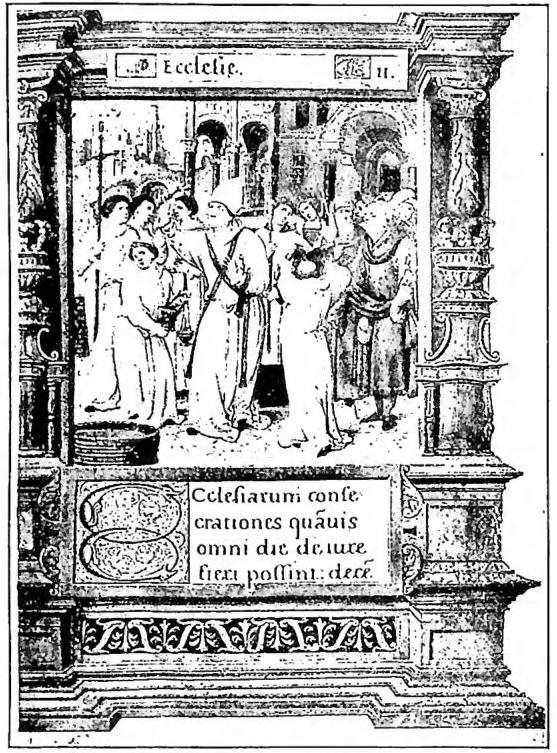
were without relics, since the law prohibited their deposition within the city. In time, the custom was established of dedicating the church to some saint; consequently, the transfer and placement of relics also came to occupy a fixed place in the rite of consecration, so that the most solemn part of the d. consisted of the triumphant procession with the relics, as attested by s. Ambrose (Epist., 22, 1-2), Sozomen (Hist. excl., VII, 21), and s. Jerome (Contra Vigilantium, 5). In this way the depositio Martyrum became confused with the d. of the church, and it became law to place the relics of the martyrs beneath the altars. At that time the rite of the d. was composed as follows: 1) throughout the preceding night, vigils were celebrated before the relics, solemnly displayed in another church. 2) The following morning, the relics were carried in solemn procession, to the singing of psalms and hymns and with many lamps lit, into the church to be dedicated, where they were deposited in the altar. 3) The solemnity ended with the celebration of Mass there. According to a letter from Pope Vigilius to Profuturus of Braga, the consecration of a church consisted simply in the celebration of the divine Sacrifice in it; if the church was dedicated to a saint, the placement of the saints’ relics was added. The pope also already knew, though not as a mandatory ceremony, the sprinkling of the church with holy water, later called Gregorian water (v. ACQUA). Other ceremonies were added later: in the East, especially the anointing of the altar with chrism, already mentioned by s. Ephrem; in the West, this anointing is not found before the Council of Agde (506), canon 14 (Mansi, VIII, 327); from the Gallican rite came the anointing of the church walls, the ablutions, and other practices. These rites—deposition, sprinkling, and anointing—were already found united in the sixth century in the Gallican rite of the d. (Gregory of Tours, De gloria confessorum, 20), and subsequently increased ever more, as is shown, from the eighth century onward, by the numerous Ordines dedicationis. Thus, as Eastern customs spread and merged with Western ones, there resulted that complex of rites which today makes the d. of a church one of the most solemn and significant ecclesiastical ceremonies. The current rite of the d. of a church is contained in the Roman Pontifical.
On the evening preceding the consecration, in the place where the relics of the saints to be placed on the altar are deposited, Matins and Lauds of the Commune plurimorum martyrum are to be recited, because, according to an ancient custom, at least one relic must be that of a holy martyr. During the night, an honor guard is kept before the relics. On the following day, after the penitential psalms have been recited before them, a procession proceeds to the door of the church to be consecrated; while the litanies are sung, the protection of all the saints is implored. Then the water and salt are blessed and, after the blessing with holy water, the consecration begins with the solemn taking possession of the new house of God by the bishop. At the outset, as he makes three circuits of the exterior of the church with his clergy, he sprinkles its walls; at the end of each circuit he strikes the church door and asks: Attolitie portas, etc. (Ps. 23, 7). On the third circuit the church is opened, and the bishop makes the sign of the cross on the threshold with his pastoral staff, driving away the demons, because Christ crucified thus takes possession of the church—a notion that is subsequently illustrated even more fully by other ceremonies. The bishop then enters the church with only the clergy and attendants and, having closed the door, invokes the Holy Spirit, recites the litanies of the saints once more, and, while the Benedictus is sung, writes the Greek and Latin alphabets with his pastoral staff in two strips of ash, in the form of a decussate cross, running from the four corners of the church. It was in fact the custom among the Romans to mark with a large X on the ground the space intended for the construction of a new house, and Roman surveyors commonly drew transverse lines, marked at their ends with letters, when measuring land; and since this X had the form of the decussate cross and of the first letter of Christ’s name (Χριστός), the ceremony came to signify that Christ was taking possession of that place. The recollection of the phrase from Apoc. 22, 13 (“I am the alpha and the omega”) then suggested the idea of inscribing the Greek alphabet in the two lines of the X; the Latin alphabet was added later, and in some places the Hebrew as well (v. ABECEDARIO).
The building, now the property of God, receives a special sanctification, beginning with the altar. After invoking God, the bishop prepares and blesses the Gregorian water, in which salt, wine, and ashes are mixed, probably in imitation of the rite of Moses (Ex. 24, 6 ff.). With it the bishop marks a cross on the upper and lower parts of the door in order to sanctify it, and washes the five crosses of the altar—one in the middle and the others at each of the four corners. He sprinkles the altar seven times, then, going around the church, sprinkles the interior walls and the floor three times as well. Proceeding from the high altar to the door and from one side to the other across the middle of the church, he pours the holy water toward the four cardinal points, symbolically indicating the four rivers of paradise that flow from the new paradise, that is, from the church. These sprinklings, together with prayers of very ancient origin, express the lustral or purifying effects of the consecration. A solemn Preface follows, imploring the sanctification of the place. The remainder of the water is then poured at the base of the altar, together with the mortar. Then the bishop with the…
with the clergy leaves the church and goes to the chapel where the relics are preserved and solemnly displayed. A solemn procession is formed with them, in which the people take part, going around the new church. After anointing the door with chrism, the bishop, having made his solemn entrance, anoints with chrism at the four corners the tomb, or small cavity, of the altar, places the relics inside it, and closes it, anointing the cover with chrism also, in the form of a cross above and below. The consecration of the altar, thus already begun, is completed in the numerous anointings that are performed: twice it is anointed with the oil of catechumens and once with chrism at the five places marked by a cross, then the entire mensa with the oil of catechumens and afterward with chrism; during these anointings, antiphons and psalms are sung that explain their profound and symbolic meaning. After anointing the altar mensa, the bishop consecrates the inner walls of the church, making upon them, or upon the columns or pillars, twelve anointings with chrism, censing each cross three times. Returning to the altar, he burns upon it a symbolic sacrifice composed of grains of incense and wax candles, and while everyone kneels, the Holy Spirit is invoked. All the prayers recited or sung thus far by the bishop are now summarized in a new Preface. The bishop then anoints with chrism the front of the altar and the point where the mensa joins the body of the altar, at the four corners. With this final anointing, the consecration of the altar and of the church ends. Then, after the cloths and other furnishings have been blessed, the altar cleaned and clothed with its ornaments, following a final incensation and some prayers, the solemn Mass begins, during which, after the consecration, the lamp that must burn perpetually before the Blessed Sacrament is lit. Thus the ceremony comes to an end. For the anniversary of the d., V. CHIESA, in Enc. Catt., III, cols. 1508–11.
D. « ANGELICA ». - This expression is commonly used to designate the miraculous d. of a church attributed to Christ with the assistance of angels and saints.
The most celebrated example is the angelic d. of Einsiedeln, which is celebrated annually on 14 September; if, however, that day falls on a Sunday, the solemnity lasts for eight consecutive days (until 1853, for 14 days), with a great influx of pilgrims. The primitive chapel was dedicated on 14 September 948 by Corrado, bishop of Constance. In this regard, the legend relates that the prelate, keeping vigil on the night preceding the d., heard angelic chants in the chapel, specifically those of the rite of the d. In the morning a heavenly voice cried out three times that the sanctuary had been consecrated through divine intervention. This fact is reported by a bull of Leo VIII, dated 11 September 664 (Jaffé-Wattenbach, no. 3708), which exists only in copies from the 14th century and whose authenticity is highly disputed and disputable. The legend, which fully developed in that same 14th century, then relates
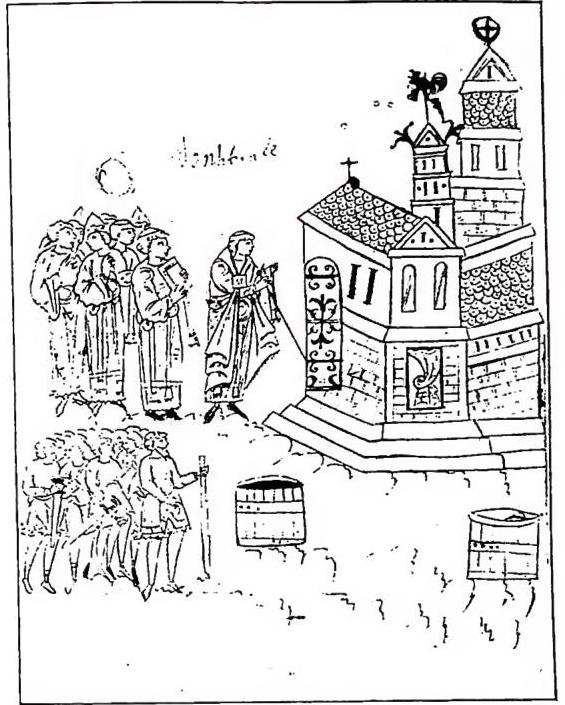
DEDICAZIONE, RITO della - D. d'una chiesa: the consecrating bishop knocks on the door with the foot of the pastoral staff. Drawing from the Pontifical of St. Germans in Cornwall (10th century) - Rouen, Municipal Library, ms. 368 (A. 27), f. 2v.
how Christ, descending from heaven, took the violet chasuble (even today the solemn Mass is celebrated in violet), and with the assistance of saints (s. Stefano is said to have sung the epistle, s. Lorenzo the Gospel) and angels proceeded to the consecration. The first general reports of this miraculous d. date only from the 11th century. In the 16th–18th centuries the angelic d. became an extraordinary solemnity throughout Switzerland, and even today the feast is immensely popular. The foundation of this account remains purely legendary.
Other angelic d. are claimed, for example, for the churches of St-Denis (Paris), St-Pierre-le-Vif (Sens), for the cathedrals of Westminster (London), Augsburg, Prague, Vercelli, Avignon, and for the sanctuary of Monte Gargano.