
SACRIFICE. - From sacra facere ("to perform the sacred act"), sacrifice, in its most general sense, is that religious act by which the offerer, through the offering or victim, enters into mystical communion with the Being to whom the sacrifice is directed. For sacrifice to occur, the following are required: 1) an offerer, who may differ from the one performing the sacred act; 2) an object, animate or inanimate, to be offered; 3) the intention of entering, through the sacrificial act, into communion with the Being to whom it is directed.
I. SACRIFICE IN NON-CHRISTIAN RELIGIONS
Sacrifice can be unbloody (oblation, libation, offering), as occurs among the most economically and culturally primitive groups, and bloody when, with the development of even the most elementary agricultural and pastoral occupations, domesticated animals are offered, whose killing serves to make the offering effective by removing the animal from profane use and taking away the life that is to be offered to the deity, in a deeper and more integral conception of sacrifice itself.Towards bloody sacrifice, therefore, all peoples, advancing towards more complex and progressive cultural conditions and settling into the great political and ethnic societies of the ancient world, have oriented themselves; sacrifice understood not only as homage to the deity but also as a means to enter into more intimate communion with it through the victim specifically chosen and pre-consecrated, whose blood, vehicle of life, serves precisely to establish a mystical contact between the offerer and the deity itself.
During the Roman imperial era, in accordance with the spiritual tendencies of the time, it was believed that the blood of certain sacrificed animals had the power to divinize the souls of the offerers, freeing them from mortal fate. The belief in the divinization of souls, which Arnobius (II, 62) and Servius (ad Aen., III, 68) attribute to the Libri Acherontici of the Etruscans, was, however, in essence already known (Lares, Manes, Deus parens) to ancient Rome (Ribezzo).
1. Theories on the origin of sacrifice
Modern ethnology has presented three different hypotheses on the origin of sacrifice. According to E. B. Tylor’s animism, sacrifice is essentially a gift that man makes to the deity to obtain in return either the use of the fruits of the earth or other favors he may need: he conceives these deities as endowed with the same habits, affections, and desires as men. According to the totemistic theory, now faded as an integral explanation of the religious fact, sacrifice would originally be a communion: insofar as the human group, which considers itself descended from a divine animal, on certain solemn occasions, to renew the bond of kinship with the god and purify its own blood through an ingestion of divine blood, kills the sacred animal (which is otherwise always respected and never killed) and ritually consumes II. W. Robertson Smith theorized this opinion in a seductive but unconvincing manner, followed by F. B. Jevons, S. Reinach, and E. Durkheim. According to the historical-cultural school of Fr. W. Schmidt, finally (though Fr. Lagrange had already, based on elements offered by Semitic peoples, supported the same thesis), sacrifice originally is the gift of an object that contains life within itself and serves as sustenance of life (firstfruits), offered by the primitive to the deity whenever he must make use of the fruits of the earth. This theory, integrated with elements offered by higher religions with a mystical orientation, better explains the facts found in sacrifice among primitive human groups and among the great ethnic religions (Egypt, Assyria, Israel, India, Greece, Rome, China).With the evolution of the religious spirit parallel to the progress of civilization in economy, politics, and thought, which leads the individual to give greater value to his inner life in the face of the authoritarian principle of the state religion, supranational (universal) religions arise, either due to the work of a religious reformer born and lived in the full light of history (Buddha, Muhammad) or as a religious sublimation of a primitive, generally agrarian, cult, linked to a mythical founder of divine nature (Dionysus, Osiris, Attis, Mithra). These are the so-called mystery religions because they suppose a secret initiation and a series of rites in which the initiate (who can access them without regard to bonds of race, caste, or nation) assimilates to the god, in the confidence of gaining spiritual benefit in life and securing a blessed immortality after death. In these religions, sacrifice assumes its highest value because it reproduces and commemorates the sacrifice of the god and considers this sacrifice as a sign of salvation for those who wish to gain its benefit.
2. Practice of sacrifice
Sacrifice unfolds according to three phases or moments: preparation, action, and conclusion.a) Preparation. - Being the religious act par excellence, sacrifice must take place in an environment that is already sacred or at least made so for the occasion with preliminary ceremonies of consecration. As for the form, one must distinguish between the one for whose benefit the sacrifice is offered (offerer), who may be either a single individual or an entire social group, and the one who, as an expert, performs the sacrificial act (sacrificer, priest, minister). Both the one and the other must be in a state of ritual sanctity (abstention from venereal contact, bathing, new or white garments, fasting, special emblems or tattoos), and maintain this state of separation from the profane world until the sacrifice is completed.
The victim, then, is either already a sacred animal (totem) or must be made sacred through special rites and ceremonies. First of all, it must be without any physical defect; then, chosen and washed, adorned, crowned, it is invited to proceed spontaneously toward the place of sacrifice, sometimes even praised to exalt its value, bring it closer to the deity, and thus make it a more fitting vehicle for the participation of life between the offerer and the deity. This consecration of the victim is concluded by a special ceremony: anointing with butter (India), oil (Israel), or a sprinkling of spelt and salt (mola salsa, Rome) or barley (οὐλοχύται, Greece).
b) Action. - Once the victim is consecrated, the killing proceeds, which releases the principle of life enclosed in the animal, thus becoming, through its blood, an effective means of communion. It is brought near the altar, oriented either toward one of the cardinal points or toward the presumed dwelling of the gods, and in profound silence, broken only by the sound of a ritual instrument or the murmur of sacred formulas, it is struck down, or its throat is cut, or it is suffocated, according to the various rituals and the species of the animal. Once on the ground, it is quartered, its entrails or omentum are extracted, which are the portion reserved for the gods, while the rest is desacralized and tasted by the offerer and those who have participated in the sacrifice.
c) Conclusion. - Once the sacrificial action is completed, the participants, before re-entering common life, must discharge the sacrality accumulated upon them by the sacrifice through ablutions, the removal of sacred garments, and the "purification," that is, the desacralization of the utensils that served in the sacrifice.
3. Various kinds of sacrifice
According to the classification adopted regarding the various kinds of rites (v. RITO), sacrifices are either connected with rites of passage, or sacrifices of oblation, or sacrifices of propitiation.a) Sacrifices in rites of passage. - This category includes sacrifices that occur in the most important circumstances of domestic worship: birth, naming, death; sacrifices of pubertal initiation (v. INIZIAZIONE), sacrifices connected with initiation into mystery cults (v. MISTERI), sacrifices of the threshold, of the boundary, of hospitality, and funerary sacrifices.
b) Sacrifices of oblation. - These are the most numerous because they are offered to maintain peace with the gods, acknowledge their dominion, and thank them for the benefits received. The great civilizations of the ancient world practiced this form of sacrifice above all.
c) Sacrifices of propitiation. - These are subdivided into three main categories: agrarian sacrifices, expiatory sacrifices, and foundation sacrifices.
Agricultural sacrifice stems from the postulate, characteristic of the "mystical" mentality of the primitive, that man must contribute through his action to the rhythm of the seasons so that the earth may yield its fruit. It also presupposes the animistic belief that the cultivated field possesses its own principle of life, synthesized in a spirit (spirit of vegetation) that can be embodied in an inanimate being (stone, effigy), an animal (fox, dog, rooster), or a man. To this spirit, a portion of the harvest—which belongs to it—must be offered in order to use the harvest itself without harm. This spirit, which would fade after the harvest, must be incorporated into some object or animal and kept alive through the sacrificial act. Agricultural sacrifice, therefore, consists of two moments: a) the expulsion of the old spirit of vegetation in the guise of a man or an animal; b) the introduction of a new principle of life.
From agricultural sacrifice, the transition to the sacrifice of the god is easy when the human victim replaces, as the spirit of vegetation, the vegetable offering. For by losing contact with the vegetable element, the spirit of vegetation loses its autonomy in favor of human individuality and assumes its name, moral personality, and eventually also its legend. Once this mythical legend is created, the figure of the god is also fixed, and the periodic agricultural sacrifice becomes the salutary repetition of the sacrificial event that originally occurred to the god, the iteration of which serves to ensure for men the benefits (no longer agricultural but religious) of that primordial immolation. In certain mystery religions (mysteries of Attis, Adonis, Osiris), it is possible to recognize the sublimation of an ancient agrarian rite (v. MISTERI).
Expiatory sacrifice proceeds from the sacred-magical concept that evil (physical or moral) can be transferred from one object to another, which is then removed or killed. A typical case of expiatory sacrifice was, in Israel, that of the scapegoat upon which the high priest, dressed in linen and after appropriate lustrations, heaped, by laying both hands on its head, all the sins of the people, and which he then had immediately led away by a man who was to abandon it in a desert place. The victim of an expiatory sacrifice could also be human, as occurred in antiquity: in Marseille in the event of a plague (Serv., Ad. Aen., III, 57) and annually in Athens during the festival of the Thargelia (v.). Expiatory sacrifices also include those of lustration (v. LUSTRAZIONE).
Foundation sacrifice partakes of both the consecratory and expiatory elements and is based on the concept of placing the spirit of the sacrificed animal (or man) as protector of the building to be constructed. Thus, the Batak of Sumatra place corpses on the corner beams of their dwellings; the Bedouins of the land of Moab kill an animal at the spot where they plant the main pole of their tent; in ancient Canaan, excavation has yielded numerous remains of foundation sacrifices; in Rome, beneath the apse of the basilica of Porta Maggiore, the remains of the bones of a dog and a pig have been found.
4. The symbolism of sacrifice
Sacrifice is an action, as evidenced by cultic terminology (sacro facere, or simply facere among the Latins; ποιῶν, ῥέζειν, ὄρᾶν among the Greeks; אָדָה among the Hebrews), and it is a representative action that intends to effect what it reproduces. This is most evident in agrarian rites, where the spirit of vegetation is understood as a living being (animal or human) that dies and is reborn. This representative action gains greater value because it preserves and intensifies the social bond, as the human group performing the sacrifice knows it is doing so in imitation of its ancestors and in obedience to the tradition they founded and all predecessors of the group have repeated. This social sense, when the motives of magical symbolism fade due to cultural development, remains precisely as representative of collective life, which thanks to it has been maintained and increased, but sublimates its meaning in a highly moral sense.II. SACRIFICE AMONG PRIMITIVE PEOPLES
1. The sacrifice of firstfruits in original cultures. — A marked characteristic of original cultures, it consists in offering to the Supreme Being the firstfruits of the means of subsistence that man obtains from hunting and woman from gathering. The offering is made before the rest is consumed. The Pygmies offer a small portion, generally chosen from the best and most vital parts (heart, liver, lungs, stomach, fat). The sacrifice of firstfruits is practiced by almost all truly Pygmy populations, by several Pygmoid groups, by the Bushmen, and by the Vedda. In the American Arctic culture, it is performed only by the Eskimo populations belonging to the most archaic stratum of Arctic culture, by the Algonquins, by some very primitive populations of California, and by the Selknam, who are the least primitive among the three populations of Tierra del Fuego. It is absent throughout the southern primitive culture (southeastern Australia and Tasmania).The diffusion of the sacrifice of firstfruits in original cultures indicates that it probably arose in conditions more prevalent among the Pygmies than in the American Arctic culture. This is also confirmed by the variety of offerings made by the Pygmies and Negritos: game, birds, fish, termites, edible caterpillars, fruit, honey, etc. The Pygmies of Gabon also sacrifice an animal that must be taken alive during the hunt. Another variant among the Pygmies of Gabon consists in offering the right side of the animal’s head (that is, the most prized part). The Baghielli Pygmies offer only vegetables and beverages. In Arctic cultures, by contrast, meat offerings are frequent, but the sacrifice of vegetable firstfruits is almost entirely absent. This absence can be explained by the climate and the economy of Arctic populations, which feed predominantly on meat.
There are still other characteristics that differentiate the sacrifice of the Pygmies from that of the American Arctic populations: the Pygmies generally offer the internal parts of the game; the American Arctic peoples, instead, offer the unopened head or the long bones, also unopened. Thus, the material offered is the brain or the marrow: the head and bones are rather the container that holds the offering. The manner of presenting the offering also varies. The Pygmies throw the vegetable firstfruits into the forest; only the Baghielli throw them into the fire. The offering of meat varies among the different Pygmy groups: some throw it on the ground, others into the fire, and still others, to protect it from termites and caterpillars, wrap it in a leaf and ceremonially place it in the hollow of a tree. Sometimes, to wrap the offering, they choose a leaf that has not yet been touched, as if to intensify the firstfruit character of the sacrifice.
In the American Arctic culture, the few vegetable offerings are thrown into the fire or placed on the ground. One of the most characteristic forms of the sacrifice of firstfruits in this culture consists in piling the offered heads and long bones on an altar. The hunters of the Lower Paleolithic did the same, as revealed by the exploration of various caves in Bavaria and Switzerland.
The sacrifice of firstfruits arose from the economic, social, and religious conceptions of original cultures and expresses homage, thanksgiving, and a request to the Supreme Being. In these cultures, man does not yet produce the means necessary for his subsistence but merely takes them from nature. The Supreme Being is considered the bestower of life not only in ancient times but continuously, because He provides the means of subsistence—animals and plants—makes them grow, and grants their use on the condition that they not be destroyed uselessly or denied to those who cannot procure them for themselves. Thus, the sustenance of the elderly, the sick, and children also has a religious value and, as such, is inculcated even in the initiations (v. INITIAZIONE) of the young. The mythology of these peoples attributes the creation of the world to the Supreme Being, who is also considered the first owner. These motifs are clear in the mythology of the Pygmies, the Indians of central California, and Tierra del Fuego, and they remain alive even among populations belonging to more recent cultures.
The sacrifice of firstfruits first and foremost acknowledges the creation, preservation, power, and ownership of the Supreme Being over the things of the world and expresses these sentiments by rendering to Him, in the form of an offering, a small part of the goods received. "In the sacrifice of firstfruits, the offerer does not so much wish to give as to say, to express something" (Schmidt), that is, his subjection, his dependence on the Supreme Being. He may also wish to express other sentiments: to ask His forgiveness for having killed animals or destroyed plants created by Him, to invite Him to the meal in order to enter into closer union with Him (an idea very probable given the liberality with which, in original cultures, it is customary to invite one another to consume together the spoils of the hunt and the fruits of gathering), to thank Him for the goods received, and to ask that He continue His protection, but the central thought is the expression of the feeling of dependence that the creature feels before the Creator (Schmidt). That the quantity offered is often very small indicates that the sacrificer does not intend to give the Supreme Being something He actually needs, nor even less to offer Him food to eat. An offering so conceived would be in opposition to the concept of spirit that various populations attribute to the Supreme Being. An offering chosen from the best parts of the spoils has a symbolic value. The formulas that accompany it also express these sentiments: "Here is your portion so that you may be generous with me when I go in search of game, which is under your protection."
2. Expiatory sacrifice in original cultures. — When the Pygmies of Gabon believe that continuous failure in hunting is attributable to some fault, they perform an expiatory sacrifice. A similar sacrifice is also practiced by the Semang. In both cases, the offerer makes a wound in an arm or a leg (Pygmies of Gabon) or near the knee (Semang), usually mixes the blood that flows with water, and offers the whole in expiation. It is probable that this sacrifice intends to substitute the offering of life. Indications of an expiatory sacrifice of one’s own blood are also found among other Pygmy populations. The concept of moral guilt that the Supreme Being can punish, either by directly striking the guilty with death or by denying him the means of subsistence, is a characteristic of original cultures. Equally vivid is the feeling of repentance and expiation toward the offended deity. Therefore, it is probable that expiatory sacrifice also belongs to these cultures. Recent research confirms this thesis.
Some Pygmy and Algonquin populations also make sacrifices with offerings to the deceased, which result from influences of matriarchal cultures. No population belonging to original cultures practices human sacrifice.
3. The sacrifice of firstfruits among the nomadic pastoral peoples of Asia. — The characteristic sacrifice of this cultural cycle is the great annual sacrifice of the horse in thanksgiving to God, who grants both men and animals the power to reproduce.
Thus, the sacrifice is performed in spring, when foals and calves are born. All the families that make up a kinship gather, and each brings one or more animals. They preferably offer a horse. This sacrifice has a particular solemnity, also due to the manner in which it is performed: among other things, the horse is adorned and positioned as if it were to leap toward the sky. This is followed by a kind of sacred meal accompanied by various offerings. In the first-fruits sacrifice of pastoral peoples, the recognition of the supreme authority of Heaven over livestock and gratitude to Heaven for granting herds are expressed even more strongly than in the sacrifices of original cultures. The religious concept of these peoples is very elevated, as also demonstrated by the fact that petitionary sacrifices hold a very secondary importance.
Another characteristic of this culture is the sacrifice of milk, an important element in the nutrition of these peoples. The nomadic pastoralists of Central Asia do not have expiatory sacrifices.
4. Expiatory Sacrifice. — Various pastoral populations of Africa and others belonging to the Nilotic group perform expiatory sacrifices, which reveal an elevated religious sense and a clear concept of moral guilt and the necessity of expiation. In the religion of the Galla, Waka, meaning "Heaven," is the Creator, the absolute Lord of the entire world, and the regulating center of individual and social life. The religion of the Galla is alive and rich in prayers, religious songs, sacrifices, feasts, and ceremonies for all circumstances of human life. They celebrate with particular solemnity a feast called Wadagia, to obtain God’s blessings upon families, villages, and the territory.
During this ceremony, which is directed by a chief priest and two "deacons," the participants perform a sacrifice that has the character of petition and expiation, as evidenced by the invocations that accompany II. When everything is ready, the chief priest pronounces the invocations ("Oh Waka, have mercy on us!" etc.), to which all respond in chorus: "Yes, have mercy on us," etc.
The Galla also offer a bull or a ram on the tomb of a deceased person. But this sacrifice is directed to God to implore happiness and the forgiveness of the deceased’s sins.
The Acholi of Uganda particularly fear the soul of one "who died in anger," because it returns to take vengeance. This soul is called lacèn (= who returns): anyone who was killed, whether intentionally or unintentionally (e.g., while hunting), may become lacèn if the due indemnity is not paid and the expiatory sacrifice is not performed. But no soul can return as lacèn unless harm was done to II. Particularly feared are: the soul of a son whose father denied him the dowry for marriage, that of a slave killed for trivial reasons, that of a father or an elder or a sick family member who was denied bread, that of one left to die of hunger at the door of a hut even if from another tribe, that of a mother whose son prevented her from remarrying after the father’s death or denied her meat, that of one killed in another’s house without the homeowner having cared to avenge him, that of one who was the victim of a grave vengeance undeserved or received a punishment greater than the guilt or even a deserved but severe punishment, that of a wife killed while fleeing to take refuge with another man because her husband beat her. Even the soul of a dog, killed under certain circumstances, returns as lacèn. When the lacèn comes to kill and begins to make someone in the family ill or appears to him in a dream and makes him wander, the sorcerer is called, who has the task of sending it away with a special ceremony, essentially expiatory, directed to the Supreme Being, during which a sheep is sacrificed. This ceremony also includes accessory elements of a magical nature. However, the sorcerer does not always succeed in his intent: sometimes the lacèn is so enraged that it kills not only the person who harmed it but the entire kinship, even the mother, father, or child, and sometimes even the sorcerer who came to send it away. This happens because Lubanga (the Supreme Being) is grieved if someone was killed, for this person was one of His own, generated by Him, and thus He consents that the soul of the dead come and kill the one who killed him. Even certain wild beasts can come as lacèn: they are the dogs of Lubanga.
Expiatory sacrifices are also performed by the Baria of Eritrea and other Hamitic, Nilotic, and related populations. The collective expiatory sacrifice of an animal caught alive in hunting is also practiced.
5. The Blood Sacrifice in Matriarchal Culture and Human Sacrifice
The spiritual conceptions proper to this widespread cultural cycle are: lunar mythology, the figure of a feminine deity, conceived as an earthly deity (mother goddess), which gradually replaces the cult of the Supreme Being. Another characteristic element is the cult of blood, conceived as the seat of vital force and in close relation to the very origin of life because when a woman conceives, menstruation ceases.In this cultural cycle, the sacrifice of first-fruits is made to the mother goddess or to the deceased. But above all, bloody sacrifice develops, first of animals, then also of humans. Still belonging to matriarchal culture is a whole complex of myths about the vital power of blood, whereby the blood of victims is used to anoint the sick and sprinkled on plants and fields. But above all, the still-warm human blood is attributed the power to strengthen vital forces that are weakening. Animism, which populates the world with spirits rarely benevolent and much more often malevolent, who can be propitiated or placated only with blood, further increases the number of sacrifices. In matriarchy, the evocation and cult of the dead and magic develop greatly. The deceased receive offerings for their journey to the other world: food, drink, and also weapons and utensils. Numerous populations hold a periodic commemoration of the dead (mostly annual) associated with sacrifices and offerings.
The spirits that populate nature and the deceased speak through the sorcerer (who is originally a woman: indeed, the sorcerer often disguises himself as a woman and imitates her voice) to explain why they have sent an illness, an epidemic, famine, defeat in war, and other misfortunes, and they demand specific sacrifices. When they are very irritated or it is a matter of public danger, they may also demand human sacrifices and require that the victim be subjected to a very slow and agonizing death. However, human sacrifice developed in secondary cultures, that is, where matriarchy had already merged with other cultures. Its origin is not yet clear; probably the belief that vital force resides in blood contributed greatly. The first human sacrifices were made to the deceased with the killing of slaves and women so that they might accompany the soul of the dead into the afterlife (later, human victims were also offered to the spirits that populate nature). Sometimes the victims are buried alive.
Even more barbaric customs, because they required a greater number of victims, are found in West Africa, in the cultures of the Pacific, in the religion of the ancient Mexicans, and in other parts of the world.
Human sacrifice was frequent in Benin. In February 1897, an English commercial mission was massacred by the troops of the king of Benin. Admiral Rawson organized a punitive expedition, which on February 17 stormed the capital of Benin. When the victors entered the city, they saw the ground before the idols' altars soaked with still-fresh human blood, and everywhere lay heaps of hundreds of victims of the sacrifices.
BIBL.:
P. Schebesta, Die Negrito Asiens, Vienna 1952; W. Schmidt, Der Ursprung der Gottesidee, Friburgo 1912-1955; id., Handbuch der vergleichenden Religionsgeschichte, Münster 1930; A. E. Jensen, Mythos und Kult bei Naturvölkern, Wiesbaden 1951; R. Pettazzoni, La religione primitiva in Sardegna, Piacenza 1912; id., Dio. Formazione e sviluppo del monoteismo, Roma 1922; E. O. James, The Beginnings of Sacrifice, Londra 1933; A. Bertholet, Wörterbuch der Religionen, Stoccarda 1952; H. Pinard de la Boullaye, L'étude comparée des religions, Parigi 1925; G. van der Leeuw, Phänomenologie der Religion, Tubinga 1933; E. Durkheim, Les formes élémentaires de la vie religieuse, Parigi 1912; R. R. Marett, The Threshold of Religion, Londra 1909; J. G. Frazer, The Golden Bough, Londra 1911-1915; E. B. Tylor, Primitive Culture, Londra 1871; A. Lang, The Making of Religion, Londra 1898; C. Clemen, Die Religion der Griechen, Bonn 1927; H. Hubert - M. Mauss, Essai sur la nature et la fonction du sacrifice, Parigi 1899; E. Westermarck, The Origin and Development of the Moral Ideas, Londra 1906-1908; A. Loisy, Essai historique sur le sacrifice, Parigi 1920; M. J. Lagrange, Études sur les religions sémitiques, Parigi 1905; S. Reinach, Cultes, mythes et religions, Parigi 1905-1923; F. Schwally, Semitische Kriegsaltertümer, Lipsia 1901; J. Wellhausen, Reste arabischen Heidentums, Berlino 1897; W. Robertson Smith, The Religion of the Semites, Londra 1889; A. Jeremias, Handbuch der altorientalischen Geisteskultur, Lipsia 1913; H. Zimmern, Vorderasiatische Schriften zur Bodenkultur, Lipsia 1903; E. Meyer, Geschichte des Altertums, Stoccarda 1909-1939; G. Furlani, La religione babilonese-assira, Bologna 1928-1929; A. Deimel, Pantheon babylonicum, Roma 1914; F. Cumont, Les religions orientales dans le paganisme romain, Parigi 1906; A. Dieterich, Mutter Erde, Lipsia 1905; J. Toutain, Les cultes païens dans l'Empire romain, Parigi 1907-1920; F. Pfister, Der Reliquienkult im Altertum, Giessen 1909-1912; E. Fehrle, Die kultische Keuschheit im Altertum, Giessen 1910; H. Oldenberg, Die Religion des Veda, Berlino 1894; A. Hillebrandt, Vedische Mythologie, Breslavia 1891-1902; A. A. Macdonell, Vedic Mythology, Strasburgo 1897; H. Lommel, Die Religion Zarathustras, Tubinga 1930; J. Duchesne-Guillemin, Ormazd et Ahriman, Parigi 1953; A. Christensen, Essai sur la démonologie iranienne, Copenaghen 1941; E. Benveniste, The Persian Religion according to the Chief Greek Texts, Parigi 1929; H. S. Nyberg, Die Religionen des alten Iran, Lipsia 1938; A. V. Williams Jackson, Zoroaster, New York 1901; J. Hertel, Die awestischen Herrschafts- und Siegesfeuer, Lipsia 1931; M. Eliade, Traité d'histoire des religions, Parigi 1949; id., Le mythe de l'éternel retour, Parigi 1949; G. Dumézil, Loki, Parigi 1948; id., Mitra-Varuna, Parigi 1940; id., Jupiter Mars Quirinus, Parigi 1941-1948; U. Bianchi, Il dualismo religioso, Roma 1958; C. Hentze, Mythes et symboles lunaires, Anversa 1932; L. Frobenius, Das sterbende Afrika, Monaco 1928; id., Kulturgeschichte Afrikas, Zurigo 1933; B. Ankermann, Die afrikanischen Religionen in Lehrbuch der Religionsgeschichte, a cura di Chantepie de la Saussaye, Tubinga 1925; P. Radin, Primitive Religion, New York 1937; R. Thurnwald, Die menschliche Gesellschaft in ihren ethno-soziologischen Grundlagen, Berlino 1931-1935; E. E. Evans-Pritchard, Witchcraft, Oracles and Magic among the Azande, Oxford 1937; id., Nuer Religion, Oxford 1956; M. Griaule, Dieu d'eau, Parigi 1948; L. Lévy-Bruhl, La mentalité primitive, Parigi 1922; id., L'âme primitive, Parigi 1927; B. Malinowski, Magic, Science and Religion, Boston 1948; A. R. Radcliffe-Brown, Structure and Function in Primitive Society, Londra 1952; C. Lévi-Strauss, Les structures élémentaires de la parenté, Parigi 1949; R. Benedict, Patterns of Culture, Boston 1934; M. Mead, Sex and Temperament in Three Primitive Societies, New York 1935; R. Firth, We, the Tikopia, Londra 1936; F. Boas, The Mind of Primitive Man, New York 1911; A. C. Haddon, Magic and Fetishism, Londra 1906; J. N. B. Hewitt, The Rationale of the Sacrifice to the Dead, Washington 1907; H. Webster, Rest Days, New York 1916; E. Crawley, The Mystic Rose, Londra 1902; J. G. Frazer, Totemism and Exogamy, Londra 1910; E. S. Hartland, Primitive Paternity, Londra 1909-1910; A. E. Crawley, The Idea of the Soul, Londra 1909; W. Wundt, Völkerpsychologie, Lipsia 1900-1920; E. B. Tylor, Anthropology, Londra 1881; J. Lippert, Allgemeine Geschichte des Priestertums, Berlino 1883-1884; H. Schurtz, Altersklassen und Männerbünde, Berlino 1902; F. Ratzel, Völkerkunde, Lipsia 1885-1888; L. Lévy-Bruhl, Les fonctions mentales dans les sociétés inférieures, Parigi 1910; G. van der Leeuw, Inleiding tot de phaenomenologie van den godsdienst, L'Aia 1924.
— G. MESSINA.
In ancient Mexico, human sacrifices were so frequent that the victims numbered in the thousands each year; slaves who had fled, prisoners of war, children, girls, and women were sacrificed. The victims were often subjected to horrific torture: flayed alive, or thrown alive into a pyre from which they were extracted half-dead and taken to the sacrificial stone. Others were sacrificed by having their hearts eviscerated (with an obsidian knife), which were then burned or eaten by the priests; others were drowned in the lake, others enclosed in a cave and left to perish from hunger. Women generally had their chests opened. The Peruvians were less ferocious: nevertheless, they offered children and girls to the Sun and buried with the sovereign some of his wives and servants, a custom also observed with great lords upon their death.
Human sacrifice has only been harmful to religion: it destroyed the concept of God's fatherhood, replacing it with that of fierce deities greedy only for blood; it reinforced cannibalism (which, however, predates human sacrifice) because human sacrifices often ended in a cannibalistic feast; it contributed to the complete loss of freedom and the value of the human person of the victims destined for sacrifice (prisoners of war, slaves, wives, and sometimes even children). The brutality of these societies (note that some of the most ferocious had achieved great technical and artistic development, as in Benin, Mexico, and certain regions of the Pacific) is even more evident from the fact that the victims often found their miserable condition natural.
The belief that the vital principle resides in blood, associated with magic, has given rise to magical rites often united with obscene practices or acts of terrifying cruelty. Headhunting, often associated with anthropophagy (New Guinea and the Solomon Islands), also aims to offer sacrifices to spirits. The Aztecs occasionally waged "flower" or "sacred" wars with the sole purpose of procuring victims for sacrifices (v. TOTEMISMO).
The various types of sacrifice, particularly the holocaust, appear almost under the same names in the Ugaritic tablets (Rās Samrah), which predate Moses by a few centuries. The Bible itself mentions various sacrifices outside the chosen people (the Midianite Jethro, father-in-law of Moses, Ex. 18:20; Balaam, Num. 23:1, 13; Job, Job 1:7; 42:8) not to mention the sacrifices practiced by the Canaanite peoples (Lev. 18:21; 20:25). Therefore, Moses regulated and consecrated to the worship of the true God a ceremonial already in use, purifying it of superstitious forms. On the other hand, not all the minute prescriptions regarding sacrifices must necessarily be attributed to Moses: the elaboration of the ritual could have been subject, as even Catholic exegetes admit, to a period of evolution, which, however, escapes our control due to the scarcity of sources. But without doubt, the essential prescriptions, as well as the differentiation of the various sacrifices, including that of expiation (v.), are of Mosaic origin.
Sacrifices are distinguished by their matter into bloody, with the shedding of blood (Heb. zēbhaḥ, Gr. θυσία), and unbloody, consisting of the "offering" of food or perfumes (Heb. minḥāḥ "gift," from māhāḥ "to give"). The bloody sacrifices, which were the sacrifices par excellence, were subdivided, according to their purpose and rite, into holocausts, peace offerings, and expiatory sacrifices. They were public or private, depending on whether they were offered for the entire community (such as the sacrifices prescribed in the various
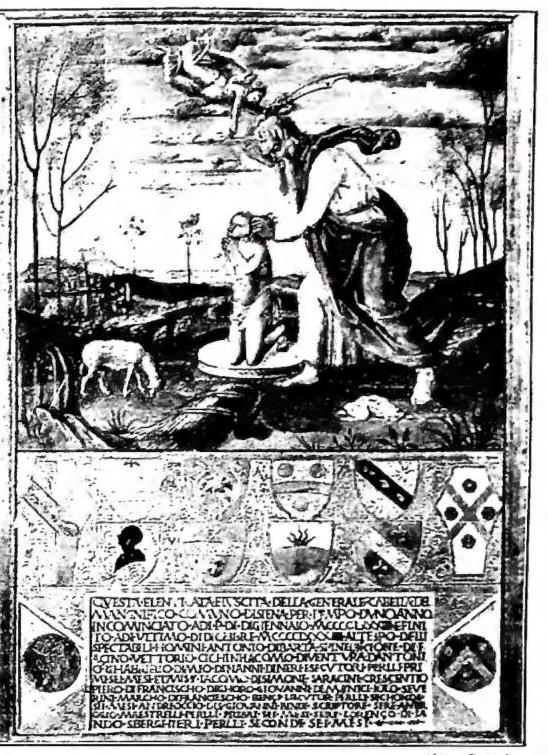
(phot. Grassi)
SACRIFICE - The sacrifice of Isaac, type of the sacrifice of Jesus Christ. Tablet of the Biccherna, painted by Bernardino Fungai (1483) - Siena, State Archive.
The holocaust entailed the total combustion of the victim and was the latreutic sacrifice par excellence. The peace or salutary sacrifice (zēbhaḥ śēlāmīm, or briefly śēlāmīm, intensive plural) was offered in thanksgiving or for impetration or even in fulfillment of a vow: in this sacrifice, the victim was partially burned (only the fatty parts); another portion (the breast and the thigh, which first had to be "waved" between the altar and the sanctuary) belonged to the priest; the remaining flesh pertained to the offerer, who consumed it within the sacred precinct and invited relatives and other persons, especially the poor, to the banquet (cf. Deut. 12:12, 18; 16:11 ff.; I Sam. 1:4 ff.; Ps. 21:26 ff.): legal purity was required for participation in the sacrificial banquet. In the expiatory sacrifice (hipper, probably from an Akkadian root meaning "to remove"), the fundamental idea was expiation or satisfaction for some fault or external infraction of the law, or even for some more serious legal stain or impurity (e.g., leprosy); the sacrifice for sin (ḥaṭṭā’āh "sin") and the sacrifice for guilt (’āšām "guilt") were distinguished; for both, there were differences in rites and victims (the reason for the distinction lies in the lesser or greater gravity of the transgression according to the law); expiatory sacrifices were mostly of a private nature, and in individual cases, the quality of the victim was prescribed; the portion not burned on the altar was consumed by the priests; but if the expiatory sacrifice was for the high priest, for the priests, or for the community (such as those public sacrifices to be offered on the new moon, Passover, Pentecost, on each day of the Feast of Tabernacles, and especially on the Day of Atonement), the flesh was burned outside the sanctuary. At the time of the Maccabees, the expiatory sacrifice for the dead is attested (II Mach. 12:43); but it is presumed to be older. Alongside the bloody sacrifices, unbloody sacrifices often accompanied them with an integrative function: but these could also be independent acts of worship (such as the daily incensation, the oil for the lamps, the bread of proposition and that for Pentecost, the ears of grain for Passover, the sacrifice called of jealousy, that for sin offered by the poor, etc.). Besides that for incense (for the date of the introduction of incense cf. Rev. bibl. 23 [1914], pp. 161-87), two kinds of unbloody sacrifices were distinguished: offerings of food (minḥāḥ) and of drink (nēsekh, Gr. σπωδῆ "libation"). They consisted of: fine wheat flour (barley flour only in the sacrifice of jealousy [Num. 5:15]), roasted grain, unleavened cakes and bread (Lev. 2), the ears of grain for Passover and the firstfruits of bread for Pentecost; among liquids, wine and oil. Salt and oil were added to all oblations, and incense to some, which in turn, especially in the daily sacrifice, was sprinkled with other aromatic substances (cf. M. Löhr, Das Rauchopfer im Alten Testament, Halle 1927). Unbloody sacrifices are as ancient as bloody ones, as evidenced by the example of Cain and Melchisedech (Gen. 4:3; 14:18).
The victims of sacrifice were only clean and domestic animals, the only ones deemed worthy of God and also the most precious and proper, namely bovines, ovines, and caprines, as well as turtledoves and pigeons; they had to be free from any blemish or defect (23 imperfections were specified) and of young age (bulls generally three years old, calves and lambs no older than one year, rams and goats from one to two years); only males for the Passover, holocaust, and expiatory sacrifices "for guilt" (for peace and expiatory sacrifices "for sin," animals of both sexes were admitted; in birds, the difference of sex was not considered, according to the Talmudists).
Sacrifices of human lives, widely practiced by ancient peoples (Sumerians, Egyptians, Greeks, Romans, Germans), are severely prohibited in the Bible, which considers them an impiety proper to the Canaanites (Lev. 18:21; 20:1-5; Deut. 12:31; 18:9 ff.). Rationalists wrongly adduce the example of Abraham: if God ordered the patriarch to sacrifice his son Isaac (v. ISAAC), it was only to test his faith and obedience, as is expressly stated (tentavit); indeed, at the opportune moment, He prevented him from completing the sacrifice and had it replaced by that of a ram (Gen. 22). The example of Jephthah (v. JEPHTHAH), who sacrificed his daughter believing himself obliged to fulfill a rash vow (Judg. 11:30 ff.), only demonstrates that that judge did not have an exact notion of the true worship due to Yahweh: the Bible does not pronounce on the morality of that act. The redemption of the firstborn (Ex. 13:13), rather than proving the contrary, confirms the divine prohibition of human sacrifice: since the firstborn (v. PRIMOGENITI) of man could not be immolated (as was prescribed for the firstborn of animals, with the exception of the donkey), they had to be redeemed by an offering. Unfortunately, the example of the Canaanites and other neighboring peoples sometimes led the Israelites to that abominable practice, as can be seen from the fact that Hiel, in the reconstruction of Jericho, sacrificed two of his sons (I Kings 16:34; cf. Josh. 6:26, where the misdeed is the object of execration); likewise, some impious princes sacrificed human lives to Moloch in Jerusalem itself, that is, in the valley of Ben-Hinnom or Gehenna (cf. II Kings 16:3; 21:6). Especially in the northern kingdom, the sacrifices of children were frequent (ibid. 17:17: that crime is seen as one of the causes of the end of the Kingdom of Israel). The Bible and the prophets have severe words of condemnation against these misdeeds (cf. Ps. 105:37 ff.; Mic. 6:7; Jer. 7:31; 19:5; 32:35; Ez. 16:20 ff.; 20:26).
The rite was essentially the same for all bloody immolations: leading the victim to the place of sacrifice, in the inner court of the Temple before the altar of holocausts; imposition of hands, as a sign of donation to Yahweh and also of vicarious representation (the idea of transferring guilt could only be present in expiatory sacrifices); slaughter (which was usually performed by a skilled Levite or even by the offerer himself; the blood was collected by the priest in a bronze basin: the act could be vitiated by 3 defects); sprinkling of the blood, which was the most sacred part, considered by the ancients as the seat of life (cf. Lev. 17:1 ff.: the rite of sprinkling varied according to the type of sacrifice); combustion of the victim (total or partial according to the various sacrifices). The true sacrificial act consisted in the effusion and sprinkling of the blood, which, together with the combustion, signified that the sacrificed life was offered immediately to God.
The place of sacrifice, during the forty years in the desert, was the court surrounding the tabernacle. Centralization (cf. Lev. 17:1-9; Deut. 12:5-14) was maintained afterward around the Ark; when the Temple was built in Jerusalem, it was recognized as the only legitimate place for sacrificing (except in exceptional cases of sacrifices offered by prophets or in places consecrated by a special divine vision: cf. Judg. 6:20-28; 13:8-23; II Sam. 24:16-25; I Kings 18:29-38; other cases are to be considered abusive). Therefore, during the Babylonian exile, and definitively after the destruction of Jerusalem, the sacrificial cult ceased in Israel.
In the sacrifices of the Old Testament, a twofold value must be distinguished: proper and symbolic. The first, which could almost be called sacramental because inherent to the rite as such, consisted in the power to eliminate the contaminations induced by some transgression or defect, and to restore ritual or levitical justice (emundatio curvis: Hebr. 9, 13), enabling the person to legitimately participate in the acts of worship. The other, symbolic, was inherent to the act as an expression of internal acts of faith, adoration, gratitude, and compunction, from which its spiritual efficacy derived.
Unfortunately, this element of interiority was often neglected, as the people deluded themselves into propitiating Yahweh with the mere external offering of rich sacrifices; the prophets energetically protested against this formalism. And if in their struggle against erroneous ideologies they sometimes expressed themselves with vehemence (cf. Am. 5, 21-25; Os. 6, 6; Is. 1, 11-14; Mich. 6, 6-8; Ier. 6, 20; 7, 21 sg.; Ps. 49, 7-15), they did not intend to condemn sacrifices as such, willed and ordained by God Himself, but to restore external worship to its religious and moral significance, since God cannot accept the offering of sacrifices and the observance of external rites where the internal tribute of the spirit and the compunction of the heart are lacking: what God demands with sacrifice, indeed prefers to any external act of worship, is the practice of justice and the observance of His law, in which lies the essence of true worship.
Furthermore, the sacrifices of the Old Testament are recognized as having a typical, that is, prefigurative value in relation to the perfect sacrifice reserved for the New Testament, which is the sacrifice consummated by the God-Man on the Cross for the sins of all times, for the faults of the entire humanity (cf. Hebr. 9, 28; 10, 12). In view and by virtue of this future sacrifice, God in His mercy accepted the ancient imperfect sacrifices, working through them in man, where the necessary dispositions existed, also a justification with the remission of sins and the conferral of grace. With the sacrifice of Christ, the ancient sacrifices and the entire ritual economy of the Old Testament, imperfect and transitory, ceased juridically, as foretold by the prophets (cf. Dan. 9, 27; Mal. 1, 11) (cf. Hebr. 9, 11-10, 14).
The noblest among the sacrifices of the Old Testament was the holocaust (Gr. ὁλοκαύτωμα, ἡ ὁλοκαύτωσις, from ὅλος, αὐτός "entirely burned," Volg. holocaustum, holocaustma), Heb. 'alāh (from 'alāh "to ascend," in the sense, according to some, that the victim is "carried" to the altar, or, rather, that the victim "ascends" to heaven with the sacrificial fragrance); also called kālīl (among the Phoenicians ielēni kalīl) and in rabbinic literature gēnārā' "complete offering." The total combustion of the victim was essential (with the exception of the skin, always excluded from sacrifices; according to Jewish tradition, the sciatic nerve was also excluded, in memory of Jacob [cf. Gen. 32, 32]; Hullin, 7, 1).
The rite is carefully described in Lev. 1, 1-17 and Num. 15, 3-9. The major victims were first slit, cut into pieces, and washed; then placed to burn on the altar "as a holocaust, an offering by fire of pleasing odor to the Lord" (Lev. 1, 9: an anthropomorphic expression to be understood, as in other parts of the Bible, in a figurative sense, meaning that the sacrifice was offered in homage of adoration to Yahweh). With the blood of the victim, the priest sprinkled the sides of the altar, while the sacred fire finished consuming it, and the ashes were removed in the morning to a decent place outside the sacred precinct (Ex. 29, 38, 42; Lev. 6, 8-13). According to Flavius Josephus, the parts of the victim, before being burned, were sprinkled with salt (Antiq. Iud., III, 9, 1). The holocaust was ordinarily accompanied by unbloody offerings (libation of wine, offering of flour mixed with oil, Num. 15, 4-11). Often, together with the holocaust, a peace offering was made: a rite of festive intimacy that followed the act of pure adoration to Yahweh (cf. Ex. 18, 12; 24, 5; Ios. 8, 31; Iudc. 20, 26; 21, 4; I Sam. 6, 14 ff., etc.).
By its essential and specific rite, the holocaust was a most solemn act of homage and adoration to God, and expressed better than any other rite or sacrifice the absolute dependence and perfect dedication of man to the Creator, in the recognition of his own nothingness and of His supreme dominion (St. Thomas, Sum. Theol., I-II, q. 102, a. 3, ad 8). Therefore, it was the perfect expression of external worship, the preeminent latreutic act.
The holocaust in the Old Testament could not be lacking in any feast or in the most solemn religious manifestations. Holocausts were public or private; and the latter, obligatory or voluntary. Among the public and solemn ones, the most important was the perpetual sacrifice of a lamb (v. AGNELLO) or kid (two on the Sabbath) to be offered every day, morning and evening (Ex. 29, 38 ff.; Num. 28, 1-10), independently of any other sacrifice for particular occurrences or circumstances. For the principal religious solemnities, the following holocausts were prescribed (cf. ibid. 28-29): new moon or neomenia, 2 calves, 1 ram, 7 lambs; Passover, as in the new moon, but for seven continuous days; Pentecost, 1 calf, 2 rams, 7 lambs; Atonement, 1 ram for the high priest and another for the people, in addition to 1 calf and 7 lambs; Tabernacles, numerous holocausts on each of the 8 days of the solemnity (ibid. 29, 13-38). Special holocausts were offered on exceptional occasions: famous for the number of victims, for example, were those offered by King David for the proclamation of his son Solomon as successor (1000 bulls and as many lambs and rams: I Par. 20, 21) and by Solomon when he ascended the throne (II Par. 1, 6) and when he dedicated the Temple (ibid. 7, 1-7).
Among private holocausts, some were obligatory (such were those prescribed for the consecration of the Levites, priests, and the high priest [Lev. 8]; for purification after childbirth [ibid. 12, 6-8]; for the initiation of Nazirites [Num. 6, 14-16] and for their purification from contact with a corpse [ibid. 6, 10 ff.]; for purification from leprosy [Lev. 14, 19 ff.]; and for various legal purifications); others were voluntary or of private devotion (to thank God for a signal benefit, to implore some grace, etc., cf. Num. 15, 3, 8). Unlike other bloody sacrifices, the holocaust could be offered also for non-Israelites. - See plate XCIX.