ETRUSCHI, RELIGIONE degli. — Religion, and in particular the religious thought of the Etruscan people—which flourished in central Italy during the 1st millennium B.C.—is unfortunately known in an extremely uncertain and fragmentary manner, owing to the scarcity and one-sided nature of the sources. The original documents in Etruscan are limited to a few ritual texts, including only one manuscript of any considerable length (that of the mummy wrappings of Zagreb), much of which is difficult to interpret with certainty, and to a certain number of dedicatory formulas on statues, vases, and other votive objects. Greek and Latin literary sources make up for this deficiency, though very imperfectly, with mostly indirect and fragmentary information about the deities, myths, forms of worship, religious customs, and sacred writings of the E. The most reliable evidence available, although limited by its very nature, is archaeological: that is, the remains of sacred structures (temples, altars, etc.) and their furnishings, together with depictions of deities, legends, and sacred ceremonies appearing in funerary painting, sculpture, urns, and engraved mirrors.
Despite these difficulties, it is possible to recognize, or at least glimpse, certain fundamental aspects of the religious world and various details of the beliefs and cults of a people whom ancient tradition generally regarded, by common consent, as exceedingly religious, to the point of deriving their name, through a naïve etymological explanation, from the very act of sacrificing (Tusci from ἀνατάξαν). Etruscan religion cannot, historically and as a whole, be separated from that of the other pagan peoples of the classical world with whom the E. came into contact and shared developments in civilization: still less from the religion of the Italic peoples, and especially of the Romans, who summed up and transmitted their spiritual heritage. Nevertheless, there are indications that primitive features survived in Etruscan religiosity, probably connected with the world of Mediterranean prehistory, and that beliefs and forms of worship spread from the Near East flowed into II. The predominance of certain irrational tendencies in the relations between the human and divine spheres, the obscurity of the supernatural forces that continually act upon human life, the importance and variety of divinatory practices, and the frequent representation of semideities and monstrous demons in some way set the religious attitude of the E., in its most intimate and original core, against the rational and mythologically determined forms of Greek beliefs. But Hellenic cultural influence was so strong upon the Italic world, from the dawn of historical times onward, that it in turn imposed upon Etruria Greek personal cults, divine images, and myths; thus it may be said that within Etruscan religion various, complex, and even contradictory elements coexisted. It is probable that an attempt to organize and codify Etruscan religious thought and practice took place only in the Hellenistic period, when Etruria was already under the sovereignty of Rome, through the work of the priestly oligarchies entrusted with the interpretation of theological and ritual matters and to whom we owe the sacred books (“aruspicini,” “fulgurali,” and “rituali”) mentioned in classical literature and unfortunately now lost.
The norms of worship proper, that is, of sacrifices
and offerings, likewise fell within the “discipline”
and had to be contained in the “ritual books.” The few
surviving Etruscan ritual texts make it possible to recog-
nize the similarities between Etruscan sacrificial ceremonies
and those of the Italic and Latin peoples. Worship was
practised in sacred places (templa, probably sasni in Etruscan),
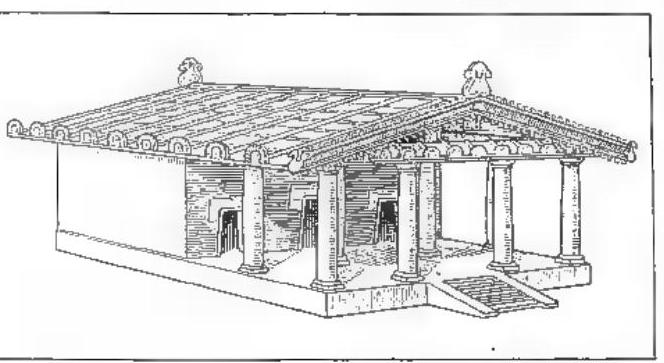
consisting of enclosures with altars, in which actual temple
buildings also stood. Orientation was of great importance,
in relation to auspices and the minute
rules of the rites: the eastern region (left) was consid-
ered benevolent and propitious; the western (right) hostile and
liquids, and incense; nor are testimonies lacking of gifts,
more or less precious (works of art, vases, various objects),
dedicated by private individuals in the sanctuaries. Priests
officiated, sometimes gathered into colleges; from Etruscan
sacred and funerary inscriptions, several particular titles
are known (cepen or cipen, perhaps to be connected with the
Sabine cupenent; cisneve; celu; santi, etc.).
It remains to mention the Etruscan doctrines concerning time
and death. The former were expounded in the “fatal books,”
the latter in the “acherontic books,” which formed part,
both of them, of the “ritual books.” The conception of the
fatal term of life applied to men, cities, and nations and
consisted in the belief in a periodic crisis at the end of
determinate phases of existence, whose threats could be
averted through special ceremonies, and in an irrevocable
limit marking the end of the entire life cycle. The doctrine
of the “centuries” is closely connected with these conceptions.
More complex is the problem of beliefs concerning death and
the hereafter, upon which archaeological evidence sheds light,
albeit indirectly and sometimes uncertainly. From the very
origins, the funerary rite of cremation is encountered in
Etruria alongside that of inhumation; but the practice of
protecting the mortal remains of the deceased, constructing
the tomb in imitation of the house and placing in it objects
of personal adornment, weapons, furnishings, food, and other
funerary offerings, decorating the walls with images of life
and ceremonies, and finally faithfully representing the
features of the deceased (whence the portrait arose) is clear
evidence that originally the ancient Mediterranean belief
in the partial vitality of the spirit of the deceased survived,
together with his remains, inside the tomb. From the
tomb paintings there later emerges the affirmation of the
conception of an Avernus modelled on the Greek image, but
with a literary colouring based on the belief in apotheosis,
which could be attained through special sacrifices: an
Etruscan ritual text, that of the Capua tile, probably con-
tains a description of such sacrifices. - Vedi
tav. XLVIII.
(courtesy of Prof. M. Pallottino)
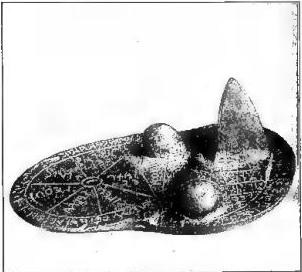
ETRUSCHI, RELIGIONE degli - Bronze model of a Trevian
liver at Piacenza. It was intended for the teaching of
divinatory fulgural discipline. It is divided into 16 sections
bearing the names of as many divinities who can hurl
the lightning from the sky; in the three projections, some
see the symbols of the Earth (globe), the Sun (cone), and
the Sky (pyramid) — Piacenza, Civic Museum.