
APOLLO. — God of Greece, one of the most popular deities of the Hellenic religion. His origin is uncertain, and his name has resisted the efforts of philologists to arrive at a satisfactory etymology; his original character is likewise unknown.
For some, A. is the Greek god par excellence, whether Dorian or Ionian; for others, he is a foreign god who would have supplanted pre-Hellenic divinities. Depending on the etymologies, the importance assigned to individual ancient sources, or particular aspects of the god, A. has been regarded as originating in Asia Minor (Leleges or Lycians), or in the Aegean; or he is thought to be an insufficiently documented Hittite god, Apulunas, who in turn would go back to the Babylonians.
No other divinity has the multiplicity of functions that we find in A. He is the god of agriculture: he drives away diseases and animals that might damage the crops and brings them to maturity; he is the god of the woods. As a shepherd god, he gives health to the flock: legend likewise knows him in this aspect, making him serve as a shepherd for Admetus and having Hermes steal his oxen. He was also the god of hunting, of young men, and of the gymnasium, the god of contests and the first victor at Olympia, protector in wrestling and in war. He was the god of roads, traffic, and markets, the god of mountains, the sea, and navigation: in the latter capacity he often had sanctuaries on the seashore and was known especially as A. Delphinius, with an extensive cult in Crete and the Peloponnese. He was the protector of colonization, the founder of new cities (A. Archegetes), and oaths were sworn in his name. He was the god of music, the master of the Muses, whose choruses he led (A. Musagetes); his favorite instrument was the lyre. Above all, he was the purifier of moral and physical evils, the one who freed men and cities from every pollution and indicated the way of expiation: in Aeschylus, he alone
can redeem matricidal Orestes. Physical evils were the result of the god’s anger, but he could cure them, just as he cured moral evils: he was therefore also the god of health and a physician, although in this function he was partly replaced by Asclepius, whom one legend made his son. He was the god of light and of the sun. Some consider this his original aspect, while others point out that his identification with the sun does not go back beyond the fifth century B.C. and was due above all to the influence of Asia Minor, where numerous solar divinities were identified with A. He enjoyed great popularity as the god of divination and oracles. At times he also granted mortals knowledge of the future (Cassandra, the Sibyls, etc.), but generally divination was linked to individual sanctuaries.
The best-known was the oracle of A. Pythius at Delphi, which the Homeric hymn claims was founded by the god himself after his victory over the serpent Python, which spread desolation throughout the territory. In reality, A. seems to have replaced an older oracle of the earth. The priestess mounted the sacred tripod and delivered responses under the intoxicating influence of the vapors rising from a fissure in the ground. The Delphic oracle had a great influence on private and public life and was the religious center of the Greek world, of the colonies, and of those who came into contact with the Greeks: the Lydian kings sent to consult it; Syracuse, Cyrene, and the Etruscan cities of Caere and Spina had money and treasures at Delphi; Rome sent embassies during the siege of Veii and after Cannae. According to Plutarch, Sulla wore around his neck, as an amulet, a small gold statuette of the Delphic god. Delphi’s importance endured until the fall of paganism: apocryphal oracles circulated, as though to legitimize the new Christian religion. In Asia Minor, the oracles of Patara, of A. Clarius at Claros, and of A. Didymeus near Miletus, among others, were famous. At Delphi, A. gave responses only from spring to autumn; in winter the god stayed with the Hyperboreans. According to another legend, he dwelt at Patara in Lycia: this legend belongs properly to Delos, the center of the cult of A. Delios, the rival of Delphi and, during certain periods, as powerful and renowned as II. At Delos, the two twins A. and Artemis and their mother Latona were joined in worship, and the legend of A.’s birth was localized there.
Some have noted contradictions in the cult and attributes of A., but the fusion is ancient and was already complete in the Iliad, where A., together with Zeus and Athena, is the most powerful god; he is the brother of Artemis, the “far-shooter,” armed with the silver bow whose arrows bring disease and death; the god of music, who leads the choruses of the Muses; and the prophetic god. He bears the epithet Phoebus, which some connect with light and others with divinatory prophecy.
The festivals in honor of A. were not numerous. The principal ones were the Carnea, celebrated especially in the Dorian lands; the Hyacinthia, likewise chiefly Dorian; the Thargelia at Athens and in the Ionian cities; and the Daphnephoria.
The most usual attributes of A. were the bow and arrows, the lyre and, in connection with the cult of Delphi, the tripod and the omphalos. Among the animals sacred to him, the doe, the roebuck, and, in the Peloponnese, the wolf were especially frequent; among the trees, the laurel, born from the metamorphosis of Daphne, the maiden vainly loved by A., and, at Delos, the palm.
A. entered Rome at the end of the regal period. He was not assimilated to indigenous divinities, but both there and in Etruria he retained his own name. The archaic A. from Etruscan Veii is life-sized, dressed in a chiton and cloak, and is a distinguished example of Etruscan coroplastic art; it was found in the excavations of 1915 and is now in the Villa Giulia Museum. In 433 B.C., on the occasion of a pestilence, he was given a temple in the Flaminius Meadows, which was dedicated in 431. In 212 the Apollinarian Games were introduced; they became permanent in 208. The cult of A. received great impetus from Augustus, who built a temple in his honor on the Palatine. In Rome, A. remained above all a god of health, and in this aspect his cult also spread through the provinces, where he was assimilated to indigenous divinities such as Belenus, Grannus, and others. His cult continued in the countryside even after the fall of paganism: in 529, St. Benedict destroyed an altar of A. at Montecassino.
Ancient art represented A. according to two schemes: in a long garment and nude; in the archaic period, also wearing the chitoniskos and bearded. Subsequently, the clothed A. remained only in the case of A. Citharoedus. Generally, A. is nude, with his hair loose or tied up. In vase painting he is preferably represented in mythical scenes, among which the most frequent are his struggle with Heracles for the tripod of Delphi, with Hermes for the doe, with the serpent Python, the slaughter of the Niobids, and others. — Vedi Tav. CXXV.
Luna Banti
APOLLO (Ἀπολλῶς, contraction of Ἀπολλώνιος preserved by the codex Bezae). - Christian missionary of the apostolic era. A Jewish Alexandrian (according to Aigrain, Holzner, and others: a Platonizing disciple of Philo), converted, well-versed in the Holy Scriptures, and a brilliant speaker, he appeared in Ephesus in 53-54 (between the first and second sojourns of St. Paul), where in the synagogue he preached Jesus Christ with fervor (fervens spiritu). However, though well-informed about the life of the Savior, he knew little of His doctrine: he was acquainted only with the baptism of John (according to the codex Bezae, he had been instructed in Alexandria by disciples of the Baptist). Priscilla (v.) thoroughly instructed him. What they told him of Paul’s work begun in Corinth prompted him to go, furnished with letters of recommendation, to Achaia, where he supported the Apostle’s preaching, demonstrating from the Scriptures the messiahship of Jesus (Act. 18:24-28). He rendered excellent service in Corinth to the cause of the Gospel, and Paul praises him for having watered what he had planted (I Cor. 3:6).
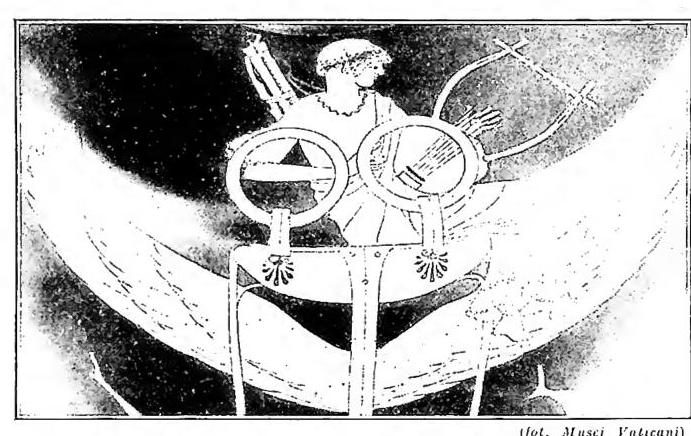
(photo: Vatican Museums)
APOLLO - A. on a winged tripod flying over the sea. Greek vase painting. (c. 480 B.C.) - Vatican, Museo Gregoriano-Etrusco.
The name by which a party in the Church of Corinth was designated, opposed to the parties aligned with Peter and Paul (I Cor. 1, 12; cf. St. Clement of Rome, ad Cor. 47, 3-4). It seems that the insistence with which Paul rejects "the wisdom of oratory" (I Cor. 1, 12 ff.; 3, 4-5, 22) is partly aimed at condemning the infatuation produced by the learned and subtle speech of A. Yet it does not appear that A. himself, prudent and humble, gave cause for this. Indeed, to avoid any division among the faithful, he departed from Corinth and refused to return there, despite Paul's requests (I Cor. 16, 12), with whom he was staying in Ephesus (year 57).
He remained a faithful collaborator of Paul (ibid. 3, 4-6), who later recommended him to Titus (Tit. 3, 13): A. was thus in Crete (perhaps as the bearer of the letter) around 65, and was preparing with Zena for a journey whose destination we do not know (return to Corinth, according to St. Jerome). The supposed affiliation of A. with a Judeo-Christian sect of Baptists is discussed and denied by J. Thomas (Le mouvement baptiste en Palestine et Syrie, Gembloux 1935, pp. 96-102).
St. Jerome (In Titum, 3: PL 26, 598) makes him bishop of Corinth; the pseudo-Dorotheus of Tyre (PG 92, 1064-65) and the Constantinopolitan Synaxarion (p. 786) make him bishop of Caesarea; local traditions assign him the see of Dyrrachium, or Colophon, or Iconium; but without foundation. The Roman Martyrology commemorates him on December 9. He is sometimes called "apostle" (Synax. Constantinop., p. 376).
Luther was the first to Hebrews (v.) to him; this hypothesis, spread by F. Bleek (1828) and followed by G. Lünemann, A. Hilgenfeld, O. Pfeiderer, H. Alford, and others, was taken up by the Catholics J. Ev. Belser (1901) and I. Rohr (Der Hebräerbrief..., 4th ed., Bonn 1932: A. was the "redactor") although only on vague conjectures (alleged "Alexandrian" traits of allegorical exegesis and style). The opinion of E. H. Plumptre (The writings of Apollos, in Expositor, 1 [1875], pp. 320-48, 409-35), who attributes to A. the Alexandrian book of Wisdom, was accepted by some (P. Heinisch, Das Buch der Weisheit, Münster 1912, p. xxiii).