
SIBILLA. – The S. (etymology unknown) is, in the classical tradition, a virgin, a young woman, though at times also conceived as decrepit, who, when inspired and as it were possessed by Apollo, reveals the future: « Sibylla dicitur omnis puella cuius pectus numen recipit » (Serv., Ad Aem., III, 445); an essentially popular concept, insofar as all peoples recognize in woman a greater receptivity and, consequently, a greater capacity to submit to the possession of a divinity and to express its will.
I. THE S. IN NON-CHRISTIAN RELIGIONS. — In Greece this figure (of which there is no trace in the Olympian religion) developed under the influence of the cult of Dionysus, characterized precisely by demonic possession—that same possession, namely, from which the Pythia at Delphi arose. The S. and the Pythia differ from each other in that, whereas the Pythia has a more defined manifestation, more controlled in its manner and effects, the S. enjoys greater freedom of personal inspiration, not necessarily linked either to a sanctuary or to a priesthood.
Although unique in conception, the S. had various local specifications, almost always associated with a sacred spring or a cavern; Varrone (in Lattanzio, Div. Inst., I, 6) fixes their number at 10 and arranges them in the following chronological order: Persica, Libica, Delfica, Cimmeria, Eritrea, Samia, Cumana, Ellespontica, Frigia, Tiburtina. Of these and others mentioned by the authors, three are the principal ones: the Eritrea, named Erofie, belonging to Ionia; the Cumana, which is that Eritrea transported to Italy; and the Babilonese (named Sabitu or Sambete), unknown to Varrone and becoming fashionable during the Hellenistic period as the East’s reaction to Roman domination.
II. THE SIBYLLINE BOOKS IN ROME
They are almost certainly of Etruscan origin and, thanks to an Etruscan king—Tarquinio Prisco according to Varro (in Lactantius, Div. Inst., I, 6), Tarquinio il Superbo according to Pliny (Nat. hist., XIII, 88)—were introduced into Rome from Cuma, a place renowned for the cult of Apollo and for the presence of the S. According to tradition, an old woman offered the King nine of these books, burning three of them at each refusal to purchase them. The King bought the last three and had them placed in the Capitoline temple, where a special commission of duumviri, later decemviri, and subsequently quindecemviri sacris faciundis consulted them (libros adire, libros inspicere) at the Senate’s invitation. They were also called libri fatales, with clear reference to their contents (Lactantius, Divinae Institutiones, I, 6, 13).In conformity with the rigidly legalistic spirit of Roman religion, which abhorred enthusiastic manifestations of religious feeling, the S. in Rome was reduced, in the hands of the Quindecemviri, to being a written voice, interpreted, at the command of the authorities, by a technically trained priesthood in cases in which the aim was rather to calm than to intensify religious excitement, «ad deponendas potius quam ad suscipiendas religiones»; that is, above all on the occasion of public natural or social calamities, so that it might suggest the means of appeasing the gods and thus restoring the «pax deorum». Indeed, the Sibylline books were consulted nine times on occasions of falling stones (meteorites), in addition to sporadic cases of earthquakes and famines. The remedies suggested are always of the same kind: supplications, lustrations, lectisternia, expiatory sacrifices, and the construction of temples.
Destroyed in the fire of 83 B.C., the Senate ordered that they be reconstituted and for this purpose sent an embassy to places renowned as the dwelling places of S. (Tacitus, Ann., VI, 12). It returned with about a thousand verses, which in the year 76 were deposited in the rebuilt Capitoline temple. And since political falsifications had infiltrated them, Augustus had them subjected to a rigorous revision and placed them in the new temple dedicated by him to Apollo on the Palatine (Suetonius, Aug., 31).
It was the Cumana S. who announced, in accordance with the new Neopythagorean ideas, the birth of a new era, which seemed then to be opening, at the end of the civil wars (Ultima Cumanae veniti am carminis aetas: Virgil, Ed., IV, 4), coinciding with the triumph of Augustus; it was the Sibylline books that prescribed in 17 B.C. the celebration of the secular games (Horace, Carm. saec., 5), which in Augustus’s conception were to-
(Int. Alimari)
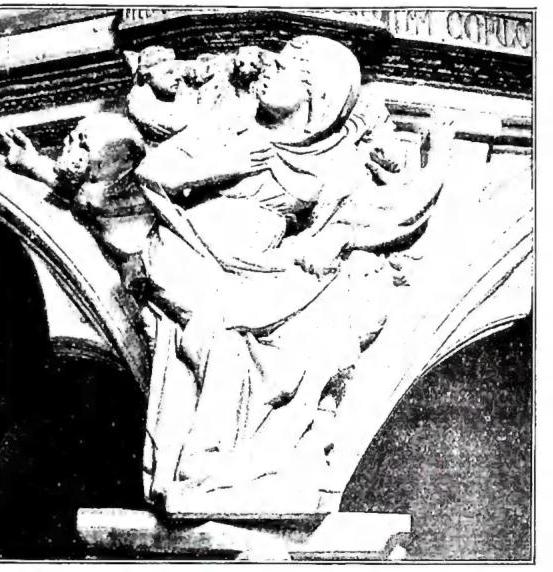
SIBILLA - A S., sculpture by Giovanni Pisano (1298). Detail of the pulpit of the church of S. Andrea - Pistoia.
were meant to signify the closing of a troubled age and the beginning of a new era.
The Sibylline verses had the characteristic of being acrostic, both for mnemonic purposes and as a guarantee against alteration (Cicero, De div., II, 11). Their wording was deliberately obscure and general, so that it could be adapted to the most varied circumstances. They were consulted throughout the Republic and the Empire, up to Julian the Apostate (Ammianus Marcellinus, XXIII, 17). Around 400, Stilicho ordered that they be burned (Rutilius Namatianus, II, 52).
III. SIBYLLINE ORACLES
Greek historians allude to predictions attributed to the S. Their collections, entitled Χρηγοί Σιβαλλικαί, must soon have begun to circulate; but only scant fragments have come down to us (C. Alexandre [V. op. cit. in bibl.], II, pp. 118–47).The well-defined collection transmitted under the name of Sibylline Oracles has nothing to do with pagan religion. It consists of 14 books of very different periods and origins, which exploit the name of the S. for propagandistic purposes. In the attempt at literary assimilation, undertaken especially by the Jews of Egypt, recourse was often had to the expedient of presenting entire works or isolated sayings under the patronage of some celebrated Greek historian or poet. By means of this literary device, a supposed dependence of Greek civilization on Hebrew civilization was ostentatiously asserted. The mystery surrounding the authoritative sayings of the S. facilitated this literary falsification, sometimes very skillful, at other times rather childish, which began in the 2nd century B.C. and continued into the Middle Ages.
Fourteen Sibylline books are known, comprising the oldest texts (2nd century B.C., 4th century A.D.), whose origin cannot always be described. Books IX–X are lost, if indeed they were ever composed.
The first two clearly show themselves to be the result of an unfortunate splitting in two of a single primitive work. Only a few verses survive from books IV, VI, VII, XIII (respectively: 192, 28, 164, 173), while some fragments remain (Geffcken records 8, comprising about a hundred verses in all) whose original book is unknown. This shows how their manuscript transmission presents multiple problems, compounded by the difficulty of establishing the various layers in passages that have evidently been interpolated.
Book III is the oldest part of the collection, which according to many was already begun in the time of the Maccabees (mid-2nd century B.C.). The book comprises 829 dactylic hexameters. It was composed in Greek, as even a superficial examination of the language demonstrates. In the poetic fiction, the S., who lived before Homer, is presumed to narrate future history in veiled fashion, with many repetitions and anachronisms. The description of the Tower of Babel is famous. Jewish glories are exalted; in prophetic style, idolatrous nations are cursed and monotheism is advocated. Messianic or eschatological elements are rare and debatable (vv. 652–68). According to some authors, Virgil in his Eclogue IV was inspired by this book, especially by vv. 785–95, where, with images similar to those of Is. 11:6–9, he describes the messianic peace. The work appears to be free from Christian interpolations, to which vv. 767–84 are sometimes assigned.
Books VI and VII are undoubtedly of Christian origin, the former being a brief hymn to Christ. In Book VIII (500 vv.), after the fictitious prophecy concerning the Roman emperors from Julius Caesar to Hadrian, there occurs the celebrated acrostic Ἰησοῦς Χρειαστὸς θεοῦ υἱὸς σωτὴρ-σταυρός (vv. 217–50), of which St. Augustine speaks at length (De civitate Dei, XVIII, 23), giving its Latin translation and attributing it to the Erythraean or Cumaean S. The Emperor Constantine (Oratio ad sanctum coetum, 18–19: PG 20, 1285–92) not only cites the acrostic, but also defends its authenticity as attributed to the Erythraean S., asserting that it had already been translated into Latin by Cicero. The assertion
probably derives from a misunderstanding of a passage in De divinatione (II, 54). Book XIII (173 vv.), which speaks of the Roman emperors up to Gallienus, is also Christian. Books XI (324 vv.), XII (299 vv.), and XIV (361 vv.), of little historical interest, are the work of Jews, but with substantial Christian reworkings and interpolations. They, certainly no earlier than the 2nd–3rd century A.D., show how in this period there was a revival of the Jewish S. with an anti-Christian polemical purpose. In a later period, isolated poems also arose, attributed particularly to the Tiburtine S.
The influence of the Sibylline Oracles was more literary and artistic than ideological. Ancient ecclesiastical writers, particularly Clement of Alexandria, Theophilus of Antioch, and Lactantius, who devotes an entire chapter, De divinis testimonis et de Sibyllis et earum carminibus (Divinae institutiones, I, 6), frequently resorted to the Sibylline texts to demonstrate the expectation of the Messiah among the pagans. An allusion to their eschatological passages is still found in the well-known V. Texte David cum Sibylla of the Dies irae (cf. Orac. sibyll., IV, 172–79).
At the dawn of the Renaissance, Beato Angelico painted the S. Eritrea alone amid the entire series of prophets in the framing of the great Crucifixion, frescoed in the chapter house of the Convent of S. Marco in Florence. From Andrea del Castagno we have, from the same period, the vigorous S. Cumana, once frescoed in the Villa Pandolfini at Legnaia and now preserved in the convent of S. Apollonia in Florence. Four graceful statuettes of S. (perhaps by Pier Matteo d’Amelia) are seen interspersed with those of the prophets in the vertical friezes of the magnificent door of the Florentine Baptistery known as the Gate of Paradise, the work of Lorenzo Ghiberti. On the splendid pavement of the cathedral of Siena, decorated with marble graffiti, ten S. are represented in the side aisles according to designs by various masters in the late fifteenth century. In 1484 Domenico Ghirlandaio frescoed four S. in the triangular compartments of the vault of the Sassetti chapel in the church of the
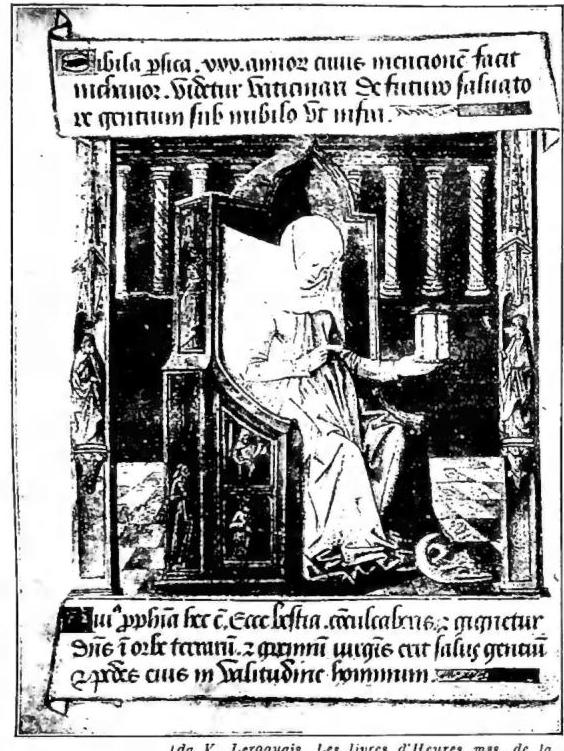
SIBILLA - The Persian Sibyl. Book of Hours, according to the liturgical use of Rome, executed ca. 1480 for Ludovico di Laval—Paris, National Library, ms. lat. 920, fol. 17r.
Most Holy Trinity in Florence. In the same dispersed arrangement, four Sibyls are seen in the vault of the Baglioni Chapel of the collegiate church at Spello, frescoed there in 1501 by Pinturicchio, who likewise adorned the ceiling decoration in the apse of S. Maria del Popolo in Rome with four Sibyls, executed by him in 1508. The Sibyls and prophets painted in the Borgia apartment in the Vatican Palace are the work of Pinturicchio’s workshop. On the walls of the Collegio del Cambio in Perugia, Perugino painted six Sibyls together with six prophets, beneath the Eternal Father in Glory; among these Sibyls, one—namely the Libyan—is attributed to the collaboration of the young Raphael.
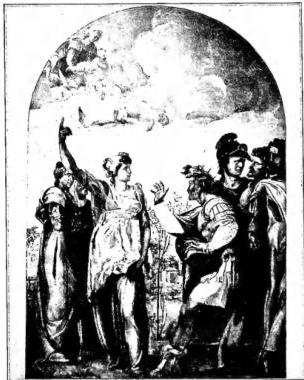
The most famous representation of the MERISI, MICHELANGELO (v.), frescoed on the vault of the Sistine Chapel; five of them (Erythraean, Persian, Delphic, Cumaean, and Libyan) are seen there alternating with seven prophets. Two years later than the vault of the Sistine is Raphael’s fresco in the church of S. Maria della Pace in Rome, where four Sibyls (Cumaean, Persian, Phrygian, and Tiburtine) are grouped with various putti in a harmonious elegiac scene. On the vault of the Caraffa Chapel in the church of S. Maria sopra Minerva in Rome are four Sibyls painted in the early sixteenth century by Raffaellino del Garbo. In the church of Fontegiusta in Siena, a fresco by Baldassarre Peruzzi, datable to 1528, depicts the Tiburtine Sibyl announcing to the emperor Augustus the birth of Our Lord. The mediocre Sibyl, sculpted in marble by Raffaello da Montelupo, visible in the upper part of the funerary monument of Giulio II in the church of S. Pietro in Vincoli in Rome, seems to be the final representation of the ancient prophetesses in sacred art. Also noteworthy is the splendid painting by D. Dossi of the Maga Circe, conceived as a grandiose image of a Sibyl, preserved in the Galleria Borghese in Rome. - Vedi tav. XXIX.