
SYMBOL and SYMBOLISM. — From αὐv = “with, together” and βάδω = “I throw,” with the meaning of “to put together,” to bring objects and ideas close to one another. Setting aside, because they are not relevant here, the attribution of symbols to those objects whose separate or broken parts, once reunited, served as a sign of recognition, and to those other objects that served as a token of entry into a place, the term symbol is used above all in two senses: 1) as a formula or doctrinal profession that unites adherents to the same faith, such as the symbols or regulae fidei, the distinctive mark of the faithful belonging to the Catholic Church (and for this see SYMBOLS OF FAITH); 2) as something sensible—an object or action—having a relation of meaning with respect to a spiritual object, by virtue of a certain resemblance highlighted through an intellectual comparison, and it is this second sense that is treated here.
Symbolism, therefore, signifies the tendency to represent ideas through symbols, as well as the science that studies symbols and their value.
I. SYMBOL AND SYMBOLISM IN NON-CHRISTIAN RELIGIONS
Symbolism can be realistic when, as occurs in primitive mentality, it sees behind material things (depicted, represented through action, etc.) a very close relationship between the representative and the thing to which the representation refers; magic (v.) are fundamentally symbolic rites. This realistic value remains even when culture rises from the primitive to more complex conceptions, as in the ancient Greek and Hellenistic mysteries, in which the initiatory rite not only symbolizes but also enacts (vision, sacred meal, touching) the sacred union between the initiate and the god of the mystery.Symbolism can be suggested by intellectual congruence or by conventional motifs; thus the swastika, originally a solar symbol, became during the German National Socialist delirium a symbol of Aryanism; the crescent moon has become, for reasons unknown, a symbol of Islam: and above all the cross is the symbol of Christianity.
For a symbol to have a unifying efficacy it must be intelligible, that is, intuitively revealing of the religious truth it symbolizes, but not too intellectualistic otherwise it would lose its mystical efficacy, nor too minutely adherent to the thing symbolized, lest it not be grasped or easily recalled to memory. For smaller groupings, proper to groups of initiates, the symbol can be more complicated and mysterious because in this case it serves as a token of recognition for the initiates alone.
The reality of religious symbolism, indispensable for realizing mystical life in the individual and in the group, tends to assume a more spiritual value. Thus it happens that in the highest phases of mysticism the orant dispenses with sacred images, consecrated places, and ceremonies, and concentrates on meditation performed in silent recollection.
Since the symbol is a synthesis of the beliefs and religious experiences of the social body, it follows their fate and therefore either dissolves or evaporates when religious schemes collapse, or crystallizes when the group, due to historical and ethnic contrast, closes itself to external influences and exchanges. Since law regulates and consecrates social relations with men, symbolism, in its various aspects of sign, gesture, and formula, has in it a use all the more extensive the more primitive the society.
Thus the breaking of a scroll in Greece, or of a rod or stipulation in Rome, whose two parts remain in the hands of the contracting parties or witnesses, symbolized the stipulation of a contract; thus all legal formulas accompanied by gestures relating to various parts of the human body: the head in cases of adoption and inauguration; the lobe of the ear (considered the seat of memory) in manumissions, inheritances, testimonies (antestatio); the hand as a symbol of power (in manum convenire, in manu esse, manumittere, manus conserere, manus inicere, manum opponere); the foot as a symbol of possession, especially of immovables. In medieval law, ceremonies of adoption and investiture were all characterized by a symbolic ceremony: the cutting of a lock of hair (tonsure) for those who entered ecclesiastical service; the girding with a sword for elected knights; the delivery of the chalice or pastoral staff for the investiture of an ecclesiastical fief; of a clod of earth for that of a civil one, etc.
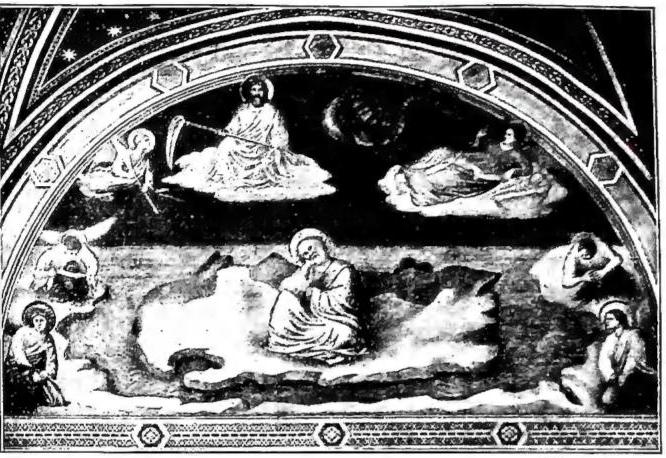
(Int. Anderson)
SYMBOL AND SYMBOLISM — Visionary symbolism of St. John the Evangelist on the island of Patmos (Rev. 12 ff.). Detail of the frescoes by Giotto (after 1320) in the Peruzzi Chapel, restored in the 19th century — Florence, Church of Santa Croce.
M. Wiener, Von den Symbolen, Berlin 1924; E. Cassirer, Philosophie der symbolischen Formen, 3 vols., ibid. 1923–31; W. Deonna, Quelques réflexions sur le symbolisme, in Revue hist. religions, 88 (1924), pp. 18 ff.; S. A. Mackenzie, The Migration of Symbols and their Relation to Beliefs and Customs, London 1926; G. Lanoë-Villène, Le livre des symboles; Dictionnaire de symbolisme et de mythologie, Paris 1930; L. Lévy-Bruhl, L’expérience mystique et les symboles chez les primitifs, ibid. 1938; G. Cumont, Le symbolisme funéraire des Romains, ibid. 1941; M. Eliade, Traité d’histoire des religions, chap. 13, La structure des symboles, ibid. 1949, pp. 372–91. V. especially, for a judgment on the various hypotheses concerning symbols and the relations between the symbols of pagan religions and those of Christianity: K. Prümmer, Religionsgeschichte, Handbuch, Freiburg im Br. 1943, index; Symbol e Symbolismus, pp. 916–17; Tiere, p. 918.
Nicola Turchi
II. SYMBOL AND SYMBOLISM IN HOLY SCRIPTURE — The term occurs in its etymological sense in the Septuagint and in the Vulgate (“dantes symbola”) of Prov. 23:20–21, where it designates the portion that the guests “put together” for the common meal.
A distinction must be drawn between symbol and metaphor and other rhetorical figures of speech. In the description of a symbol, the biblical words are used in their proper literal sense, whereas in metaphor (or in allegory, which is sustained metaphor) and in other rhetorical figures the terms are employed in a transferred literal sense. Parables and fables may also be regarded as literary symbols; they are invented narratives designed to signify higher realities. In the prophetic books of the Bible and in the Apocalypse, many symbolic visions, symbolic actions, and symbolic numbers are found. Symbolic actions also appear in various historical books, e.g., those performed by Samuel (1 Sam. 11:5–7), Jonathan (ibid. 20:20–22), the prophet Ahijah of Shiloh (who, by tearing his mantle into twelve pieces, symbolized the division of Solomon’s kingdom: 1 Kings 11:29–39), a son of the prophets (ibid. 20:35–43), the false prophet Zedekiah (ibid. 22:11), Elisha (2 Kings 14–19), and Nehemiah (Neh. 5:12–13). In the New Testament, baptism in water may be considered a symbol connected with water: the baptism of John the Baptist (a sign of repentance), that of Jesus (an efficacious sign of grace), and ablutions
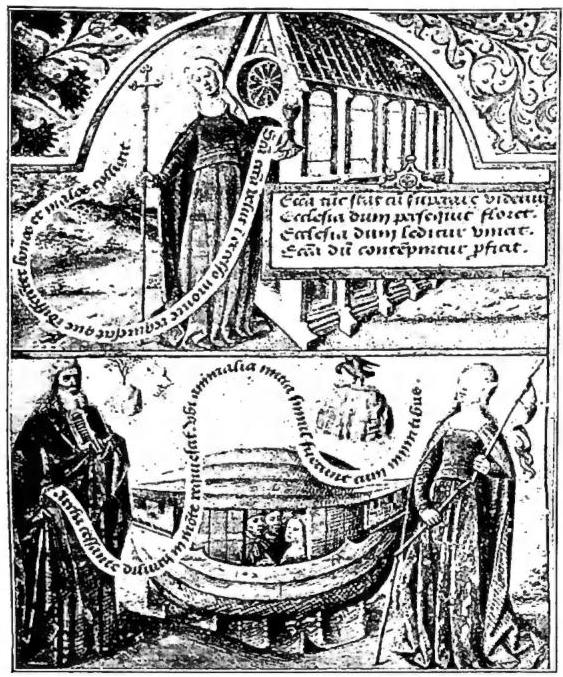
(from M. Vleberg, L’Eucharistie dans l’art, Paris 1916, p. 225)
SYMBOL AND SYMBOLISM — Symbolic representation of the Church and the Synagogue. Minister of a Missal according to Parisian usage (15th century) — Paris, Bibliothèque Mazarine, ms. 412, f. 4°.
Many of the actions of the Pharisees (to signify legal purity), Pilate’s washing of his hands (a symbol of innocence), etc., are symbolic. The symbolic action of Agabus (v.), who binds his hands and feet with Paul’s girdle, foretells Paul’s imprisonment (Acts 21:10–13).
The frequent use of symbolic actions by the Jews leads one to believe that certain strange actions of Isaiah (chap. 20), Jeremiah (chap. 19), and especially of Ezekiel (v.) and Hosea (v.), were truly performed. It may, however, be conceded that some of these actions were performed only in vision or were described merely as didactic parables. Scholars debate whether certain biblical narratives, especially those in the early chapters of Genesis, the books of Jonah and Tobit, should be interpreted, at least in part, as symbols.
1. Concepts
Since for the human spirit symbol is the most natural means of understanding and expressing spiritual realities, and since everything invisible and spiritual is manifested through sensible realities, it also has considerable importance for the knowledge and expression of religious realities, which are not revealed to man except through sensible realities and by means of them (cf. Rom 1:20). “The heavens proclaim the glory of God; the birds of the air and the lilies of the field evoke in the soul the idea of divine Providence” (cf. Ps 18:1 or Mt 6:26–30). Here we are not dealing with a simple conceptual or logical inference, but with a perception of a poetic kind.Symbolism has sometimes been expressed in Platonic terms (e.g., in Origen); it is, however, grounded in a metaphysical reality, the analogy between the different degrees of being, upon which the entire philosophy of the sign is founded (cf. St. Thomas Aquinas, Summa Theologiae, III, q. 60, a. 2–3).
The Bible brings a new enrichment to the notion of symbolism outlined above: not only is it known that it is natural for man, through sensible things, to attain knowledge of intelligible realities (St. Thomas Aquinas, loc. cit.), but also that creatures bear the mark and trace of the Creator impressed upon them, and that man in particular was created “in his image and likeness” (Gen 1:26). Hence human realities are naturally suited to signify divine realities. For this reason, human language can express in Scripture the Divine Revelation. And when “the Word became flesh,” there occurred the sensible manifestation (epiphany, theophany) of the mystery of God. He himself is the mystery of God (Col 2:2), that is, the manifestation of God through the sensible veil of the assumed nature, which both conceals and reveals Him at the same time. The Church and the Sacraments, which are the prolongation of the humanity of Jesus, Christian worship, and liturgy are further manifestations of this symbolism: even the Christian community rests upon a mass of symbols derived from the essential dogmas of creation, the Revelation of the Word of God, the Incarnation, and the Redemption that actually took place.
Of course, symbolism can have its dangers: it can lead a primitive religious mentality to identify the symbol with the reality (magic, idolatry), or, conversely, it can suggest to a rationalist spirit the idea of reducing it to a mere allegory or an empty sign. These dangers, however, should not lead us to underestimate the importance of this mode of expressing religious realities, which penetrates even into the mystery of the Incarnation itself. If the Word of God is manifested to man through the assumed humanity, His properties and activities (which might be called symbols), and if man, in turn, naturally employs symbols to express the knowledge he has received from God, then theology (θεολογία, discourse about God, treatment of God) can well be constructed on the foundation of such symbols. Alongside a theology of a logical and conceptual nature, the Church has known a symbolic theology (theological symbolism), the history of which must now be traced.
2. Historical development
It is not difficult to discover traces of theological symbolism in the history of Christian thought. St. Ignatius of Antioch sees in the bishop and in the visible hierarchy the image (τύπος) of God and of the invisible hierarchy (Magn. 6:1; Trall. 3:1). But such symbolism developed especially in Alexandria, where Neoplatonic influence and the “spiritual” exegesis of Scripture created a favorable environment for II. Clement devoted many pages to what he calls the symbolic genre (συμβολικόν εἶδος) (Strom. 2:1:1–2 sqq.; CB, II, 113 sqq.). Here we find both poetic or biblical allegory and properly religious symbolism. To know God, Who is transcendent, two paths are open to the human spirit: negation (negative theology, cf. e.g., Strom. 5:12:81–82; CB II, 380) and analogy, which gives rise to symbolism. Visible things have a spiritual sense and signify invisible things; the world, in its totality, is nothing other than a religious language, founded upon an ontological resemblance, more precisely upon exemplarism: the spiritual world is the archetype, the sensible world is the image of that model (Strom. 5:14:93; CB, II, 387). Clement was the first to outline a theory of religious symbolism: he especially discovered its psychological and pedagogical utility (Strom. 5:46:9–56–57; CB, II, 357, 364) and made wide use of it in the allegorical interpretation of Scripture. Yet he employed it very little as an instrument of theology. When he dealt at length with the mysteries, which can only be known mystically (Strom. 1:1:13; CB, II, 10), this was more out of literary reminiscence of the Eleusinian or Dionysian mysteries than for the purpose of theological elaboration. In particular, his sacramental theology, in which theological symbolism is most developed, is relatively poor.By contrast, in Origen, who is the first to make a complete and highly developed theological synthesis, symbolism was employed in a much more systematic way. Not only is his theory of the senses of Scripture imposed by the symbolism of human psychology (Scripture has three senses, just as man is composed of body, soul, and spirit), but his entire theology is constructed in every detail upon the notion of symbol (μυστήριον): “In sacramentis fiunt cuncta quae fiunt” (In Gen. hom. 9:1; PG 12, 211). The sensible world is made in the image of the intelligible world (In Lev. hom. 5:1; ibid., 447), the events of the history of Israel are the image of the soul’s journey toward perfection (In Num. hom. 27; ibid., 780–801), the historical life of Christ is the symbol of the life of the Church, the mystical body (In Joh. Com. 10:20; CB IV, 209), the visible Church is the image of the invisible and heavenly Church, its rites are the image of what takes place spiritually in the invisible Church: similarly, ecclesiastical reconciliation of the penitent is the sign of his return to the spiritual Church of the “saints” (K. Rahner, La doctrine d’Origène sur la pénitence, Paris 1950), and likewise the sacramental eating of the Body of Christ is the image of the spiritual eating of the Logos. The Logos manifests Himself under a threefold sensible aspect: of the Incarnation, of Scripture, and of the Church, which are therefore, in different respects, three symbols and mysteries of the Word.
This theology often lacks rigor and can disorient certain minds little sensitive to the notion of symbol; for this reason, Protestants regarded Origen as the theorist of a pure symbolic Eucharist (F. Loofs, Leitfaden zur Dogmengeschichte, Halle 1906, p. 212; A. Harnack, Dogmengeschichte, I, 4th ed., Tübingen 1910, pp. 476–78), and certain Catholics find themselves at a loss to respond (thus F. Prat, Origène, Paris 1907, p. 313; J. Tixeront, Histoire des Dogmes, I, 10th ed., ibid. 1924, p. 324; G. Bareille, Origène, in DThC, V, cols. 1138–39; P. Batiffol, L’Eucharistie, ibid. 1938, pp. 270–71). Yet it reveals no less an immense richness and gives to the “mystery” all its breadth and depth, sacramental and ecclesiological at the same time, offers all the elements of the sign, and opens the way to the theology, so fruitful, of the res et sacramentum.
The Latin Fathers made extensive use of symbolism outside of exegesis, especially with regard to the Sacraments, or rather the Sacramentum (or mysterium), because the concept of Sacramentum had a broader meaning than the word “sacrament” does today: it encompasses both the mystery of Scripture and that of the Incarnation, both the mystery of the Church and that of the Sacraments (cf. St Hilary’s De Mysteriis, St Ambrose’s treatises De Mysteriis and De Sacramentis, and De Incarnationis Dominicae mysterio). Already St Cyprian employed the symbolism of the Eucharistic elements to construct a theology of the Eucharistic Sacrifice and its ecclesiological significance (Ep., 63, 13: CSEL, 3, 712), just as the symbolism of Baptism, which is one, provided him with a way to illustrate the mystery of the Church’s unity (unitatis Sacramentum: Ep., 74, 11: CSEL, 3, 808).
St Augustine, who knew the works of St Cyprian and, through St Ambrose, had been influenced by some aspects of Origen’s thought, became for the West the initiator of a “symbolic” theology of the Sacrament, which fits into the theology of the sign (cf. De doctrina christiana, I, 2, 2: PL 34, 19-20). The Sacrament is a sign: a sacrum signum (De Civitate Dei, X, 5: CSEL, 40, 452; Ep., 138, 7: CSEL, 44, 131), whose value depends on an analogy and likeness to the thing signified (Ep., 98, 9: CSEL, 33, 531). The thing, the res, signified by the Sacrament is Christ.
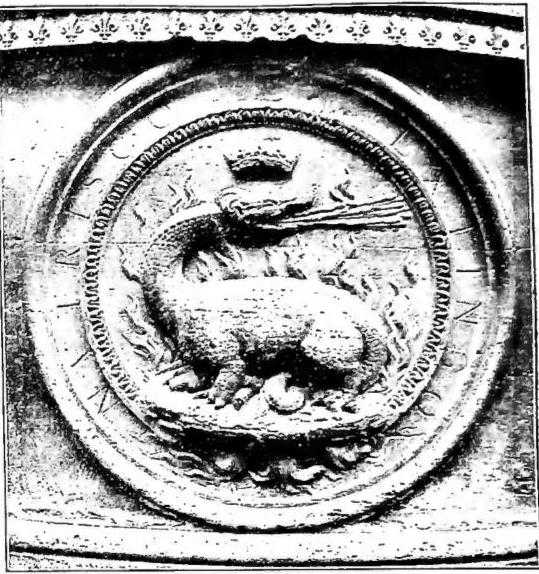
SIMBOL AND SYMBOLISM — The salamander, which was believed capable of living in fire and rekindling its flames, is a symbol of justice, constancy, and ardent love; for this last symbolism it was adopted by Francis I, King of France, as his emblem with the motto: “Nutrisco et extinguo.” Renaissance relief inserted on the façade of the church of S. Luigi dei Francesi in Rome.
In every aspect of its mystery, all the events narrated in the Old Testament are sacraments fulfilled in Christ (see the texts cited by Feret in the bibliography). Thus the Eucharist, to take this most important example, is the sign of Christ’s physical body, but also of His “ecclesiological” body, and the Eucharistic body is at once res et sacramentum. Following St Cyprian, St Augustine discovered in the Eucharistic elements the sacrament of the Church’s unity, the “mysterium... unitatis” (Serm. Guelf. 7, 2: ed. G. Morin, in Miscellanea Agostiniana, I, Rome 1930, p. 463). These texts, like those of Origen, perplexed some scholars who could not reconcile them within Augustine’s sacramental perspective and therefore arbitrarily distinguished in him between symbolism and realism. In this theology, without doubt, the causality of the Sacraments (vis, virtus) tends to recede into the background; yet for St Augustine the connection between sign and what it signifies (aliud videtur, aliud intelligitur; Sermo 272: PL 38, 1247) is not merely extrinsic: it rests upon an analogy of nature. Similarly, when St Augustine seeks to discover in human psychology images of the Trinity, he does not intend to offer a conventional illustration of the mystery; since man was created in the image and likeness of God, his soul must bear a vestige and sign of the Creator, which can constitute the best analogy for the revealed mystery. The ascent, therefore, from the sign to the divine reality of which it is a symbol is theological symbolism in the strictest sense of the term. It was precisely this symbolism that enabled St Augustine to pass from believing to understanding (De Trin. XV, 1, 1: PL 42, 1057), which properly constitutes the work of the theologian.
The influence of Augustinian symbolism endured throughout the Latin Middle Ages. It must, however, have occasioned disorientation, revealing the difficulties that arise in maintaining a fully balanced theological position. In the 9th century, Paschasius Radbertus bent Augustinian Eucharistic theology toward realism (De corpore et sanguine Domini, n. 831) and pushed forward a clear development of theological elaboration, rigidly fixed in the richness of symbolism. Opposing him in a work of the same title, Ratramnus (859) argued, as it seems, that if Christ’s body is present in mysterio, this is only as the figure or the power of the body. When in the 11th century Berengar, denying what was later called transubstantiation, appealed to St Augustine and his definition of the sacrum signum, the rationalist tendencies of his thought and his rigid dialectic have nothing in common with the theological elasticity of the Fathers. Though he denied transubstantiation and remained quite imprecise regarding real presence, he was not a symbolist in the manner of Origen and Augustine. Thus the theology of the patristic or monastic type, steeped in Scripture and symbols, gradually gave way to a “scientific” theology of a conceptual and deductive kind (M. D. Chenu, La théologie comme science au XIIe siècle, Paris 1943). There was genuine progress, achieved not only under the influence of historical contingencies (the introduction of Aristotelianism) but also through the impulse of human reason, which seeks to give its faith a scientific structure so as to grasp its full intelligibility.
The great scholastic doctors, however, did not thereby lose the riches of the Augustinian tradition. The sacramental theology of St Thomas Aquinas is entirely founded on the notion of sign (Sum. Theol. 3a, q. 60, a. 1), and here the Summa, in contrast to the Commentary on the Sentences, which depends entirely on Hugh of St Victor, indicates a return to the Augustinian conception; it then completes the full elaboration of the notion of res et sacramentum, already sketched by Origen and Augustine, then by Peter Lombard, and based entirely on a twofold symbolism (ibid., q. 63, a. 3). Thus his theology of the Eucharist, which undoubtedly centers on transubstantiation and real presence (ibid. qq. 75, 76, 77), remains faithful to the Augustinian tradition regarding the ecclesiological and eschatological symbolism of Christ’s body (Eucharistia est Sacramentum ecclesiasticae unitatis, ibid., q. 73, a. 2; res huius Sacramenti est unitas corporis mystici, ibid., q. 73, ad 3; cf. q. 73, aa. 4, 5, 6; q. 74, a. 1). Similar observations could be made regarding many questions in the Summa: those, for example, dealing with the work of the six days (Sum. Theol. 1a, qq. 68–74), or the Old Law (ibid., 1a–2ae, qq. 98–105), or the rites of the Mass (ibid., 3a, q. 83; it is easy to see that St Thomas studies the Eucharistic sacrifice precisely from this point of view). The theological synthesis of St Thomas, raised to the highest degree of rigor and scientific precision, gave religious symbolism its proper value. This equilibrium was not to last: classical theology tended to ignore the full richness of symbolism, which surfaced in certain arbitrary allegorical exegesis or in certain explanations of the rites of the Mass (already in Amalarius), both so far removed from true liturgy and from the true spiritual sense of Scripture. A revival of theological symbolism can, however, be noted in certain positions that are, moreover, far removed from the symbolism of the Fathers.
Some leaders of the “Reformation,” such as Zwingli and Calvin, who denied real presence, saw in the Sacrament of the Supper nothing more than the image or figure of the crucified and risen Christ. “Our Lord Jesus Christ has left to His Church, His spouse, His image in the Sacrament of the Supper” (Zwingli, Corp. Ref., IV, iv, 858); Jesus instituted and gave to His disciples “the figure of His Body and His Blood” (Calvin, Institution chrétienne, IV, 18, 19 and 20). Calvin could even appeal to certain expressions of the Fathers (some liberal Protestants interpreted Tertullian, Origen, and St Augustine in this sense), but in reality this does not correspond to their thought, which never opposed symbol (image) to reality.
Quite different is the “religious symbolism” or “symbol-fideism” that emerged at the end of the 19th and the beginning of the 20th century. Drawing on the thought of Schleiermacher, some Protestant theologians, for example A. Sabatier (1839–1901) and E. Ménegoz (1838–1921), regarded our religious concepts as necessarily inadequate to their object, mere symbols. Dogmas are symbolic expressions not of the objective and transcendent religious reality itself but of our religious experience. This, and nothing more, can be demanded of the Fathers. Certain modernists, for example M. Hébert (1851–1916), adopted this position again: dogmas are nothing but symbols by which the human spirit expresses to itself the moral truths by which it must nourish its action. This tendency is clearly condemned by the encyclical Pascendi Dominici gregis (Denz.-U., 2079).
L'encicl. Humani generis (12 ag. 1950) ha fatto allusione a coloro i quali ritengono che «transubstantiationis doctrinam, utpote antiquata notione philosophica substantiae innixam, ita emendandam esse ut realia Christi praesentia in S.ma Eucharistia ad quendam symbolismum reducatur, quatenus consecratiae species, nonnisi signa efficacia sint spiritualis praesentiae Christi, eiusque intimae coniunctionis cum fidelibus membris in corpore mystico» (AAS, 42 [1950], pp. 570-71). Ridurre così il simbolismo eucaristico a non essere più che il segno di una presenza «puramente spirituale» sarebbe abusare delle formole di s. Agostino, e compromettere il dogma della presenza reale.
3. Conclusione
Si è mostrato che il simbolismo teologico è un elemento importante del pensiero cristiano; è da deplorare che uno spirito assai acuto, un razionalista, non l'abbia apprezzato o l'abbia anzi deformato fino al punto di metterlo in opposizione al realismo della fede. Si deve confessare che il pensiero moderno è divenuto estraneo a un tal modo di esprimersi. Già Harnack l'aveva notato a proposito di Origene: «Noi, oggi, intendiamo con il nome di s. una cosa che non è quella che essa significa; una volta, invece, si intendeva per s. una cosa che era, in qualsiasi maniera, realmente ciò che essa significava» (Dogmengeschichte, I, 4a ed., Tubinga 1910, p. 476). In tale osservazione si trova la spiegazione del profondo significato del simbolismo teologico degli antichi, come pure la spiegazione del processo di deformazione a cui l'hanno sottoposto i moderni. Se, pur conservando le esigenze razionali e realistiche che sono il magnifico risultato della teologia scolastica, si potesse ritrovare questo senso del s. e del «mistero», un incalcolabile beneficio ne deriverebbe al pensiero religioso che potrebbe così avvicinare certi spiriti moderni, più sensibili di una volta all'espressione simbolica e artistica; pertanto il rinnovato contatto con la Scrittura, i Padri e la liturgia (s. Tommaso non l'aveva mai abbandonato) non può essere per la stessa teologia scolastica che un fecondo arricchimento.Tommaso Camelot
IV. SACRED SYMBOLISM AND LITURGICAL SYMBOLISM
I. Specific Character of Symbolism
Liturgical symbolism differs from religious symbolism in general and from every other kind of human symbolism by the fact that it symbolizes and represents truths, realities, or concepts and ideas of a supernatural order.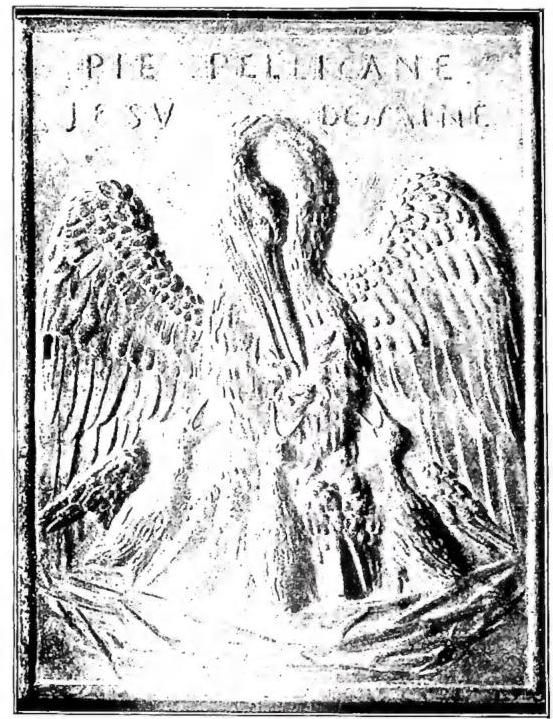
(courtesy of Mons. G. Faltani)
SYMBOL AND SYMBOLISM — The Pelican, considered as a symbol of the Eucharist. Tabernacle door, work by V. Crocetti (1950). Rome, University Chapel.
The term symbol (from Greek σύμβολον, σύμβολον, “token, pledge”) denotes both the thing that serves as a sign and the reality it represents. In liturgical usage, the symbol is not merely a sign but also a means through which grace is conferred, as in the Sacraments. This double aspect is evident in the ancient liturgical prayers (Oremus) that accompany sacramental rites. For example, the old Oremus used on the feast of the Beheading of St John the Baptist, drawn from the ancient Gelasian Sacramentary (cod. Vat. Rel. 316), says: “Grant us, O Lord, that the solemnity of St John the Baptist may enable us to venerate with reverence the sacred mysteries we have received and to rejoice that they are more fully accomplished in us.” Similarly, the fifth Oremus for the Blessing of Palms, which appears only from the 11th century onward, contains the felicitous formula “factum et significatum,” thus uniting the two elements that constitute liturgical symbolism: the thing serving as the symbol and the supernatural truth or reality it represents. As in the Sacraments, this includes a supernatural action wrought in man through the symbol, that is, through the Sacrament or sacramental, which is the real vehicle of grace. St Gregory the Great repeatedly insists on the religious, scriptural and liturgical symbolism of the divine word. One example suffices: in Homily 11 on the Gospels he begins with a descriptive definition that applies to all other cases: “The kingdom of heaven... is therefore compared to earthly things so that from what the mind knows it may rise to what it does not know, so that by the example of the visible it may be drawn to the invisible” (PL 76, 1114-15).
The Middle Ages, building on this foundation, cultivated liturgical symbolism with such predilection that it ended in exaggerations and arbitrary, artificial interpretations. Attempts were made to find symbolism in things, actions and words that had none at all: for example, when every part and action of the Mass was seen as corresponding to the Passion of the Lord, a correspondence that does not in fact exist. The initiator of these exaggerated symbolic interpretations was Amalarius, followed by almost all the most notable medieval treatises, such as Honorius of Autun, Sicard of Cremona and William Durandus. It is therefore no wonder that with Humanism and the Reformation religious and liturgical symbolism fell into disrepute. With recent and more thorough studies of liturgy and religious psychology, a proper re-evaluation of religious, and especially liturgical, symbolism has begun to gain ground, and it is hoped that in a future reform true and sound liturgical symbolism may be restored to new vitality, as has been successfully done, for example, in the reform of the Easter Vigil.
4. Things
In the liturgy a great variety of things are used in many different ways: vestments, furnishings, utensils, liturgical buildings, objects from the plant or animal kingdoms or the insensible world, works of art, etc. Many of these “things” are also necessary for ordinary daily human life: water, light, fire, house, clothing, food, etc. Some are used without any symbolic intention, while others, even in civil and everyday use, are not free from symbolic associations and interpretations. One need only recall the universal symbolic significance of water, light, fire (fusion), salt as a preservative, certain flowers or trees (lily, rose, violet, palm, laurel, etc.), and certain colors (with meanings varying according to the usage of different peoples). Many of these symbolisms arise quite naturally from the original purpose of the things themselves; others are more conventional, depending on differing psychological determinations proper to various populations (black as the color of mourning among Indo-Europeans, white among the Chinese, Japanese and neighboring peoples; the kiss as a sign of love and tenderness among Eurasian peoples, but unknown among Negroid populations, etc.). Many such symbolisms, natural and common in themselves, have also passed into worship among the same peoples and, consequently, into the worship of the Catholic Church. Many of them were later formed through the interpretive work of liturgists, especially medieval ones, beginning with Amalarius (9th century). Often a thing used in the liturgy, originally without any express symbolism, was later honored with a special blessing, and this quickly led to a symbolic interpretation: this is the case with many sacramentals.A few notes on the best-known symbols will be helpful:
a) Light. — Symbol of God and especially of Christ (Paschal candle), of Faith, of the enlightenment received in Baptism; also a symbol of offering and sacrifice, as the luminous matter is consumed in its own flame (Eucharistic lamp). The use of illumination, necessary in itself, soon acquired a symbolic interpretation, as in antiquity: the illumination of cities on the holy night of Easter.
b) Sun. — The great solar lamp, in all religions, holds special importance, being itself deified or at least considered a symbol and image of divinity. Christianity, uniting the pre-existing reality of solar symbolism, so widespread, with the supernatural reality, and following directly the direction given by the Lord Himself, who presented Himself, humanly speaking, as “the light of the world,” made particular use of solar symbolism, especially felt in antiquity, much closer to us than to the various solar cults that flourished in ancient paganism (cf. J. Dölger, Sal und Salbung).
c) Water. — Also widely used symbolically and subject to broad symbolic interpretation in all religions, it is employed by Christianity (preceded by the Synagogue) in its rites as a sign of lustration and purification, accompanied by various blessings and giving rise to various kinds of holy water, from ordinary blessed water to waters with admixtures of other substances (ashes, balsam, etc.) for solemn lustrations and in various consecrations (churches, bells, etc.).
d) Salt. — Salt is widely used in Catholic liturgy, especially because of its quality as a preservative, whereby it has become a symbol of “wisdom” that preserves from “insipience” and of all supernatural gifts (grace, virtues) that preserve the soul from sin and the influence of the “world.” Hence the use of salt in baptismal rites and in the blessing of various holy waters. By contrast, the ancient and common use of salt as a sign of barrenness (sprinkled over cities destined for destruction and annihilation) did not enter into ecclesiastical symbolism.
e) Incense. — Incense and incensation (commonly used not only in ancient pagan cults but also in the ceremonial of ancient courts, since princes, first Oriental and later also Roman, were considered representatives of the divinity) passed into the use of the Church with the same traditional religious symbolic meaning, as a sign of veneration toward sacred persons (the pope, the priest as representative of Christ in liturgical celebration) and also as a sign of civil veneration, that is, of distinction (this being the original origin of the incensation of sacred persons); it was also used for sacred things, whether blessed or consecrated and otherwise sacred: hence the use of incensing things immediately after their blessing (branches, candles, ashes, etc.), the extensive use of incense and incensation in major consecration rites (church, altar, bells, etc.), and the incensing of certain things, objects or sacred vessels during various functions, especially at Solemn Mass (the Book of the Gospels, the altar, the Sacred Species during the Consecration).
f) Among the sacred objects that have gradually been filled with symbolism, the sacred building, the church, with all its furnishings, and above all the altar, as the place of sacrifice and the central point of the church, stand out. However, the primitive symbolisms surrounding the church and altar are relatively few and quite natural: the church (building) as a visible sign of the invisible Church whose earthly portion it encloses in the liturgy, namely, the community of present-day Christians; and the altar as a sign and image of Christ. But soon, from the 3rd century onward, when the grand rites of the consecration of churches and altars developed, symbolisms multiplied, and the Middle Ages succeeded in attributing a symbolic interpretation to everything, often highly recherché and artificial (cf. J. Sauer, op. cit. in bibl.).
3. Persons. — Symbolism soon took hold of sacred persons, that is, those consecrated to the celebration of the divine mysteries, namely, those engaged in worship, beginning with the people themselves, the singers, the various sacred ministers, up to the highest ranks. The fundamental symbolism, which is largely based on revealed truths and thus on invisible realities, is that of the representation of Christ, the Apostles or disciples of Christ, and the Church as the community of the faithful and the figure of the future eternal Jerusalem. Here too the Middle Ages went far in explanations and interpretations, even arbitrary ones; yet the real foundation mentioned above always remains, by which the entire sacred community, including the presiding celebrants, is surrounded by rites and ceremonies that are in turn symbolic and representative (kisses, reverences, bows, genuflections, incensations, etc.). Even the vestments worn by those engaged in worship soon received symbolic (mystical) interpretations, especially in the Middle Ages. The arrangement of sacred vestments and their decoration, as well as the canon of liturgical colors, also partly depends on these symbolisms. Certain sacred persons, among whom princes (emperors, kings) were enumerated from the early Middle Ages onward, then received a special consecration or blessing, rendering them capable of acting and functioning according to the demands of their office; some of these transmissions of office and dignity are, in the Church, true Sacraments by divine institution (v. below), while other constitutive and sacramental blessings are not.
4. Numbers. — A certain importance in liturgies is held by the symbolism of numbers, a universal human element from the very dawn of humanity. According to the very ancient and widespread use of the duodecimal system, the numbers 3, 4, 9, 12, 24, etc., are commonly valued. The Old Testament knows and amplifies this symbolism with the numbers 7 and 40 and others of lesser importance. The same numbers pass into the symbolism of the New Testament and thus into the liturgy, though often with a new foundation drawn from Revelation, such as the Most Holy Trinity, the seven Sacraments, the twelve Apostles, the twenty-four elders, and so on. Some liturgical elements are explicitly based on the symbolism of numbers, such as the ternary or triple ternary of litanic invocations (the Kyrie), the seven candelabra in the ancient papal liturgy, later adopted in the episcopal rite, the twelve crosses in the consecration of churches (the Apostles, the gates of the heavenly Jerusalem), and many others.
5. Animals. — Antiquity and the Middle Ages insisted greatly on animal symbolism; one need only consider the Physiologus and medieval bestiaries, Romanesque and Gothic sculpture, and the animal figures in the initials of Lombard, Irish, and Romanesque manuscripts. The lion, symbol of Christ himself but also of the devil (a typical example of multivalent symbolism), the fish, the sheep, the eagle, later the pelican, the fox and the hare, the serpent—all display a wealth of symbolism that finds wide application especially in sacred art, and at times and for certain categories also in liturgical formulas.
6. Sacramental symbolism. — In the administration of the Sacraments properly so called, one must distinguish between accidental and secondary symbolisms and true sacramental symbolism in the strict and direct sense. The Sacraments of the Church, by immediate divine institution, since they produce supernatural and in themselves invisible effects, have been bound to visible signs or symbols so that they might become perceptible to men; these signs not only signify but also, normally—unless there is a peremptory obstacle—effect the specific sacramental grace, in conjunction with the sacramental form that determines and circumscribes the efficacy of the external sign (action). Here we are confronted with true symbolism, or imaginative representation through an external act that has a natural and direct relationship of similarity or affinity with the thing signified. But this sacramental-symbolic act, which together with the form constitutes the Sacrament, is then surrounded and enriched by a greater or lesser quantity of other symbolic actions that are not essential to the Sacrament itself but belong to its liturgical execution. The most common sacramental symbol is the laying on of hands or of a hand, as a sign and testimony of the transmission or exercise of a power or faculty with respect to the person to whom it is applied (Penance, Holy Orders). In Baptism the sacramental symbol consists in immersion in water (burial) and emersion (resurrection); in the Eucharist it is constituted by the form of a sacrificial banquet, while the sacrifice is represented under the form of two separate sacramental species; anointing with oil, on the other hand, is the sacramental symbol in the anointing of the sick, a sign of the healing of the soul from sin and its consequences.
Sacramental symbolism, over the centuries, has undergone variations and evolutions, sometimes even in the form of simplification or reduction, unfortunately not always without loss of immediate perception of the symbolism itself, that is, of the image. Thus, for example, the essential rite of Baptism has today commonly been reduced to the form of a rapid ablution of the head; yet, as is clearly evident from the primitive sacramental ceremony and from the dogmatic explanations of St. Paul (especially Rom. 6), the sacramental symbolism of Baptism consisted in complete immersion under water, followed by emersion, as a real and concrete image of the burial of Christ under the earth and of His subsequent resurrection. The true and fundamental symbolism of Baptism, with the present rite of ablution, has become so weakened, both among the faithful and among priests, that it is no longer perceived: in its place has come the idea of washing, a symbolism that retains something of the primitive. St. Thomas (Sum. Theol., 3°, q. 66, a. 8) summarizes the question of the sacramental symbolism of Baptism in these terms: “It must be said that immersion more expressly represents the figure of Christ’s burial, and therefore this manner of baptizing is the most praiseworthy and common. But in other modes of baptizing something of the symbolism is also represented, though not so expressly. For in whatever way ablution is performed, the body of man or some part of it is placed under water, just as the body of Christ was placed under the earth.”
The question of sacramental symbolism today, in the climate of liturgical restoration and from a particular pastoral perspective, acquires a new importance, all the more so as the present generation is generally less capable and inclined toward such symbolisms.
(da E. de Lorey, Le Bestiaire de l'Escurial, in Gazette des Beaux-Arts, 1863, p. 329)
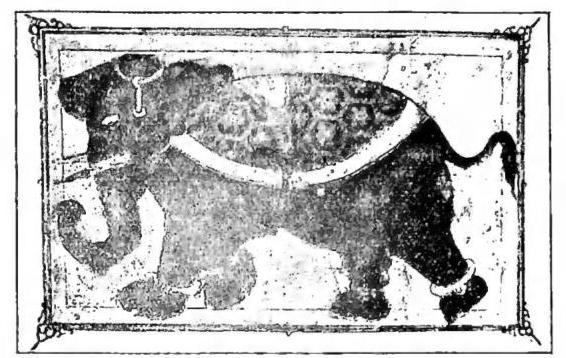
SYMBOL AND SYMBOLISM — Elephant, symbol of chastity, according to the Physiologus and the Bestiaries. Miniature from an Arabic bestiary illuminated by 'Ali ibn Mohammed (1354) — Madrid, Escurial Library, Arabic codex 898, f. 16.
V. SYMBOL AND “SYMBOLISM” IN LITERATURE — Designation of a group of kindred poetics that appeared and were formulated in France between 1870 and 1890, arising from a progressive distancing from decadentism. In 1885 J. Moréas, replying to P. Boudier who had accused Verlaine, Mallarmé and their circle of “decadentism,” defined such poets as symbolistes. Not to be overlooked is the contribution of an earlier, more widespread knowledge of Far Eastern literatures.
Symbolism drew from poetry, to which it turned its gaze (that of Baudelaire, Verlaine, Rimbaud, Mallarmé), an attitude and an expressive category—the elaboration of the symbol, the “correspondences”—eternal in themselves—and proposed them to new poetic personalities (those of Verhaeren, Jammes, Claudel, Apollinaire, George, Yeats, Hofmannsthal), each of whom, in varying degrees, by different paths, and with manifold connections, would give expression to the theme. It influenced other poets as well, such as Gide, Proust, Ibsen, Blok, Bal’mont, Valéry, Rilke, Wilde, Swinburne, whose poetic centers are more or less distant, of different traditions and hues.
Schematically, one might discern the “seal” that symbolism impresses on image, rhythm, sound, etc., in the “disembodiment” of these elements, which in reality brings it closer to Parnassianism—against which it intended to react—and (what is more distinctly its own) in loosening their traditional relationships, thus proposing new associations. In its more debased forms, therefore, symbolism lapses into impotence chiefly through a lack of rhythm, harmony, and order, through meager rational abstraction and nebulousness. The poetry that draws inspiration from it, or takes it as its historical basis, is marked by a new horizon and has accustomed contemporary man to seek (among other things, through the vigilant effort to renew, in poetic tone alone and in position alone, words now worn out) new ways of approaching the relationships between subject and object, between the contingent and the absolute. This latter impulse has created lively affinities between symbolism and certain spirits particularly sensitive to the religious problem. Symbolist poetry sets vibrating in vast and silent spaces simple rhythms, pared-down melodies, and few essential images. Also noteworthy is the new meaning that symbolism gives to emptiness, namely (as Rilke has noted) not the description of the object, physical or spiritual, but of the contours it leaves marked in physical and spiritual space, ambient and distant (one need only recall Mallarmé’s Igitur). As no less a consequence, it has necessitated a new reflection on the limits, or the difficulty of establishing them, between poetry and that quid which might be called sub-poetry.