
ARISTOTELIANISM. —
1. MEDIEVAL A
An event of primary importance in the development of medieval thought, destined to produce consequences of the first order in intellectual life, was the encounter, in the 13th century, between the masters of the University of Paris and Arab and Jewish Aristotelian philosophy. For the first time, Christendom—until then Platonizing and Augustinian in tendency, with a typically theological mentality—found itself confronted by the formidable scientific and philosophical synthesis of Aristotle, of naturalistic inspiration, which for several reasons could be said to conflict with its vision of life. A. constituted a genuine surprise for the masters of the Faith, and the appearance of his doctrine upon the tranquil surface of the theological waters gave rise to one of the most painful struggles remembered in the history of culture.Around 1200 most of Aristotle’s works had already been translated into Latin. Of the Organon, we know that the Logica vetus had been translated by Boethius, and that it was already in circulation in the 12th century. Gerard of Cremona (d. 1187) and Henry Aristippus (d. 1162) translated, the former from Arabic and the latter from Greek, almost all the Libri naturales. In the 12th century, translations of the Physica, the De anima, and a partial translation of the Metaphysica (books I–IV, 4: Metaphysica vetustissima) and of the Ethica nicomachea (books II and III: Ethica vetus) also became known. Moreover, Porphyry’s Isagoge, Boethius’s commentaries on the Categoriae and De interpretatione, Themistius’s commentaries on the Analytica posteriora, Alfarabi’s Distinctio super librum Aristotelis de naturali auditu, Avicenna’s Parafrasi, and so forth, all made a significant contribution to the dissemination of knowledge of Aristotle.
At the beginning of the 13th century, Aristotle’s penetration into the Latin world must already have been well advanced, since the Council of Paris of 1210 (Chartularium Univ. Paris, I, p. 70, n. 11) and the ordinances of the papal legate Robert of Courçon of 1215 (ibid., I, pp. 78–79, n. 20) prohibited the teaching of the Libri naturales and their commentaries. We also have a letter dated 7 July 1228 from Gregory IX, addressed to the professors of theology at the University of Paris (ibid., I, pp. 114–16, n. 59), in which profound concern is expressed regarding the invasion of philosophy into the field of the sacred sciences: the Pope asserts that theology is the queen of all knowledge and that philosophy, in relation to it, has only an ancillary function. In 1229, on the occasion of a serious crisis that had broken out within the University of Paris, the University of Toulouse was founded, where, among the subjects
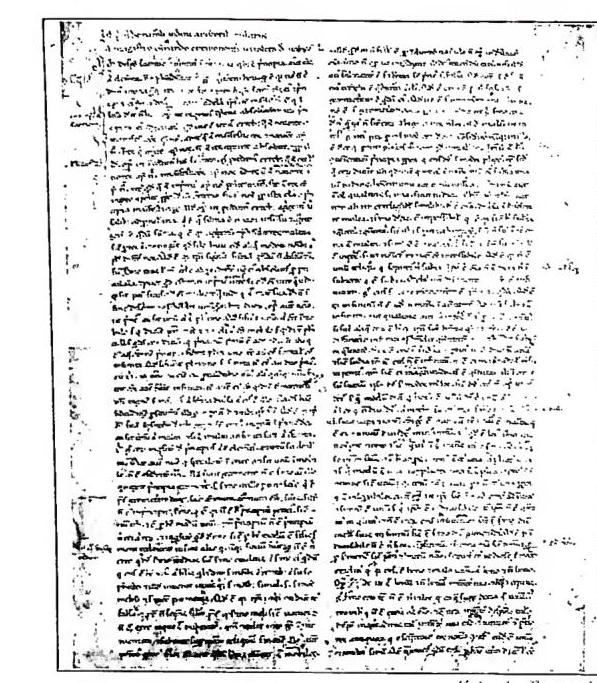
ARISTOTLE — Incipit of the book De naturali auditu, translated from Arabic by Gerardo di Cremona. Parchment codex (13th–14th century) — Aosta, library of the Major Seminary.
In a letter of 13 April 1231 (ibid., I, p. 138, no. 79), Gregory IX, in the letter of 12 [April] 1215 against Aristotle’s Libri naturales, declared them prohibited “quousque esaminati fuerint et ab omni errorum suspitiunt purgati”. Indeed, in a letter of 23 April 1231 (ibid., I, pp. 143–44, no. 87), the Pope appointed a commission charged with this correction of the Stagirite, with a view to his better use for the purposes of Christian science. This commission evidently failed to complete its work, since we possess a letter of 22 September 1245 from Innocent IV, which still prohibited the teaching of the natural books “quousque esaminati fuerint” (ibid., I, pp. 185–86, no. 140).
The introduction of Aristotle into the University of Paris thus encountered difficulties until around 1245. The persistence of this distrust of the Libri naturales may also have been due to the arrival of Averroes’s commentary, which Michele Scoto began to translate (cf. R. De Vaux, La première entrée d'Aristote chez les latin, in Revue des sciences philos. et théol., 27 [1933], pp. 193–245), and which definitively entered the philosophical library of the Latins around 1235. The translation of Averroes constitutes the most important cultural event of the first half of the thirteenth century. Through it, the Latins came into contact with a thinker of very great talent, a fanatic of Aristotle, whose immense scientific encyclopedia he had commented upon almost in its entirety. Averroes emphasized certain naturalistic positions of the Stagirite and, in psychology, professed human monopsychism. This thesis, contrary to the Christian dogma of the survival of the individual soul, soon became the center of disputes, rebukes, and official interventions by ecclesiastical authority, which certainly made the acceptance of Aristotle’s teaching in the schools increasingly difficult (v. AVERROISMO).
The commentaries of Roger Bacon (ca. 1245) on Aristotle and on Proclus (Liber de canis) constitute the earliest document attesting to the teaching of the Physica and the Metaphysica at Paris. Officially, A. entered all the faculties of arts in 1255 (statute of 19 March). Almost simultaneously, Albert the Great began publishing his monumental paraphrases of the various Aristotelian texts in the manner of Avicenna, with the effect of rapidly disseminating the Stagirite’s vast learning among the Latins. Albert’s paraphrase, besides being a work of dissemination, also represents the first serious attempt to rethink Peripateticism in Christian terms. Albert must therefore be considered the true founder of Christian Aristotelianism.
But the most complete and enduring synthesis, one that far surpasses Albert’s reworking and reveals the originality of genius, is that of St. Thomas Aquinas, Albert’s disciple. He rethought Aristotle by drawing upon ancient and contemporary Neoplatonic and Christian authors, thereby bringing into being an entirely new philosophical system, which can best be designated by the name of “Thomism” (v.), although its principal framework is constituted by Aristotelian and Christian elements. Thomism represents, we may say, the fullest expression of orthodox and moderate Aristotelianism, while Averroism represents its radical and heterodox current.
Heterodox Aristotelianism, or Averroism, suffered two condemnations by the bishop of Paris, in 1270 and 1277. Among the theories condemned in 1277 were certain Aristotelian propositions accepted by St. Thomas. This, however, was to be the last revanche taken by the still Platonizing masters of theology against moderate Aristotelianism, because, thanks especially to Aquinas, it was introduced into all the schools and became an integral part of the Church’s official science, both philosophical and theological (scholasticism).
v. in its various annual volumes
For the historical documentation: H. Denille and A. Chatelain, Chartularium Universitatis Parisiensis, 4 vols., Parisi 1889–97; idem, Auctuarium Chartularii Universitatis Parisiensis, 4 vols., (the 3rd and 4th edited by C. Samaran and E. R. van Moo), ibid. 1894–1958. Gerardo Brun2. MODERN ARISTOTELIANISM
In this period of the development of Aristotelianism, the issue is no longer its integral revival, but rather a philosophical conception of the world, elaborated more or less systematically on the basis of certain fundamental Aristotelian elements. The various philosophers proceeded according to different criteria and with different aims, in accordance with the various historical, cultural, environmental, and religious requirements.We may distinguish various stages in this development, which, however, from the problematic and historical-evolutionary point of view, are not closely connected with one another: 1) Italian neo-Aristotelianism of the Renaissance, with analogous (but weaker) movements in France, Spain, and England; 2) scholastic Aristotelianism; 3) Protestant Aristotelianism; 4) the Aristotelian revival in the nineteenth century, which, in its various aspects—systematic, interpretive, and historical—continues to the present day.
3. Italian Neo-Aristotelianism of the Renaissance
The motives that stimulated the first phase of Aristotelianism may be divided into two categories. The first comprises the various material-formal or problematic-methodological connections with scholasticism. Renaissance philosophy, in fact, with its intention of establishing a new methodological foundation for its vision of the world, may in a certain sense be regarded as a continuation of scholastic thought, insofar as it adopted from it certain groups of fundamental problems—logical, criteriological, and metaphysical, though not so much ontological problems—which required profound reflection on methodological principles; a requirement that was felt even more strongly in the natural sciences. The second category of motives comprises the various influences arising from contact with Eastern Aristotelianism and with the lively discussions taking place among Arab philosophers concerning its meaning and value, especially in comparison with Platonic philosophy. It is precisely these influences that largely determined the singularly polemical and syncretistic character of Renaissance Aristotelianism. Following the contacts with Eastern literature, the problem arose of a double Aristotelianism, namely Averroistic and Alexandrist, which made the task of the Renaissance Aristotelians of discovering the genuine Aristotle extremely difficult, since the translations and commentaries, reflecting the thought of one or the other tendency, did not lead to absolute objectivity. (The principal translators of the period were: Bessarione, T. Gaza, Argiropulo, Giorgio di Trebisonda, L. Bruni, E. Barbaro.)The renewed Aristotelianism found support and scholarly cultivation especially at Padua (with branches in Bologna, Pavia, Ferrara, Siena, and Naples), where the tradition of Averroistic Aristotelianism had been preserved. Pietro d'Abano (v.) is to be regarded as the first representative of Averroistic influence at the University of Padua. Essentially a compiler, his translations are of no importance; he nevertheless deserves credit for having introduced the pseudo-Aristotelian Problemata into the Western philosophical milieu. His principal work, Conciliator differentiarum philosophorum et praecipue medicorum, remained widely used up to the humanist period. Pietro’s relationship to the fundamental ideas of Arabic philosophy (e.g., the eternity of the world and of matter), and particularly to the Averroistic theory of the unity of the intellect, remains obscure.
Nevertheless, despite every enthusiasm for the authority of Averroes, Pietro never upheld or promoted Averroistic ideas with the boldness that characterized the leader of the Parisian Averroists, Giovanni di Jandun, and his friend Marsilio da Padova. Giovanni defended the eternity of the universe and of motion, like the Stagirite and the Arabs, and forcefully affirmed the principle of double truth. He combined Averroistic ideas with a skepticism that prevailed without reservation in the field of metaphysical psychology. Together with Marsilio, Giovanni also developed an unorthodox ethical-political Aristotelianism. Paolo Veneto (d. 1429), known for his rather encyclopedic commentaries on Aristotle’s Physics, also understood Aristotelianism in Giovanni’s spirit; his logical works (with some Occamist influence) were officially imposed at Padua.
A disciple of Paolo Veneto, Gaetano da Thiene (d. 1465), later a professor at Padua, attempted to reconcile Averroism and ecclesiastical doctrine. Along the same line of oscillation between reason and faith, between Aristotle and Averroes, proceeded A. Achillini, N. Vernia, A. Nifo, and M. A. Zimara. Zimara’s attempt to interpret the unity of the human intellect as the unity of the universal principles of knowledge is noteworthy.
During this period, the first typographical edition of Averroes was also published at Padua, in 1472.
Meanwhile Alexandrist Aristotelianism began to emerge. It connected itself with Aristotle through the Greek commentators, especially Alexander of Aphrodisias, and displayed distinctly deistic-naturalistic tendencies, in contrast with the somewhat mystical-pantheistic tendencies of Averroism, with which it nevertheless agreed in denying the possibility of miracles and the immortality of the individual soul in an absolute sense. The founder of this Pomponazzi (v.), to whom the greatest crisis of Averroistic Aristotelianism is attributable.
Pomponazzi’s influence was considerable. Among his disciples we may mention S. Porta, G. Contarini, later his opponent, and the Spaniard Sepúlveda. A. Cesalpino, an Aristotelian who cannot be precisely classified as either an Averroist or an Alexandrist, depended on S. Porta, but also on Nifo. Even the best-known Aristotelian of the sixteenth-century school of Padua, G. ZABARELLA, GIACOMO (v.), famous for his logical writings, is now counted among the Averroists and now among the Alexandrists. The successor to his chair, C. Cremonini (“the Aristotle reborn,” 1550–1631), proclaimed even more explicitly than Zabarella the autonomy of physics as a science,
in accordance with the principles of genuine Aristotelianism, and its requirement that it be founded exclusively upon experience.
While these struggles concerning Aristotle’s logic, physics, and method were taking place, the Poetics achieved a triumph. In 1498 Giorgio Valla produced its first translation. Various editions and translations subsequently appeared through the work of A. de Pazzi, F. Robertello, B. Segni, P. Vettori, L. Castelvetro, A. Piccolomini, and L. Salviati.
Toward the end of the fifteenth century, Aristotelianism experienced a revival in France with G. Lefèvre d’Etaples (Faber Stapulensis), a commentator on Aristotle’s writings who purified him of scholastic “falsifications,” and with his disciple C. Bouillé, who attempted a singular fusion of Aristotle with the Neoplatonism of Cusanus.
In England a strong Aristotelian tradition was always maintained, at least in the general questions of philosophy and metaphysics, until the middle of the seventeenth century. Its principal center was Oxford, with I. Sanderson, I. Case, R. Crakanthrop, T. Wilson, and R. Lever; M. Carpenter was important as a metaphysician; K. Digby attempted to reconcile the fundamental metaphysical ideas of the Peripatetic tradition with the Cartesian current and the new natural science. Even in F. Bacon, the study of nature remained closely connected with the Aristotelian-scholastic horizon.
The revival of Aristotelianism was obstructed throughout this period by serious conflicts to which it eventually succumbed. The representatives of Platonism, not without success, sought to demonstrate that Plato was more consonant with Christianity than Aristotle. One of the most characteristic works in this controversy is the violent pamphlet De platonicae atque aristotelicae philosophiae differentia (written in Greek) by G. Platone (1355–1450), to which Giorgio da Trebisonda replied with the Comparatio Platonia et A. (1458). Cardinal Bessarione responded by recognizing Aristotle’s scientific merits, but placing Plato above him in the theological-philosophical sphere. Stronger reactions arose later on the part of scientists against the abstractionism and the qualitative rather than quantitative tendency that governed the solutions to physical problems offered by the Aristotelians in opposition to Galileo; F. Patrizzi (1529–97), for example, was a fierce opponent. Aristotle’s logic was vigorously opposed by L. Vives (1492–1550) in Spain and P. de la Ramée (1515–72) in France.
But it was not these external reactions that decided the fate of Renaissance Aristotelianism; rather, it was intrinsic deficiencies that caused its almost total disappearance with the rise of the new philosophy associated with Descartes. An objective examination cannot fail to establish that it was an attempt to found and systematize a vision of the world by inadequate and insufficient means. The question of method, which imposed itself before all others, had not been resolved, despite some promising beginnings, for example in Pomponazzi; consequently, one observes polemics without a valid criterion of discernment, systematic attempts without adequate penetration of the problems and, worse still, the philosophically unworthy principle of double truth. Excessive attachment to tradition prevented an understanding of A.’s authentic thought, and this misunderstanding in turn was one of the principal reasons why the elaboration of a systematic doctrine of being was neglected. The Stagirite’s profound metaphysical insights were overlooked, while his physical theories, by then superseded, were increasingly emphasized. All this, together with formalism in logic and abstractionism and deductivism in method, excluded every possibility of a genuine revitalization of Aristotelianism.
2. Scholastic A. — Rather than marking the beginning of progress, the great Aristotelian-Thomistic synthesis historically and speculatively became a pause, perhaps because of its overly systematic and consequently closed character. Indeed, among orthodox scholastics from the fourteenth century onward, one observes essentially a reaffirmation of Aristotelian-Thomistic thought together with the conviction that they possessed genuine Aristotelianism (and thus little exegetical concern), but without noteworthy speculative progress, especially in the seventeenth and eighteenth centuries.
The first continuators, more interested theologically than philosophically, commented on the works of Aristotle and St. Thomas: thus Capreolus (1380–1444), Cardinal Gaetano (1486–1534), who remained faithful to Thomistic Aristotelianism in the Averroist milieu of Padua, and Silvestro da Ferrara (1474–1526); cf. C. Giacon, La seconda scolastica, part I: I grandi commentatori di s. Tommaso, Milan 1944. In the sixteenth century, a vigorous Aristotelian-Thomistic revival occurred only in Spanish scholasticism: F. da Vitoria, M. Cano, D. Soto, D. Báñez, Fr. Toledo, G. Vásquez, faithful Thomists; L. Molina and F. Suárez, rather eclectic, were Aristotelians in logic (with Occamist influences) and in physics, while also accepting, especially the latter, decisive ontological and metaphysical elements from the thought of the Stagirite. The important Commentarii collegii Conimbricensis Societatis Iesu (Coimbra, 1588–1606), on various works of Aristotle (with P. Fonseca, 1528–97, as its principal initiator), should be noted. In the seventeenth century, some outstanding Thomists remained faithful to traditional Aristotelianism: Giovanni di S. Tommaso, Silvestro Mauro. The historical importance of this strictly scholastic direction of Aristotelianism lies chiefly in its having kept the thought of Aristotle alive and preserved a high speculative level, even though, as has been said, it lacked genuine progress in its problematic; and this made possible its vigorous revival in the nineteenth century, after it had stagnated and even become lost amid modern currents for approximately a century and a half.
3. Protestant Aristotelianism. — The progressive development of Aristotelianism within Protestantism offers a picture entirely different from that of orthodox scholasticism, which by the sixteenth century had become stagnant.
This development began with the return to Aristotle initiated by Melanchthon (1497–1560), who, also under the influence of Italian Aristotelianism, led to a complete revival of Aristotelian philosophy. Around 1600, Aristotle’s metaphysics too was incorporated into the new doctrinal system and subsequently gave Protestant philosophy in the seventeenth century its distinctive imprint. One of the most important features was the growing tendency to make ontology autonomous. In close contact with scholasticism, the traditional questions of the metaphysics of being were treated and critically discussed; from certain points of view, this direction was more faithful to Aristotle than orthodox scholasticism itself. This tendency, whose speculative moment is even today known only in general terms and to which about a hundred philosophers belonged, some of them gifted and productive, predominated throughout the seventeenth century in almost all university teaching in Germany and, though less exclusively, in Holland. Among the best-known Aristotelians of this current were D. Cramer, C. Martini, G. Gutke, V. Fromm, A. Calov, C. Timpler, and O. Casmann, who was also dependent on Italian Aristotelianism.
Considering the aforementioned tendency as a whole, one may genuinely speak of a certain deepening of Aristotle’s metaphysical thought that merits consideration. In the eighteenth century, chiefly under the influence of Pietism as well as the Enlightenment, this current, so promising in the second half of the seventeenth century, came almost to an abrupt halt. Its influence, however, is still perceptible down to Kant’s immediate predecessors. This was also the milieu in which the young Leibniz was formed (Leipzig, Jena), and its influence can be observed in some of the philosopher’s fundamental theories (entelechy, causality, finalism). Less studied is the undeniable relationship linking Spinoza and Clauberg to this branch of scholasticism (cf. P. Petersen, Geschichte der aristot. Phil. im protestant. Deutschland, Leipzig 1921; M. Wundt, Die deutsche Schulmetaphysik des XVII. Jahrhunderts, Tübingen 1939. The latter also contains a complete list of the principal centers and of all the authors, with their respective works, editions, etc.).
4. Aristotelian revival of the nineteenth century. — A new reconnection with Aristotle occurred in the nineteenth century, although modern philosophy too, from Descartes onward, had not succeeded in entirely freeing itself from the spirit of the Stagirite. Despite the recognition of Aristotle’s indisputable greatness, however, the almost abyssal methodological difference between the Aristotelian and modern currents made any renewal of Aristotelianism appear unrealizable. Under the impetus of idealism’s new evaluation of the history of philosophical thought, but also as a reaction against idealism itself and against positivistic superficialization, a new Aristotelianism took shape alongside the dominant philosophical tendencies of the nineteenth century; the magnificent critical edition of I. Bekker (Berlin 1831 ff.) also contributed to its formation. A particular enthusiasm for Aristotelian studies thus developed fairly rapidly, not without the participation of the resurgent scholasticism.
The forerunner of the new non-scholastic Aristotelian movement was F. A. Trendelenburg (1802–72). For Trendelenburg, Aristotle is and must be “the essential historical foundation” of every philosophical speculation: he developed a logic based on Aristotelian principles, opposing it to Hegelian logic (Elementa logicae arist., Berlin 1836), a tendency with which F. Ueberweg fully agreed (and thinking is representing being s); in metaphysics, the finalist idea prevailed. Trendelenburg’s studies and fundamental orientation exerted a profound influence on Fr. Brentano, who, also having an extensive knowledge of the scholastics, later became known for his exegetical studies of Aristotle, introduced many Aristotelian concepts into modern German philosophical culture, and, together with F. Bolzano, awakened a new interest in Aristotelian metaphysics in that milieu. Among others, the following should also be remembered: R. Eucken (Die Methode der arist. Forschung, Berlin 1872), Th. Waitz (editor of the Organon, Leipzig 1844–46), C. A. Brandis and H. Bonitz (studies on Greek philosophy), F. K. A. Schweiger (Metaphysik des A., Tübingen 1847–48). This extensive Aristotelian investigation, developing at first with particular intensity in Germany, later resonated strongly in other countries, where results of no less importance were achieved (in France: Hamelin, Ravaisson, Robin, Carteron, Tricot; in England: Jackson, Joachim, Hicks, Ross).
Meanwhile, the principal work of the aforementioned current took place chiefly in the exegetical field, with the aim of ascertaining genuine Aristotelianism, and led to the rehabilitation of its thought and philosophical value (Eucken, Prantl), whereas properly systematic interest was awakened above all within the neo-scholasticism of the period and among those sympathetic to it (Kleutgen, Von Hertling, Baeumker, Rolfes, Mansion, Colle). In contemporary philosophical development, aporetic Aristotelianism, rather than systematic Aristotelianism, has become an impetus—for example, in the ethics and ontology of Nic. Hartmann and others, who nevertheless do not neglect its great enduring insights, or discover them independently (e.g., H. Driesch, [v.]). In his discussions of modern and contemporary philosophy, Jos. Geyser made the fundamental principles of Aristotelianism particularly effective.
All these historical, exegetical, and systematic studies increasingly revealed the importance of the problem concerning the intrinsic development of the Stagirite’s philosophical thought. W. Jaeger was the first to set out all the problems concerning the genesis of Aristotelian metaphysics and to seek to clarify the question of Aristotle’s doctrinal development from his initial Platonism to the personal thought of his maturity (Aristoteles. Grundlegung einer Geschichte seiner Entwicklung, Berlin 1923, and other writings), not without criticism from other experts (cf. A. Mansion, La genèse de l'œuvre d'A. d'après les travaux récents, in Rev. Néoscolast. de phil., 29 [1927], pp. 307–41, 423–66); in Italy, E. Bignone and E. Oggioni follow Jaeger’s approach to some extent.
BIBL: Manca uno studio complessivo, mentre non scarseggiano monografie, specialmente per l'a. del Rinascimento; tra i manuali di storia della filosofia è indispensabile informatore F. Ueberweg, Grundriss der Geschichte der Philosophie, III, 12ª ed., Berlino 1924; IV, 12ª ed., ivi 1923; I, 12ª ed., ivi 1926, per le
edizioni, traduzioni e i commenti moderni. La bibliografia generale è speciale è aggiornata in C. Carbonara, Il secolo XV, Milano 1943, pure in W. Windelband - H. Heimsoeth, Lehrbuch der Geschichte der Philosophie, Tübinga 1935.
Oltre gli autori ed opere già citati, tra i più rappresentativi sono da ricordarsi per la prima fase: F. Fiorentino, P. Pomponazzi, Firenze 1868; id., Bernardino Telesio, ossia studi storici sull'idea della natura nel Risorgimento italiano, Firenze 1874; id., Il risorgimento filosofico nel Giustrocento, Napoli 1885 (postumo); G. Voigt, Die Wiederbelebung des klass. Altertums, 2ª ed., Berlino 1880; B. Nardi, Intorno alle dottrine filos. di Pietro d'Abamo, in Nuova Riv. Storica, 4 (1920), pp. 81-97, 464-81; 5 (1921), pp. 300-13; id., Sigieri di Brabante nel pensiero del Rinascimento italiano, Roma 1945; A. Dempf, Geisteswissenschaftliche Aufgaben der Erforschung der Renaissance-Philosophie, in Deutsche Vierteljahrschrift für Literaturwissenschaft und Geistesgeschichte, 7 (1925), p. 4; E. Troilo, Averroismo e n. padovano, Padova 1936; E. Garin, A. e platonismo nel Rinasc., in La Rinascita, 2 (1939), pp. 651-71. Sui primi inizi dell'averroismo padovano, V. F. Ueberweg, II, 11ª ed., Berlino 1928, pp. 612-19. Sui rapporti tra scolastica e filosofia naturale del Rinascimento, V. le opere di P. Duhem e A. Maier. - Per la seconda fase, oltre l'op. cit. di C. Giacon, K. Werner, Franz Suarez und die Scholastik der letzten Jahrhunderte, 2 voll., Ratisgosa 1861 e 1880, e gli scritti di M. Lechner e B. Jansen. - Per la terza fase: E. Weber, Die philosophische Scholastik des deutschen Protestantismus im Zeitalter der Orthodoxie, Lipsia 1907. - Per la quarta fase: F. Ueberweg, IV, passim; H. Windischer, Franz Brentano und die Scholastik, Innsbruck 1936. Novato Picard
#### ARITMETICA: V. MATEMATICA.