
AVERROË (Ibn Rušd, Abū 'l-Walīd Muḥammad b. Aḥmad b. Muḥammad; lat. Averroes). — While in the East Arabic philosophy rapidly declined after Avicenna, in Spain, through contact with Jews and Christians, the Arabs began, as early as the tenth century, to establish a flourishing philosophical school, whose most distinguished representative was A.
He was born in 1126 (520 Hegira) in Cordova and died at Marlāš in Morocco on 10 December 1198 (595 Hegira). Like his father and grandfather, he was qadi in his native city and physician to the caliph. He enjoyed the favor of the great until, accused of heterodoxy, he was banished to Lucena (Cordova). He cultivated law, astronomy,
medicine, philosophy, and theology. About seventy titles of his works are known to us, though they have survived only in part and almost all not in the original Arabic, but in Hebrew and Latin translations. A.’s writings may be grouped into two major categories: original works and commentaries on Aristotle. Among the original works, the following deserve notice: the celebrated medical treatise Colliget; several treatises on astronomy and jurisprudence and on the relations between faith and reason; questions concerning Avicenna’s metaphysics; a summary of the Organon; questions on physics; a reply to al-Gazzālī entitled Destructio destructionis, well known, together with the short treatise De animae beatitudine, to Jews and Christians in the Middle Ages; an interesting Epistula de connexione intellectus abstracti cum homine; and De substantia orbis.
But A. owes his renown above all to his commentaries on nearly all of Aristotle’s works. A certain number of these commentaries were lost. For the Stagirite, A. professed boundless admiration, going so far as to call him « regula in natura et exemplar quod natura invenit ad demostrandam ultimam perfectionem humanam » (In libr. De Anima, cap. 2, ed. Venice 1550, f. 169, l. 59). In the medieval West he was called, par excellence, the Commentator. A.’s commentaries are divided into three groups: the great commentaries, the middle commentaries, and the abridgements and paraphrases. In the first, A. reproduces the text in full, accompanying it with extensive exposition; in the second, the text is reproduced only in part, but the commentary is more conceptually concentrated and richer in original developments; in the third, the text is abandoned, and A. summarizes, at times with the greatest freedom, the subject matter treated by Aristotle. For the Posterior Analytics, the Physics, the Metaphysics, and the treatises On the Soul and On the Heavens, all three types of commentary exist in Latin translations; the Organon is perhaps the work commented upon most faithfully in the second and third types.
A. did not know Greek and was far removed from the spirit of Hellenism; and although he had to work from translations, far from perfect, made by Syrians, he nevertheless always succeeded in astonishing the learned world through his great fidelity to Aristotle, or at least through the acuity with which he penetrated the philosopher’s system. All the Latin Aristotelians of the thirteenth century are largely dependent on his interpretation.
The philosophical positions that most characterize A.’s thought may be summarized as follows. God is pure act and is demonstrable by reason. Among the arguments he adduces to prove His existence are those of Avicenna—those proceeding from the contingent to the necessary and from the imperfect to the perfect—but formulated more appropriately. St. Thomas Aquinas returned to a similar formulation in his third and fourth arguments for the existence of God. God created prime matter and the intelligences that inform it from eternity (the Aristotelian thesis) and directly (against Avicenna). The creation ex nihilo and the creation of the world in time are therefore denied; St. Thomas regarded the latter as indisputable only by faith. Creation did not take place merely once: prime matter, coeternal with God, is not the empty receptacle into which all forms are projected (Neoplatonism), but is, as the medieval Latins expressed it, the latitatio formarum, that is, a pure indetermination, a universal potentiality of forms. God, pure act, continually draws forms from this matter, from the potential state into the actual state. The generation of the latter is necessary (determinism) and eternal, both a parte ante and a parte post.
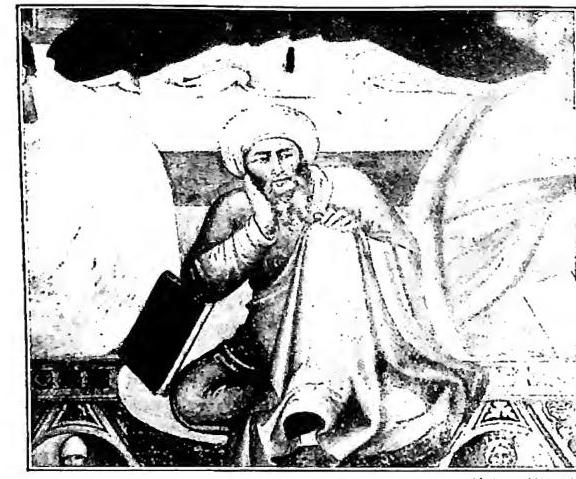
(Alinari photograph)
AVERROÈ — A. at the feet of St. Dominic. Detail from Andrea Bonaiuti’s Allegory of the Catholic Religion (14th century). Florence, Spanish Chapel in S. Maria Novella.
and so on, until reaching the moon, which is moved by the human intellect. The human intellect, insofar as it is the mover of the moon and the illuminating power that renders intelligible to each individual soul, according to the dispositions of each, its own sensible species, is identified with the active intellect of which Aristotle speaks; and, insofar as it is the mirror that reproduces and receives the cognitions acquired in each individual person, it is called material or acquired (ὑλικός). This is to be identified with the «passive» intellect of Aristotelian terminology or with the «possible» intellect of other terminologies. The passive intellect is therefore not a certain «preparation» residing in the individual soul, as Alexander of Aphrodisias maintained in interpreting Aristotle, but it too is substantially separate from each soul, like the active intellect, and is one for all souls. The union (coniunctio or copulatio) established between these and the intellect results from the illuminating action that the intellect exercises upon the sensible images proper to each individual; that is, the union occurs per continuationem intentionis intellectae cum nobis (De Anima, ed. Venice, p. 164, V. A.), and is purely accidental. Deeper unions, though likewise not substantial, occur when the individual comes to participate in the abstract essences (mystical knowledge and prophetic illumination). The human intellect, in the final analysis, is absolutely impersonal, and consequently its survival is impersonal. This doctrine of the one intellect is therefore certainly a denial of the immortality of individual souls, and it was around this denial that the heterodox Aristotelianism of the 13th and 14th centuries gathered, under the name of Latin Averroism. It should be noted, however, that A. never explicitly deduced the perishability of individual souls from the theory of the one intellect, just as it should also be observed that, by his own confession, his thinking on this matter always remained in a state of profound torment.
Regarding the relationship between religion and philosophy, A.’s position—contrary to what many maintained in the Middle Ages—cannot be accused of impiety. Philosophy and revealed religion express for him one and the same truth, although through different language and methods. The Qur’an, according to A., sets forth philosophical truth itself by means of allegories, which are excellent for convincing the unlettered; but it is the task of philosophy, if it wishes to convince the learned of those same truths, to derive from a reading of the Qur’an the scientific interpretation of religious dogmas, stripping them of the deceptive garments of allegory. This position of A., perhaps not always clearly expressed by him, is regarded as the source of the doctrine of the double truth that is reproached to certain of his Latin admirers of the 13th–16th centuries.
BIBL. The complete editions of A.’s Latin texts range from that of Padua of 1472–74 (in 3 vols.) to that of Venice of 1560 (in 11 vols.). The best is that of Venice, published by the Giunta, in 1552: Aristotelis... omnia quae extant opera... Averrois... in ea opera omnes qui ad nos pervenere commentarii. The recent editions of the Arabic texts are contained in the Bibl. arabica Scholasticorum. Sér. arabe. Edited by M. Bouygues, the following volumes had appeared up to that point (1930–38): vol. III (Tahāfūt at-tahāfūt, or «Incoherence of Incoherence»), IV (Tafsīr kitāb al-maqālāt, or «Paraphrase of the Book of the Categories»), V. II (Tafsīr mā ba'd at-tabī'at, or «Great Commentary» on the Metaphysics).
A critical edition of A.’s Latin translations, together with that of the Arabic-Latin versions of Aristotle, has recently been entrusted to the Mediaeval Acad. of America. On this subject cf. H. A. Wolson, Plan of Corpus commentariorum Averrois in Aristotelem, in Speculum, 1931, pp. 412–27; Bull. de la C'asse des lettres de l'Académie royale de Belgique, 18 (1932), 5th series, pp. 345–64; 23 (1937), pp. 294–97; 24 (1938), p. 265.
There is no satisfactory comprehensive study of A., but only a few monographs on particular subjects. Thus, the old book by E. Renan, Averroes et l’averroïsme (2nd ed., Paris 1861: the 1st ed. is from 1852; those subsequent to the 2nd reproduce it without changes), deals more with the history of Latin Averroism than with A.’s personal doctrines; L. Gauthier, La théorie d’Ibn Rochd sur les rapports de la religion et de la philosophie, Paris 1909; A. Manson, La théorie aristotélicienne du temps chez les peripatéticiens médiévaux, Averrois, Albert le Grand, Thomas d’Aquin, in Rev. Néosc., 36 (1934), pp. 275–307; C. Nalino, s. V. ENOCH. Ital., V, pp. 624–27, where there is extensive information on the editions, translations, and studies; also rich in bibliographical information is the article by M. M. Gorce, Averroïsme, in DHG, V, col. 1032 ff., though it too is devoted especially to tracing the history of Latin Averroism; M. De Wulf, Histoire de la philosophie médiévale, I, Louvain 1936, p. 305 ff. For more recent indications, consult the indexes of the Bull. de théologie ancienne et médiévale from 1937 onward. Gerardo Bruni