
CREATION. - Production of a being from absolute nothingness.
CONTENTS:
I. The Catholic dogma of creation
II. Christian iconography of creation.I. THE CATHOLIC DOGMA OF CREATION.
CONTENTS:
I. Notions and opinions
II. The dogma
III. Real relation in the creature
IV. Freedom of creation
V. The purpose of creation
VI. Creation in time
VII. The creative Trinity
VIII. Creation, an act proper to God
IX. The manner of creation.I. NOTIONS AND OPINIONS
The word creation is often used to signify a production in which the dependence of the effect upon the producer is emphasized: one creates a literary genre, a theatrical or novelistic character, a fashion, a philosophical system, etc. This usage is an extension of the meaning, technical and proper, given to the word creation to express the Catholic doctrine on the origin of the universe. In this strict, philosophical, and theological sense, creation is the production of a being from nothing, « ex nihilo », meaning that such a being, before being produced, did not exist as such, nor did its physical constituents exist: « ex nihilo sui et subiecti », according to the classic Scholastic expression. Thus, a statue is the effect of a production, but not of a creation, since it results from the transformation of preexisting matter; nor is the generation of a living being a creation, since it derives from the substance of the generator.The expression production from nothing, « ex nihilo », must not be misunderstood. It does not mean that nothingness served as raw material in the production; rather, it signifies the exclusion of any matter or subject; from nothing means « not from something », « non ex aliquo ». If one then wishes to give the preposition ex a sense of succession in time or order, it means that a being is produced when no constitutive element of it existed.
The same concept can be expressed positively as follows: creation is the production of a thing in its entire substance. For if the entire reality of the thing is produced, no element of this reality existed beforehand. Applied to the universe, creation means that the entire reality of the universe was produced by its author, without any presupposed matter or subject.
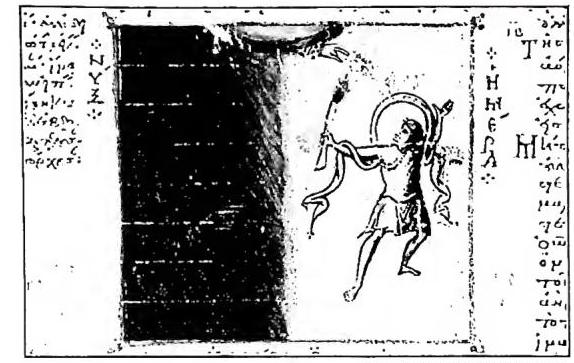
CREATION - Separation of light from darkness. Miniature from the Octateuch of the 12th century - Vatican Library, cod. Vat. grec. 747, f. 15f.
Tim., 28 c.; Respub., VI; Symp., 211, b. St. Thomas found the metaphysical concept of creation (though "ab aeterno") in Aristotle's doctrine; thus in modern times F. Brentano (Aristoteles Lehre vom Ursprung des mensch. Geiste, Leipzig 1921) and A.-D. Sertillanges (S. Thomas d'Aquin, I, Paris 1928, p. 28 ff.). Others think differently. Certainly, the Stagirite enunciated principles on more than one occasion that logically lead to creation: cf. Met., l. 2, cap. 1, 993 b; cap. 1, 1003 a; De caelo, 1, 1, cap. 9, 278 b, etc.
This uncertainty among critics demonstrates at least that in ancient philosophy the idea of creation had little prominence. Indeed, no philosopher of that time expressly denied the eternity of atoms admitted by the school of Abdera and later celebrated by Lucretius in De rerum natura.
Conscious opponents of creation begin with the Manichaeans (3rd century A.D.). These, considering evil as a physical reality, indeed as a material substance, came to admit two supreme principles, one for good substances, the other for evil substances. The Church has often condemned them, including at the Fourth Lateran Council (1215). The various forms of pantheism, explaining the world as an emanation or an evolution or a modality of the divine substance, all exclude creation as we have defined II. Modern thinkers, from Giordano Bruno to the present day, have proposed many monist and consequently pantheist systems, the principal ones—still highly influential today—being Spinozism and Hegelianism. For Spinoza, the world results from the attributes and modes of the single substance; while for Hegel, all reality is a becoming necessarily constituted and rigidly unified by the laws of thought. Little following has been gained by the materialistic monism of P. H. Holbach, L. A. Feuerbach, L. Büchner, E. Haeckel. More recent idealists, especially the Italian ones, having excluded all transcendence and denied the possibility of the perfect (v. GENTILI, I problemi della scolastica e il pensiero italiano, Bari 1913, pp. 146-47), refuse to seek the cause of this world or to speak of its origin.
A. Masnovo
II. THE DOGMA.
The Catholic faith teaches that God is the sole principle of all things and that He properly created every being distinct from Himself, whether spiritual or material, through a free act that had its effect in time. This dogma of creation, already contained in the Creeds, was precisely defined against the Manichaean Albigensians at the Fourth Lateran Council, which professes a single "principle of the universe, creator of all things visible and invisible, spiritual and corporeal, who by His omnipotent power equally made from nothing, at the beginning of time, both creatures, the spiritual and the corporeal, that is, the angelic and the earthly, and then the human, composed of spirit and body" (Denz-U, 428). At the Vatican Council, the errors of materialists and pantheists were targeted, and in the last canon, Günther (v.) was particularly addressed: "If anyone does not confess that the world and all things contained in it, both spiritual and material, were produced by God from nothing, or if he says that God did not create with a will free from all necessity, but with the same necessity with which He loves Himself, or if he denies that the world was made for the glory of God, let him be anathema" (Denz-U, 1805). This definition succinctly summarizes, in precise terms, the teaching of Sacred Scripture and Tradition.
### 1. Sacred Scripture.
The first verse of the Bible constitutes the classic argument and, as it seems, the decisive one for the formation of the doctrine. "In principio creavit Deus caelum et terram" (Gen. 1:1). To read in this text that God produced all things, drawing them from nothing, one must not consider the word "created" (in Hebrew bāra) alone, which can be understood—and indeed is understood in the same chapter—in its broader sense (vv. 21, 27), but must consider the entire proposition. What did God "create"? Heaven and earth, that is, according to the constant usage of Scripture, our world, all things. Now, He who makes the whole of this world necessarily creates, that is, presupposes nothing in His production, because the thing that would be presupposed would not be made in this production. Therefore, when God made all things, He created. Moreover, the natural sense of the first words "in principio" is that of an absolute beginning, the instant of the origin of things; and this sense does not change if one connects "in principio" with what follows, because the beginning of heaven and earth is always the beginning of all things.
We say "all things": it is, however, possible—and conceded by most—that in our text only the visible and earthly world is meant, not the angels. In this case, Genesis would speak of the origin by way of true creation of all sensible things; which can then be easily extended, based on other texts, to spiritual things. But excellent interpreters (including Protestants, such as E. König) think that in the first verse "caelum" had-kāmajūn signifies all the higher regions with their inhabitants, like "cæli caelorum," and thus also with the angels. In the second verse, the earth is presented in a chaotic state: "And the earth was without form and void (tōhū teā-bhāhā), and darkness was upon the face of the deep." Hence the obvious supposition that the term of the creation affirmed in the first verse is the formless earth. However, the interpretation of D. Petau, accepted by many (De opere sex dierum, l. 1, cap. 2, n. 10), cannot be excluded with certainty, which considers the first verse as the general affirmation of the origin of all things from the creative power of God, while the following verses would explain the details and stages of this creation.
The interpretation attempted by Rabbi Rashi in the 11th century and revived by some moderns, such as Loisy, must instead be rejected. The meaning would no longer be: "In the beginning, God created..."; but: "God began His work by saying: 'Let there be light.'" Creation would thus, according to Rashi, not be affirmed in the text but only presupposed; and according to A. Loisy, it would even be denied. As proof, it is adduced that kāreṭīth (in the beginning), being in the construct state, requires what follows as a complement: in the beginning of creating..., and thus the first main clause of the passage would be: "God said: Let there be light." But this interpretation is excluded by all versions, by the Masoretes, and by excellent recent exegetes, even non-Catholic ones, such as J. Wellhausen, S. R. Driver, S. Perowne, E. König, and others. To confirm that the first verse of Genesis asserts creation in the proper sense, many reasons can be adduced. The manifest intention of the sacred author, which is to teach the supreme dominion of the one God over all things, excludes the admission of any dualism. The sublime simplicity and absolute mastery with which God causes all beings to be produced from formless matter would not be intelligible if He were not the author of that matter itself. The Jewish tradition understood it in the manner indicated here, as seen in the Psalms, in the sapiential books, and in the famous words of the mother of the Maccabean martyrs (II Mach. 7:28): "I beseech thee, my son, look upon heaven and earth, and all that is in them: and consider that God made them out of nothing." The very name of Yahweh, taught to Moses (Ex. 3:14) and meaning "He who is," would not truly be proper to God if there were a being that had not received existence from Him and existed by virtue of its own nature.
In the New Testament, St. John and St. Paul clearly teach creation. In the prologue of the fourth Gospel, it is said of the Word: "Omnia per ipsum facta sunt, et sine ipso factum est nihil, quod factum est" (Jn. 1:3). Now, when all things are made, creation occurs. St. Paul is familiar with the doctrine that all things come from God (cf. Rom. 11:36; I Cor. 8:6). Speaking of Christ, he says that in Him all things were made, including all the angels: "In ipso condita sunt universa in caelis et in terra, visibilia et invisibilia, sive Throni, sive Dominationes, sive Principatus, sive Potestates: omnia per ipsum et in ipso creata sunt: et ipse est ante omnes, et omnia in ipso constant" (Col. 1:16-17). And the same Apostle taught the Athenians: "Quod ergo ignorantes colitis, hoc ego annuntio vobis. Deus, qui fecit mundum et omnia, quae in eo sunt, hic caeli et terrae cum sit Dominus, non in manufactis templis habitat, nec manibus humanis colitur quasi aliquo indigens, cum ipse det omnibus vitam et inspirationem et omnia" (Acts 17:23-25).
### 2. Christian Tradition.
From the beginning, Christian Tradition interpreted the Scriptures as containing the doctrine of the creation of the world, accomplished by God "ex nihilo." The very few Fathers whose use of Platonic formulas has led some to suspect them of admitting eternal matter—Athenagoras, St. Justin, and perhaps Clement of Alexandria, accused of this by Fazio—are easily given another interpretation. All others express themselves clearly on this point, so that the consensus of the Fathers in favor of the dogma of creation is truly imposing. Already St. Clement of Rome insists on it (I ad Cor., 19, 33), and Hermas exhorts belief in God the Creator, who "from nothing made all things to be" (Pastor, Mand., 1, 1). Among the apologists, St. Theophilus explicitly states that the matter with which God made the world was itself created by God (Ad Autolycum, 1, 2, n. 10), and Tatian writes similarly: "Matter is not without beginning like God... but was created, and was made by none other than the Author of all things" (Oratio ad Graecos, n. 5: PG 6, 814-18).
J. de Tonquédec, La création, in Dictionnaire de théologie catholique, t. III, coll. 2121-2183; J. Mausbach, Die katholische Moraltheologie, t. I, Münster 1918, pp. 311-320; A. Michel, Création, in Dictionnaire de théologie catholique, t. III, coll. 2067-2120; H. Dieckmann, De Deo creante et elevante, Romae 1935; J. de Blic, La création ex nihilo dans la tradition patristique, in Recherches de science religieuse, t. XXII (1932), pp. 449-463; A. d'Alès, La doctrine de la création dans l'école d'Alexandrie, in Recherches de science religieuse, t. V (1914), pp. 449-477; G. Bardy, La théologie de l'Église de saint Clément de Rome à saint Irénée, Paris 1945, pp. 135-145; H. U. von Balthasar, Schöpfung und Sünde, in Theologie der Geschichte, Einsiedeln 1950, pp. 7-48; J. H. Crehan, The Theology of Creation in the Fathers, in Theology, t. LIV (1951), pp. 345-355.
A. MICHEL.
The fables of the Gnostics gave the subsequent Fathers occasion to insist on the doctrine that all things were produced by God Himself. "Men," says St. Irenaeus, "cannot make anything out of nothing, but only from some matter; God, however, is superior to men in this, that He found the matter for His work, which previously did not exist" (Adversus haereses, bk. 2, ch. 10: PG 7, 736).
Tertullian is no less explicit: "For us," he says, "there is one God and one earth, which God made in the beginning, and of which Scripture, beginning to describe the process, says first that it was made, and then expresses its state" (Adversus Hermogenem, ch. 26: PL 2, 220). Origen marvels that great philosophers could have dreamed of a matter "unbegotten," uncreated (De principiis, bk. 2, ch. 1, nn. 3-4). For St. Athanasius, the pure concept of creatio serves to distinguish the procession of the Word from the origin of things (cf. Oratio 2 contra Arianos, n. 1: PG 26, 147). St. John Chrysostom presents this fundamental dogma, saying that Moses "uproots all the heresies that were to spring up in the Church, inasmuch as he says: 'In the beginning God made the heaven and the earth.' If, therefore, a Manichean comes to tell you that matter preexisted, or Marcion or Valentinus, or a pagan, answer them: in the beginning God made the heaven and the earth" (Homilia 11 in cap. 1 Gen., n. 3: PG 53, 25-30), and St. Augustine with perfect precision: "You, Lord, made the world from formless matter, that quasi-nothing which You made from nothing, to fashion thereafter the great things which we children of men admire" (Confessiones, bk. 12, ch. 8).
3. Proof by reason
Creatio, then, is a revealed truth. All Catholic doctors admit that it is also a truth which reason can demonstrate, at least after having learned it from Revelation. For if the world did not come from God by creatio, there would be in it something, a last subject, some matter independent of God; and this is manifest, since one can speak of creatio only when all the physical constituents of a thing are produced. Now it is impossible that anything exist independently of God. Otherwise, this thing would exist by its own nature, that is, it would be Being itself, the Ipsum esse, which has no limits and can only be unique: in other words, it would be identified with God. Therefore, it is evident that the world, distinct from God, was created. It is not useless to observe the difference between the demonstration of the existence of God and that of creatio, though the two processes are connected. To ascend to God, it suffices to ascertain that in our world some beings are subject to motion, or are caused, or are corruptible, or possess the same perfection in different degrees, or are ordered, and then to seek the proportionate cause of this. Each of these ways, which are the five of St. Thomas's Summa, leads us to a First, who is Being by essence, unparticipated Being. Instead, to prove creatio, one must consider that the only possible modes of existing are two: either by one's own nature or by dependence on another, and that existence by one's own nature cannot belong to more than one being, for the simple reason that, otherwise, there would have to be two infinites, neither of which would lack any perfection possessed by the other, and yet one of the two would have to lack one in order to be distinct from the other. The argument directly excludes atheistic or dualistic positions in the manner of the Manicheans; it excludes pantheism and every monism, insofar as the existence of finite and multiple beings is a datum of experience that obliges the intellect to find its reason in a perfect being from which all imperfect beings proceed.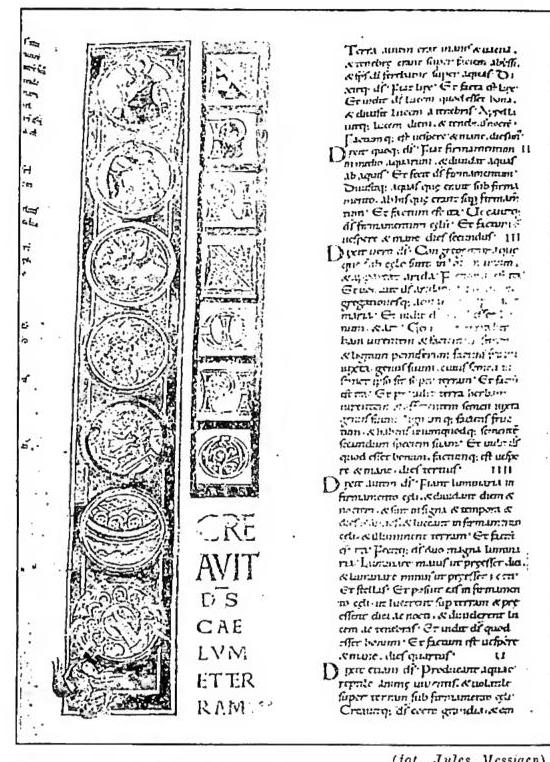
To penetrate the question more deeply, consider created causality: if from a flame another flame can arise, if from a plant another plant can germinate, if from man man is generated, that is, if each nature can communicate its own form or essence, it is not seen why God, who is the pure Act of being, cannot communicate, even in an infinitely inferior degree to His own, being itself, to which nothing can be presupposed. Now, when the effect of being is directly caused, the other objections or difficulties no longer have reason: since no effect precedes, the production of the new being is not a change, is not made with any sort of movement, is not the overcoming of a distance to be traversed (the distance from nothing to being); it is only that which changes, that which moves, that which proceeds toward a term, that requires a subject distinct from the term. That which is simply placed in being presupposes no prior subject and is only metaphorically spoken of as change, passage, or any motion.
BIBL.:
H. Pinard de la Boullaye, Création, in DThC, III, coll. 2034-2201; J. de Tonquédec, La création, in Revue thomiste, 1925, pp. 201-222; A. Michel, Création, in DTC, III, coll. 2121-2210; G. Bardy, La théologie de la création chez les Pères, in Revue des sciences religieuses, 1932, pp. 5-29; E. Gilson, L'esprit de la philosophie médiévale, Paris 1932, pp. 147-176; J. Maritain, Distinguere per unire. I gradi del sapere, Brescia 1947, pp. 453-470; R. Garrigou-Lagrange, Dieu. Son existence et sa nature, Paris 1950, pp. 385-412.
III. REAL RELATION IN THE CREATURE
Once creation is admitted, one may ask whether it entails a real addition to God or whether something more than the received being results in the creature. In the Creator, whose essence is most simple and in whom there can be no distinction between substantial being and acts, it is evident that the creative act is God Himself and consequently perfectly immanent; yet this immanent act has the power to bring into being that which is willed in II. To the interior and secret "Fiat lux" corresponds the fact: "Et facta est lux."In the creature, according to the common opinion of the Scholastics, a relation of dependence upon the Creator results. Duns Scotus, however, and with him many other doctors, deny that this relation is distinct from the being of the created thing itself. St. Thomas, on the other hand, posits it as distinct (C. Gent., I, 2, cap. 18), and rightly so, since the being of the created thing can have toward God neither the relation of act nor that of potency; now, only potency and act are transcendental relations, that is, relations identical with the things related. The relation of creatures to God is therefore real. In—
(photo: Jules Messuers)
CREATION - Episodes of the C., frieze from the Lobbes Bible, illuminated by the monk Goderanus (1084) - Tournai, Seminary.
Instead, the fact of being Creator does not add a real relation in God. A real relation truly orders toward the correlative term, and God, supremely independent, cannot be ordered to the creature.
IV. FREEDOM OF CREATION — A highly important question for forming a correct concept of creation and of the creature’s relation to God is that of the freedom of creation.
In pantheistic or emanationist systems, when creation is spoken of, it is most often understood as a process of the world necessarily originating from the very substance of God. Plotinus, like Spinoza, Scotus Eriugena, like Hegel, see in the existence of the universe—or of being insofar as nature—a necessity as strict as logical or mathematical necessities. Others, who rightly distinguish God from the world and derive the latter from the divine will, nevertheless hold that God could not have refrained from creating, nor could He have made a world different from the one created. Being perfect, God always acts for the best end. What is or will be is therefore the best and could not have been otherwise. This was already the view of Abelard, then of Malebranche, Leibniz, and, in the last century, of Günther (v.).
The Church’s teaching on this point is clear. Abelard was condemned at the Council of Sens (in 1140; cf. Denz-U, 374), and the Vatican Council declared that creation was accomplished by God « liberimo consilio » and anathematized « anyone who would claim that God does not create with an absolutely free will and that He wills the world as He wills Himself » (Denz-U, 1805).
Indeed, Scripture extols the dominion God has over His creative act in such a way that all necessity is excluded. God « has made all that He willed » (Ps. 113:11; 134:6), and St. Paul teaches that God does all things « secundum consilium voluntatis suae » (Eph. 1:11).
The Fathers sometimes insisted on the reasons of fittingness for creation. St. Augustine, for example, writes that if God, having the power to create, had not done so, He would have been envious (De Genesi ad litteram, bk. 4, ch. 16, n. 27: PL 34, 307). But these are Platonic reminiscences that do not imply true necessity. The same Augustine writes that to one who asks why God made heaven and earth, the answer must be: because He willed II. « But if one asks why He willed to make heaven and earth, he seeks something greater than the will of God: and there is nothing of the sort » (De Genesi contra Manichaeos, bk. 1, ch. 26, n. 4: PL 34, 175).
God’s freedom in creating, however, is one of those many truths that reason sees must be affirmed but struggles to conceive in its mode. On the one hand, it is clear that the will of God finds its adequate object in the infinite divine perfection and that, consequently, nothing else can be necessary for His happiness nor even increase II. It is therefore evident that God is free to will or not will creatures, and to will in the world that degree of perfection which He chooses. But when one seeks to understand the actualization of this freedom, difficult questions arise, particularly that of reconciling God’s freedom with divine immutability. God created the world by an act of His will; yet He could have not created the world, and nevertheless nothing in Him would have changed. This is certainly a great mystery, before which one can only say that the same divine act, identical with God, can, by virtue of its infinite power, posit or not posit the existence of the world, or the existence of this world or another. In God there is the power which, without change, causes or does not cause the effect: agens in quantum agens non patitur; the change lies in the second term, which is posited or not.
END OF CREATION
The doctrine of free creation is connected to that of the end of creation. God does not pursue, in creating, an end that imposes itself upon Him; rather, He must have in His wisdom an end that befits His creative act. The Vatican Council anathematized anyone who denied that the world was made for the glory of God (Denz-U, 1805).
With this definition, the Council Fathers excluded the position of Hermes and Günther, who held that God had created solely for the happiness of creatures and in no way for His glory. Seeking glory, they said, even if legitimate, is the work of the ambitious, not of God. Nor is Laberthonnière’s view much different on this point (cf. Etudes sur Descartes, II, Paris 1935, p. 370). But the Council’s doctrine is that of Scripture, which always places in God the end of things as of actions. God is both the beginning and the end (Apoc. 1:8); St. Paul wills that we do all things for the glory of God (I Cor. 10:31) and writes: “from Him and through Him and to Him are all things: to Him be glory forever” (Rom. 11:36).
The glory of God consists in the manifestation of His perfections—a manifestation that God may will, since it refers in itself to the love of the supreme good. Now, God manifests His perfections by communicating them, so that the higher, more ordered, and more perfect the creatures are—and consequently, the happier—the more the divine goodness is manifested, communicated, and glorified. Every creature that tends toward its own good tends at the same time, indeed primarily, to participate in and manifest the perfection of God (cf. St. Thomas, Contra Gent., bk. 3, ch. 24).
It is proper to rational creatures to freely conform to the natural tendency toward their own perfection or happiness, which constitutes their ultimate end. However, the reference to the glory of God is necessarily implicit in happiness, insofar as happiness is an accumulation of perfections, and every perfection participated in by men is a likeness of the divine perfections. The Scholastic philosophers express all this by calling the glory of God the primary ultimate end and the happiness of man the secondary ultimate end. In short, the glory of God is not an increase of happiness that the Creator seeks in the praise of His creatures, but the natural reference that His gifts have to His essence, which they reflect and without which He Himself could not love them.
BIBL.:
H. Denzinger - A. Schönmetzer, Enchiridion Symbolorum, Barcellona 1963; J. Kleutgen, Die Theologie der Vorzeit, II, Münster 1867, pp. 353-360; A. Stolz, Theologie der Mystik, Ratisbona 1936, pp. 10-15; G. Van Ackeren, Theologia naturalis, Roma 1957, pp. 243-245; J. de Finance, Connaissance de l'être, Roma 1966, pp. 303-305.
A. Piolanti
VI. CREATION IN TIME
Once it has been established that God is free in His creative work, it follows immediately that creation was not necessarily from all eternity. Aristotle held that the world was eternal and probably that it could not but be so. There is doubt as to what Plato thought on this point. Some attribute to him the doctrine of the eternity of the world (A. E. Taylor, Plato, London 1926, p. 442). St. Augustine attributes to the Neoplatonists the doctrine of creation necessarily eternal (De Civitate Dei, bk. 11, ch. 4, n. 2: PL 41, 319). But, since God is absolutely free in producing the world, it is clear that He can grant it whatever duration He pleases and that nothing obliges Him, if He wills the world, to will it always existing.Could God have created from all eternity, ab aeterno? St. Thomas denies that this can be excluded with certainty, since, on the one hand, God could always will creation, and on the other, nothing determines the essence of things to exist at a determined time; and if it is said that, given eternal creation, there would result, for example, an infinite number of generations, it is replied that a number supposes two terms and that in the hypothesis of creation ab aeterno, there would be only the term a parte post. Reason does not demonstrate that an eternal world, eternally created, is impossible. Nor should it be said that the tradition of the Fathers unanimously excluded the possibility of creation ab aeterno. Many texts deny only the fact of creation ab aeterno, not its possibility, or exclude from the creature an eternity resembling that of God. St. Augustine, disputing against the Neoplatonists, does not argue from the impossibility of creation ab aeterno; he merely calls it barely intelligible and demonstrates only that it is not necessary (De Civitate Dei, bk. 11, ch. 4, n. 2: PL 41, 319).
But faith teaches us that, in fact, creation is not ab aeterno and that it took place in time. This does not mean that time existed before creation. Time is the measure of motion, and where there is no creature, there is no motion either. But creation made in time means solely that there was a beginning of time and that, retracing the past through time, one would arrive at a first instant. Both the Fourth Lateran Council and Vatican I assert that God created at the beginning of time, « ab initio temporis ». Already the words of Genesis: « In the beginning God created the heavens and the earth » would hardly suit a creation without a beginning in time; and Jesus Christ manifestly excluded that the world has always existed, saying:
(Int. Anderson)
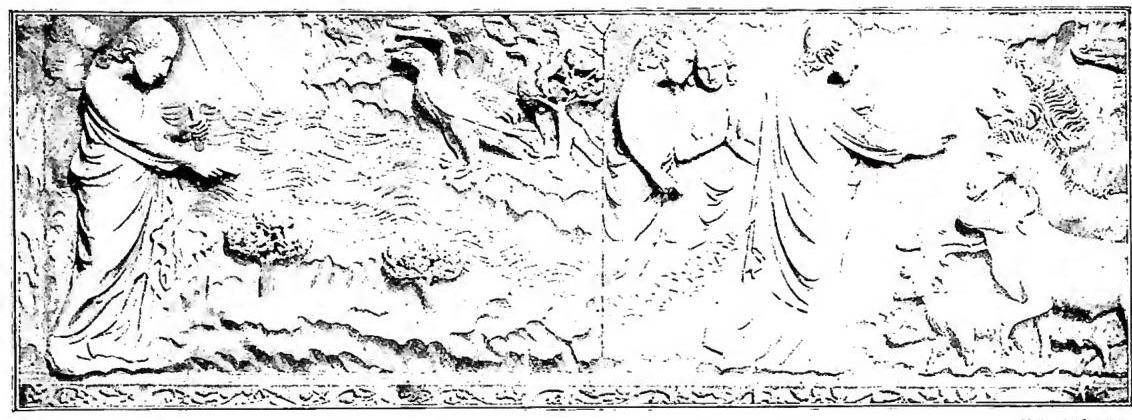
CREATION - Scenes of c., work by L. Maitani and collaborators (14th c.) - Orvieto, detail of the façade relief of the Cathedral.
"Now glorify me, Father, with you, with the glory that I had with you before the world was" (Io. 17, 5) and elsewhere: "You loved me before the creation of the world" (Io. 15, 25).
VII. THE CREATIVE TRINITY
What has been said thus far abstracts from the Trinity of persons in God. Now, how must the action of each divine person in the creative work be conceived? There were those who, seeking to demonstrate the existence of the Trinity, wished to find in things an effect proper to each person; thus, in the 19th century, Günther (v.): which would imply that each of the divine hypostases made only a part of things. Catholic doctrine on this point is clear. The Fourth Lateran Council teaches that the one true God, "Father and Son and Holy Spirit... is the sole principle of the universe, creator of all" (Denz-U, 428), and even more explicitly the Council of Florence: "The Father and the Son are not two principles of the Holy Spirit, but one alone, just as the Father, the Son, and the Holy Spirit are not three principles of the creature, but one alone" (Denz-U, 704). The creative work is therefore common to all three divine persons.Sacred Scripture does not reserve the creation of the world to the Father, but explicitly involves the Son as well, as St. John says of the Word, "All things were made through him, and without him was made nothing" (Io. 1:3). Jesus then insists on affirming the unity of operation as of nature between the Father and himself (Io. 5:17-21; 10:38, etc.). The same must be extended to the Holy Spirit, who lives in the unity of the divine nature and is explicitly said to operate with the Father and the Son in supernatural works (II Cor. 12:4-6). St. Augustine expressed the tradition thus: "Catholic faith does not say that God the Father made something, and the Son something else, but that what the Father made, the Son also made, and the Holy Spirit also made" (In Io., tr. 20, n. 3: PL 35, 1558).
The reason for this is easily seen. Creation in God is an act of intellect and will. Now, the three persons share in common the intellect and the will, that is, the one divine nature, and therefore they also necessarily share in common the creative act. Moreover, the respect or the form according to which the Creator exercises His influence is the respect or the form of being. Now, being in God is the very essence or divine nature, numerically one and common to the three persons. It is therefore not possible for one person to have creative activity without the others.
This does not preclude observing in the active creation the order of the divine processions. The very creative act resides in the Son as communicated by the Father and from the Son, so that, in a proper sense, God the Father creates through the Son in the Holy Spirit, according to the customary language of Scripture and the Fathers. When, however, creation is attributed outright to the Father, this is done only by appropriation and by resemblance to the property of the first Principle in the Trinity.
VIII. CREATION (C.), AN ACT PROPER TO GOD. - The discussion arises as to whether, besides God, creatures may also create, at least as instrumental causes. To clarify this point, a proper distinction must be made. That God is the sole Creator, at least by principal causality, of all existing beings is a truth of faith: the same truth that was defined by the councils, as seen above. If God has created everything, no other has created; thus, both Manichaean dualism and the multiple aeons subordinated to one another, which the Gnostics placed between the last, creator of the world, and the first principle, are excluded. Indeed, the Scriptural texts so emphasize the freedom and independence of the creative act that the collaboration of any instrument is excluded. Creation is the work of God alone.
Furthermore, tradition and Scripture have demonstrated the divinity of Christ by the fact that the Word created all things (Io. 1:3-4; Hebr. 1:2; St. Athanasius, Oratio II contra Arianos, n. 21: PG 26, 190); but the argument would be without value if a creature could create. As for the possibility of creatures serving as instruments to God in creation, theologians are divided: some affirm it, others deny II. The latter opinion seems more in conformity with both the texts of the Fathers and reason. For the effect caused by the instrument is presupposed to the causality of the principal agent, whereas in creation no effect precedes that produced by the Creator.
IX. THE MODE OF CREATION – The ineliminability of the concept of creation and, at the same time, the mysteriousness of the manner in which it was accomplished have already been noted. However, the first chapters of Genesis provide a highly detailed description: it is necessary to determine the value that must be ascribed to the Mosaic narrative. It should be borne in mind that the work of creation stricto sensu, that is, without any presupposition, appears completed in the first verse of Scripture, and its effect is described in the second. What follows, namely the work of the six days, is called secondary creation and is creation in the broad sense, as in Wis. 11:18, since it presupposes as its subject the earth initially created. In this secondary creation, the work of distinction unfolds over the first three days, by which the heavens, the earth with its plants, and the sea are formed and separated; and the work of adornment over the last three days, by which the stars, animals, and man are produced (cf. Sum. Theol., I, q. 69, a. 1).
Exegetes and theologians today agree that the sacred author, in distributing the production of things over six days, did not intend to confine the creative work to six days of twenty-four hours. Whether he meant by "day" an indeterminate epoch, or whether he employed the framework of the week to illustrate his account, it is always a division made not to indicate a precise duration, but to order the divine operation according to the increasing perfection of its effects.
Within the Church, despite agreement on essential points, there has always been a great variety of interpretations regarding the work of the six days. St. Augustine, led to this by certain texts that were poorly transcribed or misunderstood in their true sense—primarily Eccl. 18:1—maintains that the entire work distributed over the six days was accomplished in a single instant, so that no temporal significance remained in the enumeration of the days. However, this interpretation, at first glance so different from others, did not differ much in reality, for the Hipponian explained that, although all things were created together, they were not all created in their perfect state, but many were made only in their causes or seminal reasons, to appear later when the times had ripened those initially hidden germs.
In developing this theory, St. Augustine had occasion to enunciate principles of exegesis and theology that are highly suggestive.
II. CHRISTIAN ICONOGRAPHY OF CREATION
Medieval iconography of creation is found in illuminated manuscripts and in cycles of paintings and mosaics. It depicts the first chapters of Genesis (v.), with the six biblical days of divine labor up to the expulsion of the progenitors from the Earthly Paradise. In the fifth-century Greek Genesis codex in the National Library of Vienna, the first folio contains miniatures with the creation of the heavens, the earth, the waters, the animals, man, and the depiction of Adam and Eve near the tree. Another Greek manuscript, the Cosmas Indicopleustes (cod. Vat. gr. 699), from a sixth-century original,
presents a different iconography, derived from Egyptian cosmography with exclusive astrological references. All other more recent manuscripts follow the biblical cycle, including two Carolingian Bibles of the ninth century, one in the National Library of Bamberg, the other in the library of the monastery of S. Paolo fuori le mura in Rome, and the two copies of the Octateuch from the twelfth century, contained in codd. Vat. gr. 746 and 747.
In early medieval sculpture, interesting representations of the creation cycle are found in an eighth-century relief in the cathedral of Terracina, in the altar frontal of the cathedral of Salerno (1100), which also bears inscriptions referring to the division of light from darkness (Lux, Nox), in the capitals and reliefs of the façade of the cathedral of Modena, sculpted by Wiligelmo in 1106, in other contemporary works on the façade of the cathedral of Cremona, in the bronze panels of the door of S. Zeno in Verona, and in those by Bonanno Pisano at the cathedral of Monreale.
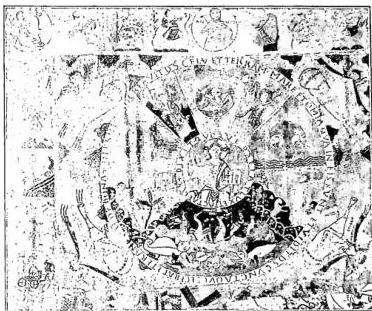
In the lower church of Assisi, a late thirteenth-century fresco depicts creation with Christ in majesty at the center, enclosed in a nimbus of cherubim.
In the Gothic period, beyond miniatures, episodes of creation are frequently found in the ornamental sculptures of northern cathedrals (Notre-Dame in Paris, Amiens, Chartres, Auxerre, Fribourg) and in stained glass, among which those of the cathedral of Ulm present an original iconography. In Italy: Lorenzo Maitani on the façade of the cathedral of Orvieto, Andrea da Pontedera, and Giotto on the Florentine campanile, dedicate interesting reliefs to creation.
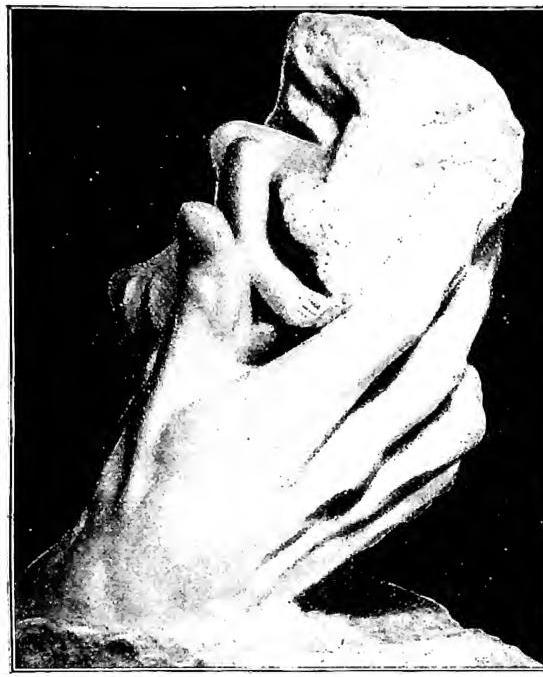
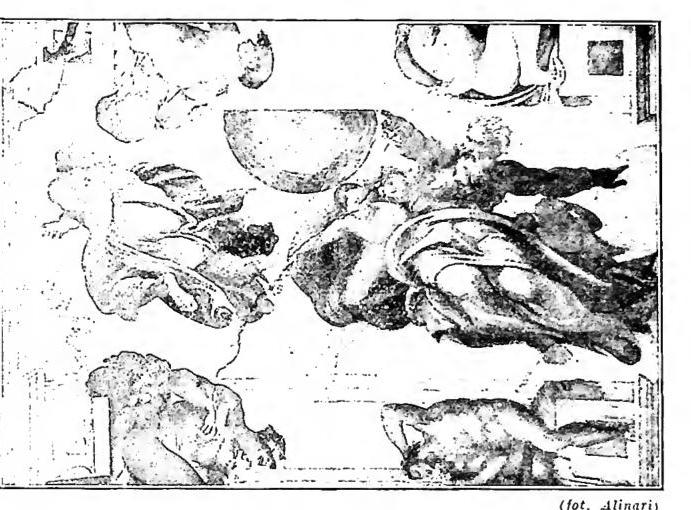
The creation finds its highest artistic expression in the nine panels of the ceiling of the Sistine Chapel, painted by Michelangelo between 1508 and 1512, and in the frescoes of the Vatican Loggias, by Raphael and his pupils, completed in 1519. A rare depiction in easel paintings is found in a work by Lucas Cranach at the Kunsthistorisches Museum in Vienna. Subsequently, apart from some representations of the creation of animals and the Flood, which served as pretexts for painters
CREATION - God creates the sun and the moon. Michelangelo - Sistine Chapel.
(fot. Alinari)
(fot. Rudomino)