
CONDORCET, MARIE-JEAN-ANTOINE CARITAT, marquis. – Scholar of the sciences and philosophy, politician, born at Ribemont in Picardy on 17 September 1741, died at Bourg-la-Reine on 29 March 1794. He devoted himself to the study of mathematics and, at the age of only 27, was admitted to the Academy of Sciences.
He took the side of the Encyclopedists (v. ENCYCLOPÉDIE), whose spirit is evident in his Lettres d'un théologien (1772) and in his edition of Pascal. In 1782 he became a member of the French Academy. In 1786 he published the Vie de Turgot, and in 1787 the Vie de Voltaire. Elected a deputy, he proposed a celebrated Rapport sur l'instruction publique and worked on the Constitution. Having fallen into disgrace upon the advent of the Commune, he was forced to hide but was denounced. Arrested and imprisoned at Bourg-la-Reine, he was found dead in prison. It cannot be ruled out that he took his own life with poison.
During his time in hiding he composed the plan of a great work that he intended to write. This was the Esquisse d'un tableau historique des progrès de l'esprit humain. In it he sought to demonstrate that the perfectibility of man has no limits and that progress may indeed be slowed, but can never be halted or reversed. He distinguishes ten epochs. After considering how the first men joined together into peoples, rose from the condition of shepherds to that of farmers, and then invented writing, he follows the development of the human spirit among the Greeks, observes the formation of the sciences, their progress, and their decline, caused chiefly by the difficulty of multiplying manuscripts and by the negligence of the Romans. The Arabs resumed the march of progress, accelerated by the invention of printing, the enemy of kings and priests. With Descartes, with American independence, and with the French Revolution, C. sees the realm of reason prodigiously extended, and contemplates the future, the tenth epoch, which is destined to realize the equality of peoples among themselves, the equality of citizens within each people, and the perfection of human faculties.
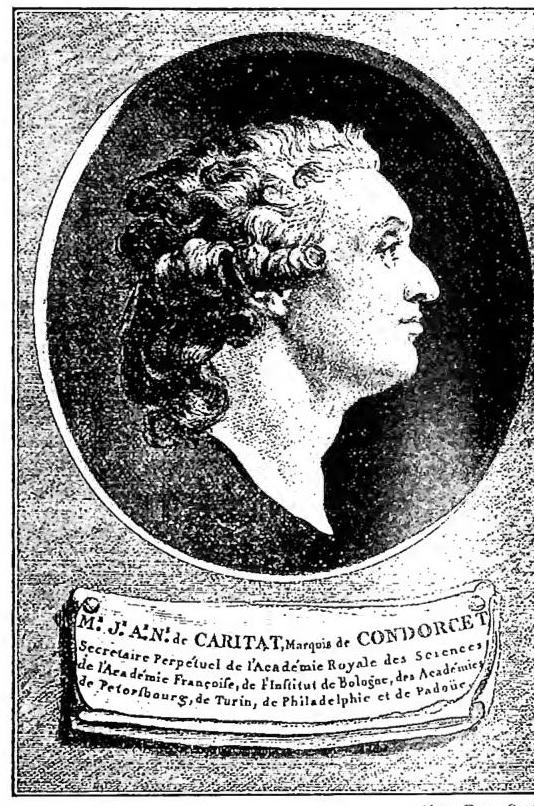
CONDORCET, MARIE-JEAN-ANTOINE – Portrait published in Condorcet-Turgot, Correspondance inédite (1770-1779), edited by C. Henry, Paris 1882 (plate between pp. XII and XIII) – Rome, copy in the National Library.
It contains many sound observations and useful suggestions; but its antireligious passion mars it and causes its inspiration, noble in itself, to go astray. Its judgments on Christianity, in particular, are unjust to the point of being ridiculous and reveal an ignorance and a preconceived bias that only the milieu of those tempestuous years can in some measure explain. The work is on the Index (decree of 10 Sept. 1827).