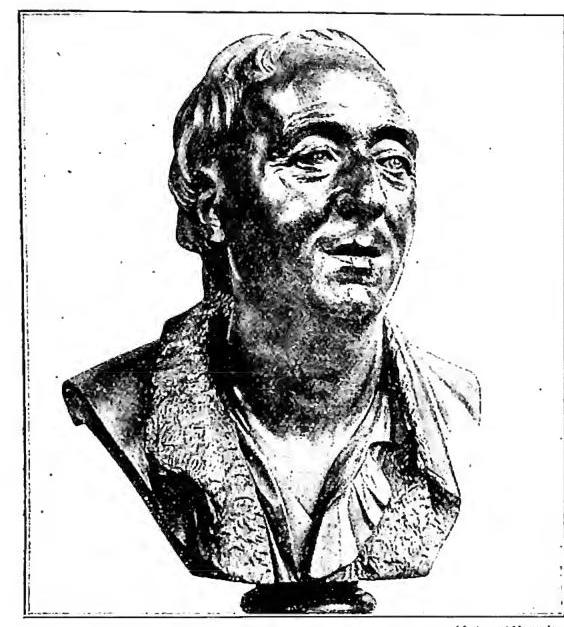
DIDEROT, DENIS

DIDEROT, Denis. — Philosopher, b. at Langres (Champagne) on 5 Oct. 1713, d. in Paris on 30 July 1784. Destined by his father for the ecclesiastical state, he attended the Jesuit college in his native city but was withdrawn from it to put an end to certain tendencies toward the novitiate. After completing his studies in Paris and rejecting every profession, he devoted himself to study, principally of mathematics and the sciences. He had only worked on some translations when, at the age of 33, he was chosen as editor of a publication that, under his direction and with the collaboration of D’Alembert, Encyclopédie (v.), one of the most significant events of the 18th century. The revolutionary and anti-religious spirit of the work, which already corresponded to the state of minds at the time, contributed powerfully to preparing the explosion of 1789. Diderot worked on it until the end, from 1746 to 1772. He was pensioned by Frederick II and by Catherine II.
Diderot’s activity as a writer was not exhausted in the Encyclopédie. Besides the various works he published, many of his writings, intended for abroad, were published posthumously: mostly short essays, tales, and dialogues, written with verve and filled with the spirit of the Encyclopédie. Diderot’s style is a model of liveliness and spontaneity, but lacks sobriety: one of his most original works, *Le neveu de Rameau*, was translated by Goethe. His *Salons* represent a valid contribution to art criticism.

Among his philosophical works are noteworthy: *Pensées philosophiques* (1746); *Lettre sur les aveugles* (1749); *Interprétation de la nature* (1759); and posthumously, *Le rêve de d’Alembert*; *Supplément au voyage de Bougainville*.

DIDYMUS THE BLIND. — Theologian, b. in Alexandria, d. there c. 398. He was surnamed “the Blind” because of his loss of sight. He was a student of Origen’s school and a zealous defender of his doctrine. He was also a prolific writer, though his works have come down to us only in fragments or in the form of catenae. Among his exegetical works remain the *De Spiritu Sancto*, prior to 381, in the Latin version of St. Jerome; the *De Trinitate* in three books, written between 381 and 392; and the mutilated treatise *Contra Manichaeos*. Some of his writings must have reached us under another name: among these is the *πρῶτος λόγος* (first discourse), which Didymus mentions in the *De Trinitate*, probably identical with the *De dogmatibus et contra Arianos*, attested by St. Jerome, and preserved in books IV and V of the *Contra Eunomium*, falsely attributed to St. Basil, the author of the first three books. Also the *Ps.-Athanasius: Contra Macedonianos dial.* would be a work of Didymus. But the attribution to Didymus of the *Ps.-Jerome on Is. 6:1-7* (L. G. Morin, *Anecdota Maredsolana*, III, III, p. 1030), attempted by W. Dietschen (*Didymus V. Alexandria al Verfasser der Schrift über die Seraphen-Vision*, Freiburg 1942), has not remained without contradiction. Other works of Didymus are lost.

Didymus’s Trinitarian doctrine, fully in accord with the Nicene faith, is inspired by St. Athanasius and the Cappadocians. As with Basil, his formula is: μία οὐσία, τρεῖς ὑποστάσεις (one essence, three persons); the Son is consubstantial (ὁμοούσιος) with the Father, and so the Holy Spirit with the Father and the Son. The three Persons have a single will and operation. The Son proceeds from the Father by generation, the Spirit by procession (ἐκπόρευσις). His admiration for Origen, which he came to defend, led him to enriched and erroneous theories on other points, such as the pre-existence of souls and apocatastasis. For this reason, Didymus was involved in the repeated condemnations of Origenism, and most of his works were lost.

As a writer, Didymus shows little concern for elegance of form, content to express himself with precision; he also suffers from the drawback of having to rely solely on dictation. His style is weak, colorless, and prolix, sometimes taking on the fervor of piety with which he discusses theological subjects.

BIBL.: His works are found in PG 39; exegetical fragments in catenae published by K. Staab, *Paulus-Kommentare aus der griechischen Kirche* (Neutestamentliche Abhandlungen, 15), Münster 1933, p. 1 ff.; the *De Trinitate* was first published by G. L. Mingarelli, Bologna 1769. — Studies: J. Leipoldt, *Didymus der Blinde* (Texte und Untersuchungen, 29, 11), Leipzig 1905; G. Bardy, *Didyme l'Aveugle*, Paris 1910; W. J. Gauche, *Didymus the Blind, an Educator of the Fourth Century*, Washington 1934; Bardenhewer, III, pp. 104-115; P. Godet, in DTC, IV, cols. 748-55; J. Lebon, *Le Ps. Basile ad Ev. Evm. IV-V est bien Didyme d'Alexandrie*, in *Muséon*, 50 (1937), pp. 61-83; I. Ulbach, *Didymus of Alexandria*, in *Bibliotheca sacra*, 1940, pp. 81-92. Recently, papyri containing texts of Didymus have been discovered by Michele Pellegrino.