
MASACCIO, TOMMASO DI SER GIOVANNI DI SIMONE CASSAI, detto. — Painter, born on 21 December 1401 at Castel S. Giovanni (S. Giovanni Valdarno [Arezzo]), died in Rome in 1428. Although, as a boy, he received the first rudiments of his art in his native town, he soon turned toward Florence, where Brunelleschi, with his studies of perspective, was suggesting a measured definition of space, the beginning of a new vision not only for architecture but also for sculpture and painting.
And in Florence Nanni di Banco first, then Donatello, were shaping in sculpture an energetic humanity, concrete in body and spirit. These precedents formed the basis of M.’s training. In a fresco in the Oratory of Montemarciano (Loro Ciuffenna), with the Madonna del latte fra z. Michele e il Battista, thought to belong to his early period, a certain moral tone is combined with remnants of Gothicism, that is, it conforms to an aesthetic climate that could not be suppressed. But the panel in the Uffizi Gallery (the central part of a lost triptych, formerly in the Florentine church of S. Ambrogio), with S. Anna, the Madonna, il Bambino e cinque angeli (c. 1422–23), to which Masolino da Panicale contributed—the amiable late-Gothic artist with whom M. was a companion in the frescoes of the Brancacci chapel (v. più oltre) and who perhaps served as his occasional master—hints, in the arrangement of the figures, especially in the Virgin’s upright figure, of stony structure, and in the Child’s athletic figure, of a physical force seemingly restrained in the gesture of blessing, at a personal language grounded in assured drawing and profound chiaroscuro, enlivened by daring chromaticism in the cry of contrasting dissonances; a buoyant and luminous chiaroscuro of Romagnol origin, which M. came to know and strengthened through Arcangelo di Cola da Camerino.
M. expresses a vigorous transfiguration of reality in a violent peremptoriness of life in his portraits: that of a Giovane in the National Gallery in Washington, and that of a Uomo in the fullness of manhood, in Boston at the Gardner Museum. Between the two paintings—which make one lament the loss of a famous fresco described by Vasari, in the cloister of the Carmine in Florence, the Sagra, that is, the consecration of the church (19 April 1422), crowded with portraits of merchants, artists, and eminent citizens—stands a Madonna dell’umiltà, also in the Washington Gallery, where the geometric aspect of the Virgin’s head, protected by a great halo in perspective, and the Child, affectionate but ugly, take on the value of a polemic with the graceful tradition of the International Gothic, in order to enter the
new order of the Renaissance, which M. was the first to represent in painting.
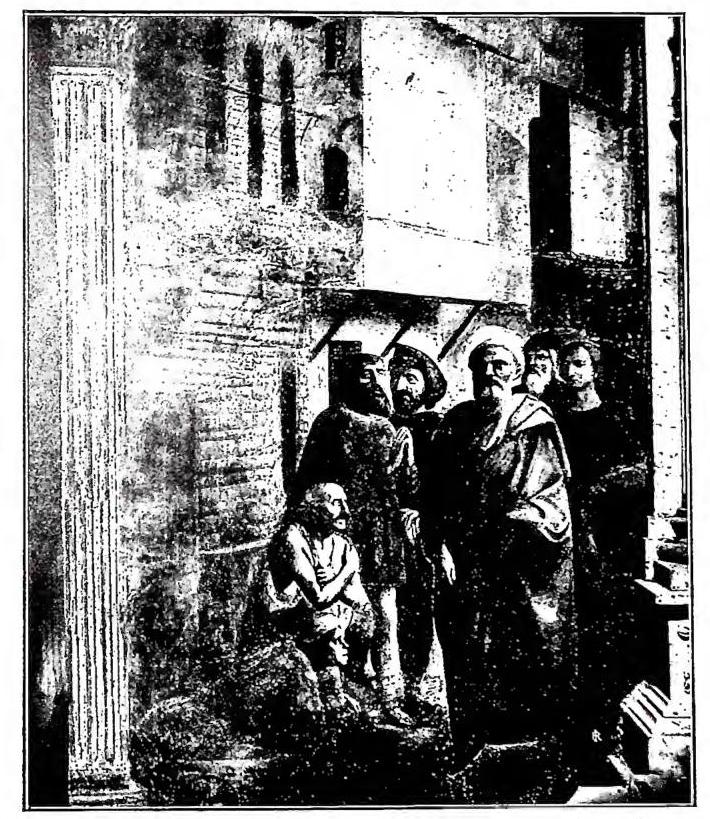
The artist appears wholly Renaissance in the frescoes of the Carmine church already mentioned, specifically those of the Brancacci chapel, begun for Felice Brancacci, a merchant and diplomat who returned from Egypt in 1423, in that same year or at the beginning of the following one, Masolino (v.), to whom the great M. was added after he had painted the vault sails. The walls were to illustrate the legend of s. Peter, but the vault and the lunettes were lost in the eighteenth-century remodeling (1746), even before a fire (29 January 1771) devastated the church and endangered the very existence of the chapel. To the first three stories frescoed by Masolino, M. had added a fourth: The Saint in the act of raising the dead, of which perhaps a memory survives in two astonished figures attributed to the young Michelangelo, in a drawing in the Teyler Museum at Haarlem. Before considering M.’s solemn surviving frescoes, however, it should be recalled that in 1426 (first payment, 26 February; last, 26 December) he executed a famous altarpiece for the Carmine church in Pisa, commissioned by the notary Giuliano di Colino degli Scarsi. There remain from it the Madonna with the Child enthroned and four angels (London, National Gallery), the Crucifixion above it (Naples, National Museum), a S. Paolo (Pisa, Museum), and a S. Andrea more than half-length (Vienna, Lanckoronski Collection), four small Saints, formerly in the framing pilasters, and the predella (Berlin, Museum), which, besides the Adoration of the Magi beneath the central compartment, represents the Beheading of the Baptist, the Crucifixion of s. Peter, S. Giuliano killing his parents, and S. Nicola endowing the three poor maidens. The four saints to whom the episodes mentioned refer are missing, as are two saints who, in the upper section, flanked the Crucifixion together with the two surviving figures. In this work M. painted, beginning with the Madonna and Child, a severe humanity, plastically defined and rationally illuminated by a unified light coming from the left; a humanity akin to Donatello’s, who had already adhered in relief to the Brunelleschian rules of perspective, of space limited and proportioned to the human figure. It is plausible to suppose that M. was in contact with the great sculptor precisely in 1426, in Pisa itself, where the latter was staying, with mutually fruitful effects which, in M.’s case, are evident not only in the defined spatiality but also in the resolutely plastic grandeur of the figures in the history of the Magi and in those of the Apostle and the Forerunner on the step (the other two, weaker works, belong to the workshop), and in the Crucifixion, here with a shading of human qualities ranging from the massive, immobile, heroized Christ to the dramatic Magdalene. M. worked on the surviving autograph frescoes of the Brancacci chapel from about 1426 to 1428. First, assisting Masolino, he took part in the great composition by this master—who went to Hungary in the second half of 1425—with the Healing of the Lame Man and the Raising of Tabitha, on the right wall, that is, in the buildings of a Florentine square set against a background of rigorous perspective and atmospheric value, in two seated figures and one standing figure, where the buoyant and luminous chiaroscuro already mentioned returns. M. must also have provided some drawing for the figure of the lame man, so praised by Vasari for the foreshortening of the leg, its chiaroscuro, and its volume, which Masolino translated rather weakly. In the two tiers of stories beneath the lunettes (which is all that remains of the fifteenth-century decoration), the idea of the architectural division with fluted Corinthian pilasters belongs to M.; these separate the stories themselves with clear Brunelleschian elegance.
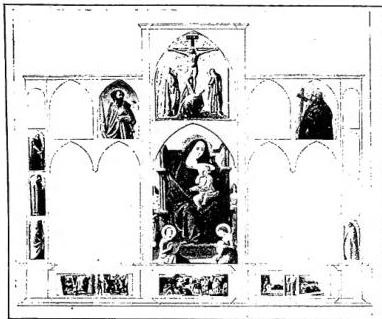
(da M. Salmi, M., Milano 1523, tov. 33)
MASACCIO, TOMMASO, detto — Reconstruction of the Pisa altarpiece.
This episode, left unfinished by M. and completed more than fifty years later by Filippino Lippi, must be connected with another moment in the Apostle’s legend frescoed on the pillar beneath the Expulsion: St. Peter in prison visited by St. Paul, FILIPPI (v.), to whom belong on the right wall St. Peter Freed from Prison, the Dispute with Simon Magus, and the Crucifixion of the Saint. M.’s paintings, executed in the order indicated, all obey a single principle (which, albeit with less concreteness and under his influence, also governs those of Masolino and governed those, likewise on the walls, that have been lost): namely, rationality in the distribution of light proceeding from an actual source—the window in the middle of the rear wall, replaced (1746) by the present ungainly window. Thus the individual scenes, according to their location, are more or less illuminated and possess their own more or less intense emergence and chromatic vibration. Color itself must originally have stood out with extraordinary vividness, as can be seen in the two assistants in the Baptism, already partly covered by the marble framing of the eighteenth-century altar. In this scene, the triangular space of a narrow valley receives the neophytes, suffused with soft chiaroscuro that is not monochrome but colored; from them the cloth of St. Peter (the head was redone by Filippino Lippi) and the kneeling person being baptized stand out, not through their contours but through their mass, rendered by tonal means, with the exaltation first and foremost of plastic form, and then of color.
The strongest light intervenes to define with stately power the figures in the Tribute (Mt. 17), a mature expression of M.’s genius, divided into three moments (Christ ordering Peter to fish in the Lake of Gennesaret for the fish in which he will find the two drachmas needed to enter Capernaum; Peter fishing against the background of a mountainous valley that widens and is articulated by a tree; Peter paying the tax collector); of these moments, the first is predominant and classically measured in the balanced arrangement of the severe landscape surrounding the noble, idealized Jesus and the Apostles, whose characters are delineated by human nuances culminating in the features of the obtuse tax collector, of unheard-of plasticity. And it was precisely for its composition and plasticity that this painting was the most admired by the Florentines of the Renaissance. In the Expulsion, the general tonality is rather dull; nevertheless, the light violently strikes the first parents with a simultaneously tragic and symbolic meaning, at the moment when they take possession of the world. And Eve’s emotion, derived from a praxistic Venus pudica—but devoid of all sensuality—corresponds to the withdrawn posture of the collapsed Adam.
On the lower register, a widespread chromatic joy appears in the Distribution of Alms, set in a hilly village suited to that elementary rural humanity, physically and morally healthy, seen in upward-looking compositions charged with anticipations; such must have been the figures in two lost frescoes: a St. Paul in the Carmine and a St. Ivo in the Badia Fiorentina. In certain touches in the landscape, worthy of a modern artist, and in certain pictorial passages in the figures, worthy of a Venetian, the prodigious innovations of M.’s painting emerge here.
The hardships within the narrow confines of a dark street in artisan Florence are then synthetically presented in the scene where Peter, dreamlike and idealized, heals the sick—now reservedly certain in their faith, now marked by animal obtuseness; and certain aspects are given greater prominence because they stand against those gray architectural forms of subdued tonality.
In the final great composition, the architectural scheme, with its polychrome enclosure and two projecting wings, recalls Giotto’s fresco in S. Croce of the Death and Funeral of St. Francis, though with a movement and depth (in the buildings on the left and in the background garden, touched with courtly refinement) that intensify the space. Wealthy burghers and a few witty commoners, kindred to Donatello’s expressive prophets, crowd together before Theophilus; they are constructed with a chromatic mixture of softened matter, brought to completion in the individual masses by clear notes, more powerfully heightened in St. Peter, firm as a pillar, and in the sharply foreshortened head of the kneeling St. Paul. The young man, however, whom the legend says was resurrected after fourteen whole years (Acts of the Apostles), has lost his native vitality in Lippi’s soft completion, in which Vasari claimed that he had portrayed the painter Fr. Granacci as an adolescent. He also lacks M.’s luminous substance, which likewise disappears in the eight figures that follow, in which one would like to recognize figures executed by Filippino; as was also the group of five figures behind Theophilus (among them Pulci), except perhaps for a young Florentine and a Carmelite who retain something of the Masaccian manner.
The great artist returns to his full authenticity on the right, on the improvised original throne in the praetorium. St. Peter sits ecstatic and praying, forming with the kneeling devotees a pyramidal plastic structure closed by the two standing groups. The soft fusion of chiaroscuro and color does not diminish the dense volumetry of those Carmelites and burghers, whose physiques are articulated with human vividness, distinguishing them from Giotto’s analogous arrangements of the suitors of the Virgin, frozen in prayer in the cycle at Padua. Among the laymen on the right, a still young man, shown three-quarter face toward the observer, seems to be recognizable as M.’s self-portrait, in place of the profile figure who, wrapped in a red mantle, towers in the Tribute, perhaps the patron Felice Brancacci. Before leaving the Carmine cycle unfinished to go to Rome, the artist must have marked on the adjacent pillar the outline of another composition: the Visit of Paul to Peter in Prison; a composition of extreme economy in the prison, crenellated like a tower, where the prisoner’s sad head is entirely in Lippi’s psychologism, but
Before his departure from Florence, M. painted two Deschi da parto. One, with a “skirmish,” which had been in the possession of the Medici, was lost, along with other works cited by the sources; the other, with the homage to a woman who had just given birth and, on the reverse, a putto playing with a marten—an example in which the artist’s workshop had a part—is in the Berlin Museum and tends toward the illustrative. He executed, principally in S. Maria Novella, the great fresco of the Trinity (formerly halfway down the church on the left wall, later transferred to the façade wall), within an architectural setting so Renaissance-like that some believed it to be by Brunelleschi himself. M., however, following in the wake of the great initiator, sought an architectural definition of the setting in relation to the figures, without a unified convergence of the perspective lines of the setting and of the figures; thus, through an illusionistic effect, the powerful group would emerge in the foreground. The frontal Eternal Father and the idealized Christ, like that of the Tribute, must be joined to the mystery of the Crucifixion (flanked by the austere Sorrowful Virgin and the monu-
revived by the colour, in certain places extremely vivid, the painting that concludes M.’s work suggests, in the illusionistic relationship between setting and figures, subsequent developments in painting, especially in the decorative field.
In Rome there are echoes of M. in the frescoes of the chapel of S. Caterina in S. Clemente (v. MASOLINO), but not his personal participation; among the works attributed to him, a small panel depicting the Miracle of the Possessed Man in the Johnson Collection in Philadelphia should be restored to his very modest collaborator Andrea di Giusto (influenced by Gentile da Fabriano and later by Angelico). In M., an intense physical and spiritual life is realized in the concreteness of space limited and proportioned to man, lord of the world, through chiaroscuro and light, with a predominance of plastic aims, to which there are sometimes added admirable anticipations of a pictorial nature. His genius developed in a straight and coherent line within a brief span of time, and does not permit the attribution to him—as a certain criticism, especially from beyond the Alps, still does—of works of uncertain character, or plainly late Gothic works due to Masolino, with whom he is even confused in the Brancacci Chapel. The artist is an expression of Florentine civilization; his world of real men coincides with that imagined by the first Tuscan humanism that preceded him; and he stands alongside the other two champions in adjoining fields—Brunelleschi and Donatello—as the founder of the painting of the new order of the Renaissance, which arose in Florence at the beginning of the fifteenth century. M., who died too young, had no pupils; nevertheless, many reflected upon and learned from the solemn histories of the Brancacci Chapel, the beginning of the Renaissance, down to Michelangelo and Raffaello. His painting, moreover, beyond all historical classification, is among the major events in the figurative civilization of every age. - Vedi tavv. XXI-XXII.