MARZIALE DI SAN GIOVANNI BATTISTA

MARCIAL OF SAINT JOHN THE BAPTIST. – French Discalced Carmelite bibliographer, born Jean Lacombe, c. 1666 at Tulle, d. 1 June 1736 at Bordeaux. A learned and exemplary religious, he held within his Order the offices of professor, prior in various convents, definitor and provincial of the province of Aquitaine.

He rendered great service to his Order and to ecclesiastical scholarship with his Bibliotheca scriptorum utriusque Congregationis et sexus Carmelitarum Excalceatorum (Bordeaux 1730), upon which subsequent bibliographers have depended.

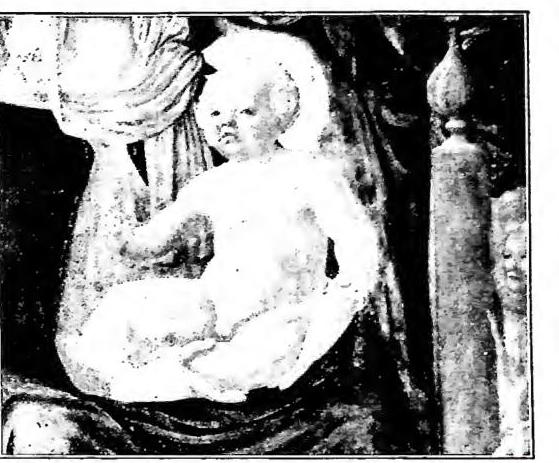
BIBL.: Enrico del S. M. Sacramento, Collectio scriptorum Ord. Carm. Exc., II, Savona 1884, p. 27; Anastasio di S. Paolo, MASSACCIO, TOMMASO, detto - Particolare del Bambino dal quadro di S. Anna, la Vergine e Gesù Bambino - Firenze, Galleria degli Uffizi.

MARCIAL, Bishop of LIMOGES, Saint – Commemorated in the German Martyrology on 30 June. According to St Gregory of Tours he would have been one of the seven bishops sent, c. the mid-3rd century, from Rome to Gaul to preach the Gospel there.

M. is said to have been assigned the city of Limoges; there, together with two priests whom he had brought with him, he preached and converted many. After his death he is said to have been buried in a crypt together with his collaborators. In 852 his body was translated to a new church.

According to a biography written in the 11th century, when in Gaul there was much debate to claim the apostolicity of various dioceses, probably by Adhémar of Chabannes, M. is described as a disciple of St Peter and sent by him to Limoges: this is evidently a legend manipulated with parochial spirit.

BIBL.: S. Gregorio di Tours, Historia Francorum, I, 30 and De gloria Confessorum, 27; L. Duchesne, Fastes episcopaux de l'ancienne Gaule, II, Paris 1910, pp. 104-117; Lanzoni, p. 57; Martyr. Romanum, p. 262 sq.; F. Wormald, The English saints in the Litany in Arundel Ms. 60, in Anal. Boll., (1946), pp. 84-86.

MARCIAL OF SAINT JOHN THE BAPTIST. – French Discalced Carmelite bibliographer, born Jean Lacombe, c. 1666 at Tulle, d. 1 June 1736 at Bordeaux. A learned and exemplary religious, he held within his Order the offices of professor, prior in various convents, definitor and provincial of the province of Aquitaine.

He rendered great service to his Order and to ecclesiastical scholarship with his Bibliotheca scriptorum utriusque Congregationis et sexus Carmelitarum Excalceatorum (Bordeaux 1730), upon which subsequent bibliographers have depended.

BIBL.: Enrico del S. M. Sacramento, Collectio scriptorum Ord. Carm. Exc., II, Savona 1884, p. 27; Anastasio di S. Paolo,
Article illustration

a new figure of the Renaissance that M. is the first to represent in painting.

In all things Renaissance appears the artist in the frescoes of the Carmine church already mentioned, precisely those of the Brancacci Chapel, begun for Felice Brancacci, a merchant and diplomat who returned from Egypt in 1423, in that same year or at the beginning of the following one, Masolino (v.), to whom was added, after he had painted the vault’s sail, the great M. The walls were to illustrate the legend of St Peter, but the vault and the lunettes were lost in the 18th-century remodelling (1746) even before a fire (29 Jan 1771) devastated the temple and threatened the very existence of the chapel. To the three first stories painted by Masolino, M. added a fourth: The Saint in the act of raising the dead, of which perhaps there is a memory in two astonished figures attributed to a young Michelangelo, in a drawing in the Teyler Museum in Haarlem. Before considering the surviving solemn frescoes of M., it should be recalled that in 1426 (first payment, 26 Feb, last, 26 Dec) he executed a famous polyptych for the Carmine church in Pisa, commissioned by the notary Giuliano di Colino degli Scarsi, of which remain the Madonna and Child enthroned with four angels (London, National Gallery), the Crocifixion above (Naples, National Museum), a St Paul (Pisa, Museum) and a half-length St Andrew (Vienna, Lanckoronski collection), four small saints, formerly on the pilaster strips, and the predella (Berlin, Museum), which, besides the Adoration of the Magi beneath the now-lost central panel, depicts the Beheading of the Baptist, the Crucifixion of St Peter, St Julian killing his parents, and St Nicholas endowing the three poor maidens. Missing are the four saints to whom the mentioned episodes refer, and two saints who in the upper part flanked, with the two survivors, the Crucifixion. In this work M. painted, beginning with the Madonna and Child, a severe humanity, plastically defined and illuminated according to a rational norm by the light that, unitary, comes from the left; a humanity akin to that of Donatello who in relief had already adhered to the perspectival rules of limited space and measured to the human figure as theorised by Brunelleschi. It is reasonable to suppose M. in contact with the great sculptor, precisely in 1426 in Pisa itself where Donatello was, with mutually fruitful effects that in M.’s case are evident, beyond the defined spatiality, in the decidedly pilaster-like figuration in the story of the Magi and in those of the Apostle and the Precursor on the step (the other two, weaker, belong to the workshop) and in the Crucifixion, here with a shading of human characters from the massive immobile heroic Christ to the dramatic Magdalene. To the surviving autograph frescoes of the Brancacci Chapel M. attended from c. 1426 to 1428. First he took part, assisting Masolino, in the great composition of this master – who in the second half of 1425 went to Hungary – with the Healing of the Lame and the Raising of Tabitha, on the right wall, i.e. in the buildings of a Florentine piazza in the background, with rigorous perspective and atmospheric value, in two seated figures and one standing, where the soft, luminous chiaroscuro of which we have spoken returns. M. must also have supplied some drawings for the figure of the lame man, so praised by Vasari for the foreshortening of the leg, the chiaroscuro and the volume, which Masolino translated rather weakly. In the two tiers of stories beneath the lunettes (all that remains of the 15th-century decoration) it is then M. who conceives the idea of the architectural division with Corinthian fluted pilasters, which articulate the stories themselves with clear, elegant Brunelleschian precision.

Beside the aforementioned composition, on the back wall M. painted the *Baptism of the Neophytes*, to which corresponds Masolino’s *Sermon of St Peter*. To the left wall is the *Tribute Money*, and on the entry pier the *Expulsion of the Progenitors* by M.; while on the opposite pier his companion had depicted Adam and Eve being tempted. On the lower register, still on the back wall, M. returns to execute the *Distribution of Alms* and the *Death of Ananias*, *St Peter Healing the Sick with his Shadow*, and finally beneath the *Tribute Money* the *St Peter in His Chair* and the *Resurrection of the Son of Theophilus, Prefect of Antioch*. This episode, left unfinished by M. and completed more than fifty years later by Filippino Lippi, is connected to another moment in the Apostle’s legend painted on the pier beneath the *Expulsion*: *St Peter in Prison Visited by St Paul*, FILIPPI (v.). To the right wall belong *St Peter Freed from Prison*, the *Disputation with Simon Magus*, and the *Crucifixion of the Saint*.

The paintings by M., executed in the order indicated, all obey a principle (which, albeit with less concreteness and under his influence, governs those of Masolino and governed the lost frescoes on the same walls), namely the rational distribution of light emanating from an actual source: the large window in the centre of the back wall, replaced in 1746 by the ungraceful window now in place. Hence each narrative scene, according to its position, is more or less illuminated and possesses a more or less intense chromatic vibrancy. It was above all the colour that originally stood out with extraordinary vividness, as can be seen in the two attendants at the *Baptism*, partly concealed by the marble framework of the 18th-century altar. In this scene the triangular space of a narrow valley encloses the neophytes rendered with soft chiaroscuro not monochrome but coloured, from which emerge the bulky figure of St Peter (whose head was repainted by Filippino Lippi) and the kneeling baptismal candidate, not by outlines but by masses of tone, with plasticism first and foremost, then colour.

The strongest light defines with statuesque power the figures in the *Tribute Money* (Mt 17), a mature expression of M.’s genius, divided into three moments (Christ ordering Peter to cast his net into the Sea of Galilee to find the coin with which to pay the temple tax; Peter fishing against a backdrop of a widening mountain valley marked by a tree; Peter paying the tax collector); moments of which the first, pre-eminent and classically measured in the balanced arrangement of the severe landscape around the idealized noble Christ and the Apostles, is refined by human nuances culminating in the features of the dull tax collector, of unprecedented plasticity. It was precisely for its composition and plasticity that this fresco was most admired by Florentines of the Renaissance.

In the *Expulsion* the overall tone is rather muted, yet the light strikes the progenitors with violent tragic and symbolic force at the moment they take possession of the world. To the emotion of Eve, derived from a modest Praxitelean Venus—but devoid of any sensuality—corresponds the pensive collapse of Adam.

On the lower register a joyous chromatic expanse presents the *Distribution of Alms*, set in a hilly village suited to that elemental rural humanity, physically and morally sound, seen from below in anticipatory groupings such as must have been the figures in two lost frescoes: a *St Paul* in the Carmine and a *St Ivo* in the Badia Fiorentina. In certain touches in the landscape, worthy of a modern, and in certain passages in the figures, worthy of a Venetian, the prodigious novelties of M.’s painting come to the surface.

The wretchedness within the narrow confines of an artisan’s street in Florence is succinctly presented in the scene where Peter, dreamy and idealized, heals the sick, now with reserved certainty in their faith, now with animal dullness; and certain aspects are heightened because of the grey architecture of a lowered tonality.

In the last great composition the architectural scheme, with its polychrome enclosure and two projecting wings, recalls Giotto’s fresco in Santa Croce of the *Death and Funeral of St Francis*, yet with movement and depth (in the buildings to the left and in the garden in the background touched by a lofty refinement) that intensify the space. Wealthy burghers and some sharp-witted commoners, akin to Donatello’s expressive prophets, crowd in front of Theophilus, constructed with a chromatic impasto of softened matter resolved into individual masses by clear accents; more energetically reinforced in St Peter, solid as a pillar, and in the sharp foreshortening of the head of St Paul kneeling. Instead, the youth said in the legend to have been raised after fourteen years (*Acts of the Apostles*) has lost its native vitality in the soft completion by Lippi, who, according to Vasari, portrayed the painter Francesco Granacci as an adolescent. It lacks the luminous substance of M., which also disappears in the eight figures that follow, in which one would like to recognize portraits by Filippino; as he did for the group of five figures behind Theophilus (among them Pulci), except perhaps for a young Florentine and a Carmelite who retain something of Massaccio’s ruggedness.

The great artist returns to his full authenticity on the right, on the primitive chair improvised in the praetorium. St Peter sits enraptured and praying, forming with the kneeling devotees a pyramidal plastic construction closed by the two standing groups.

Article illustration
(fol. Andreani
Masaccio, Tommaso, detto - *St Peter Healing the Sick with his Shadow* - Florence, Brancacci Chapel in the Carmine.

The soft fusion of chiaroscuro and colour does not diminish the dense volumetric quality of those Carmelites and burghers, whose bodies are articulated with human clarity, differing from analogous compositions by Giotto in the supplicant suitors in the Paduan cycle. Among the lay figures on the right, in a still-young man seen in three-quarter view facing the observer, one seems to recognize M.’s self-portrait, in place of the profile figure wrapped in a red mantle that looms large in the *Tribute Money*, perhaps the patron Felice Brancacci. Before leaving the Carmine cycle unfinished to go to Rome, the artist must have marked on the adjacent pier the outline of another composition: the *Vision of Paul with Peter in Prison*; a composition of extreme economy in a merloned prison like a tower, where the prisoner’s sad head is entirely in Lippi’s psychological vein, but the rigorous three-quarter view of the Apostle of Tarsus betrays its Masaccesque ancestry (through a drawing, a cartoon or a sinopia?) that Filippino is unable to conceal.

Before his departure from Florence, M. painted two *Deschi da parto*. One, with a “skirmish” that belonged to the Medici, was lost along with other works mentioned in the sources; the other, depicting homage to a woman in childbed and on the reverse a cherub playing with a weasel—an work in which the artist’s workshop participated—is now in the Berlin Museum and tends toward the illustrative. He also executed in Santa Maria Novella the great fresco of the *Trinity*, once situated midway up the left wall and later moved to the façade wall within an architecture so Renaissance in style that some believed it to be by Brunelleschi himself. Instead, M. followed the lead of the great innovator in defining the architectural space in relation to the figures, without achieving a unified convergence of the perspective lines of both. Thus, with an illusionistic effect, the powerful group emerges in the foreground. The frontal Eternal and the idealized Christ, akin to that in the *Tribute*, are united with the mystery of the *Crucifixion* (flanked by the austere Sorrowing Virgin and the monumental Saint John), in which the drama is as if repressed within the static contemplation to which the patrons—of the same stature as the deity in the Renaissance—are joined, though with their own physiognomies: the cunning, refined profile of the man and the kindly, rustic features of his companion. Enlivened by color, at times harsh, the painting that concludes M.’s work suggests, in the illusionistic relationship between space and figures, developments that would follow in painting, particularly in the decorative arts.

In Rome, echoes of M. appear in the frescoes of the chapel of Saint Catherine in San Clemente (cf. MASOLINO), though not through his personal participation; among the works attributed to him, a panel with the Miracle of the Possessed in the collection in Philadelphia should be restored to his most modest collaborator, Andrea di Giusto (influenced by Gentile da Fabriano and later by Fra Angelico). In M., an intense physical and spiritual life is realized within the concreteness of space, measured and proportioned to man as master of the world, through chiaroscuro and light with a prevailing concern for plasticity, to which are sometimes added remarkable premonitions of pictorial order. His genius unfolded in a straight and contained path within a brief span of time, and it does not permit the attribution to him—still claimed by certain critics, especially beyond the Alps—of works of uncertain character or frankly late-Gothic in style, which are instead due to Masolino, with whom he is even confused in the Brancacci Chapel. The artist is an expression of Florentine civilization; his world of true men coincides with that envisioned by the early Tuscan humanism that preceded him; and he stands alongside the other two pioneers in contiguous fields—Brunelleschi and Donatello—as the founder of the painting of the new order of the Renaissance, which arose in Florence in the early fifteenth century. M., dying too young, had no pupils; yet many meditated upon and learned from the solemn narratives of the Brancacci Chapel, the beginning of the Renaissance, up to Michelangelo and Raphael. His painting, moreover, apart from any historical contextualization, stands among the greatest events in the visual culture of all time. — See plates XXI–XXII.

BIBL.: O. H. Giglioli, M. Saggi di bibliogr. ragionata, in Bollett. dell’Istituto di archeol. e storia dell’arte, 3 (1929), pp. 55 ff.; R. Oertel, M. Frühwerke, Marburg an der Lahn 1933; M. Pirtaluga, M., Florence 1935; R. Longhi, Fatti di Masolino e di M., in La critica d’arte, 5 (1940, no. 11); M. Salmi, M., 2nd ed., Milan 1948; id., La cappella Brancacci a Firenze, 2 vols., ibid. 1949 and 1951 (with color reproductions).