
TULLE, DIOCESE of. — Diocese and capital city of the department of Corrèze, formerly of Lower Limousin in France.
It has an area of 5,887 sq. km. and a population of 254,000, of whom 245,000 are Catholics, distributed among 293 parishes grouped into 3 archpresbyterates. It is served by 228 diocesan priests and 16 religious priests; it has a major and a minor seminary, 6 male and 55 female religious communities (Ann. Pont. 1953, pp. 436).
The name seems to derive from an ancient local divinity, Tutela. The diocese was created by Pope Giovanni XXIII on 15 August 1317. The English occupied it in 1346 and 1369. A terrible fire devastated the city on 24 May 1524; it also suffered during the Wars of Religion. The diocese is a suffragan of Bourges, and its patron is S. Martino di Tours. An abbey arose on the site, founded, according to some, by s. Martino, and according to others by s. Calmino, an exile from Auvergne; the diocese was formed by subdivision from that of Limoges, and its first bishop was the abbot Arnaldo di St-Astier; but the Chapter was not secularized until 1517. Among his successors are remembered: Ugo Roger, known as the cardinal of T. (1342–43); J. Fabri (1370–1371), later a cardinal; J. Mascaron (1671–79), who died bishop of Agen in 1703; Ch. Duplessis d’Argentré (1723–1740); J. B. Berteaud (1842–78).
The Cathedral is the former abbey church of S. Martino, dating from the twelfth century. A portico with arches leads to the portal of Limousin type; the bell tower rises to 75 m. and ends in a spire dating from the fourteenth century; on its northern face, in the tympanum of the windows, is a seated Madonna between two angels, and in two niches are s. Martino and an abbot. The interior is divided into three naves by pillars formed of clusters of four columns; the apse no longer exists. The venerated painted and gilded wooden statue of S. Giovanni Battista was carried in procession on the evening of 24 June in fulfillment of a vow made in 1348 during the plague; it was called the « procession de la lunade », because in 1348 the evening of 24 June was the night of the full moon. To the right of the Cathedral are the thirteenth-century cloister and the chapter house, which preserves fourteenth-century frescoes depicting the Lord’s Entry into Jerusalem and the Last Supper. Part of the Archaeological Museum has been installed in the cloister; it contains the statue of Notre-Dame-du-Bois-des-Moines and architectural fragments from the Cathedral. Annexed to the Cathedral is the artistic « de Loyac » house, or « maison de l’abbé », dating from the sixteenth century. The seventeenth-century Visitation monastery, with its octagonal chapel, has been converted into a hospice. The former church of S. Pietro, once belonging to the Carmelites, is octagonal in form and surrounded by chapels dating from the end of the seventeenth century.
Born in the territory of the diocese were s. Martino di Brive (fifth century), a disciple of s. Martino di Tours; s. Sacerdote, born at Argentat and later bishop of Limoges (sixth century); s. Liberale, born at Brive and died there in 940, who was bishop of Embrun; s. Stefano di Aubazine, who founded a Cistercian monastery there at the end of the eleventh century (Cottineau, I, col. 185); s. Bertoldo di Mabefayde, master general of the Carmelites (twelfth century); and the missionary Dumolin Borie (1808–1838), a martyr in Tonkin. In the diocese, specifically at Maumont, was born Pierre Roger, Clemente VI (v.), and at Château-des-Monts was born Stefano Aubert, Innocenzo VI (v.).
The principal sanctuaries venerated in the diocese are Notre-Dame-de-Belpeuch at Camps, Notre-Dame-de-Chastre at Bar, Notre-Dame-du-Pont-du-Salut (pilgrimage on 8 September); Notre-Dame-du-Roc at Servières; Notre-Dame-de-la-Buissière-Lestards; Notre-Dame-de-la-Chabanne at Urssel, with a wooden statue of the Madonna; Notre-Dame-de-Penacor at Neuvic, an ancient church (twelfth–fifteenth centuries).
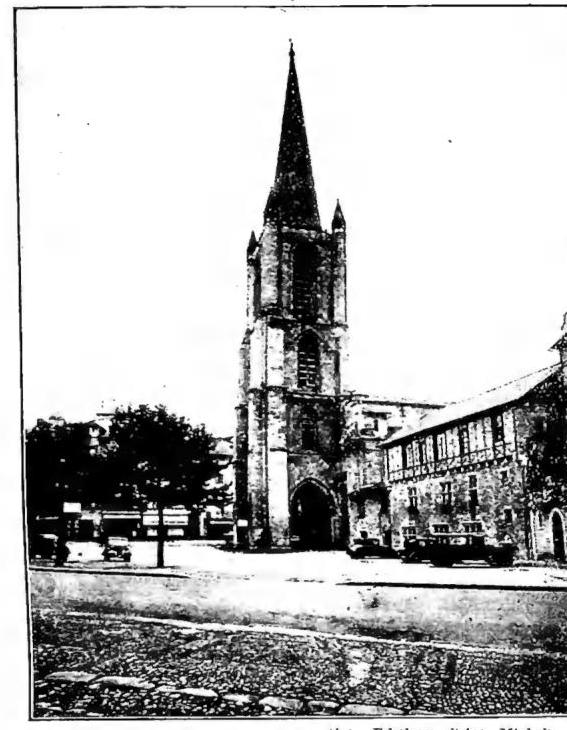
(photo Editions d’Art Michel)
TULLE, DIOCESE of — The Cathedral tower (twelfth–sixteenth centuries) and the « maison de l’abbé » (sixteenth century) — Tulle.
with a Romanesque church; it passed to the Cluniacs in 1096 and to the Maurists in 1663 (Cottineau I, cols. 296–97). The Chartreuse of Notre-Dame at Glandier was founded in 1219 by Archambaud de Comborn; it was suppressed in 1790, re-established after 1869, and suppressed again in 1905 (Cottineau, I, col. 1290). The Benedictine abbey of S. Pietro Uzerche was founded between 958 and 991 by Bishop Ildegario; it was secularized in 1745. The twelfth-century abbey church has three naves, five radiating chapels, a crypt, and a Romanesque bell tower (Cottineau, II, col. 3248). The priory of Meymac, founded by Arcibaldo III, viscount of Comborn, in 1080, became an abbey in the first part of the twelfth century; it passed to the Cluniacs in 1662 and to the Maurists in 1670 (Cottineau, II, cols. 1839–40).
The church of the former Benedictine abbey of Beaulieu-sur-Dordogne, founded by Rodolfo di Turenne, archbishop of Bourges, around the year 885, is noteworthy; it is a prominent example of the Languedoc Romanesque school of the twelfth century. Its southern portal, of the type found at Moissac, also presents the Last Judgment in the tympanum; it has a square tower on the façade and an octagonal one over the transept. The interior has three naves with upper galleries and two terminal apses in the transept, at the center of which rises a dome. The choir is surrounded by an ambulatory with three radial chapels; in the apse are bas-reliefs of the Assumption and coronation of the Blessed Virgin. In the sacristy is a wooden image of the Madonna clad in silver (twelfth century); there are also reliquaries from the thirteenth century.