
LIMOGES, DIOCESE of. — City and diocese in the departments of Haute-Vienne and Creuse. It has an area of 11,085 sq. km. and a population of 522,442 inhabitants, of whom 475,000 are Catholics; it has 480 parishes, served by 355 diocesan priests and 7 religious priests, 3 male and 76 female religious communities (Annuario Pontificio, 1951, p. 247).
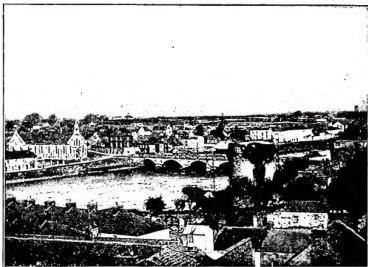
It is the ancient capital of the Lemovices, situated high on the banks of the Vienne, 2 km. from the present city. The Romans called it Augustoritum; it later extended into the plain now occupied by the faubourg St-Martial. In the Middle Ages L. consisted of the Cité, the residence of the bishop, with the Cathedral, monasteries, etc., and the Château, the residence of the viscount and the civil popula-
The oldest list of the bishops of L. is the autograph list of the chronicler Ademarus, a monk of S. Marziale, which extends to 1030; it was continued in the thirteenth century by another monk of the same abbey and extends to 1294. Gregory of Tours gives s. Marziale (v.) as the first bishop of L., one of the seven bishops sent from Rome in the middle of the third century (Historia Francorum, I, 30); he is commemorated on 30 June in the Hieronymian Martyrology (L. Duchesne, Fastes épiscopaux de l'ancienne Gaule, II, 2nd ed., Paris 1910, pp. 104-117). Other known bishops are Enrico, sent into exile (d. in 485), Rurico I and II; their epitaphs were composed by Fortunato (Carm., IV, 5), as was that of Exocuis (ibid., IV, 6); Lupo, who signed the foundation charter of the monastery of Solignac in 622; Stadilo (846-60), who crowned Carlo il Calvo king of Aquitaine; and Aldo, who took part in the Council of Soissons (866).
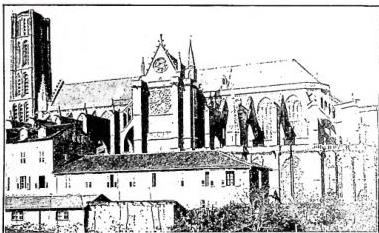
From a basilica called St-Pierre-du-Sépulcre one entered a crypt, a place of pilgrimage, which was divided into three chambers: in the first were the sarcophagi of s. Marziale and of two priestly companions of his, Alpiniano and Stratocliano; in the second, those of a matron named Valeria; in the third, those of a duke named Stefano. Until the ninth century the sanctuary was served by ecclesiastics, the first of whom bore the title of martyriaria; in 848 the monastery was established, and the basilica of the Most Holy Saviour was erected, the body of s. Marziale being transferred there. The dedication took place in 852; the building was reconstructed at the beginning of the eleventh century and consecrated on 19 November 1028. In 1535 the monastery was secularized and the monks were changed into canons; everything was destroyed by the French Revolution. A legend relates that s. Marziale, having gone to the pagan temple of L., broke the statues of the pagan divinities and consecrated the building to s. Stefano. In 1012 Bishop Odoino demolished the church in order to build a new one, which was burned by Ademaro, viscount of L. After being restored, it was consecrated by Urban II on 29 December 1095. Burned by the inhabitants of the Château in 1105, it was repaired. The vault of the crypt is decorated with a colossal figure of Jesus Christ, a small image of the Magdalene, and the symbols of the evangelists Luke and John (L. Bourdery, Peintures de la crypte de la cathédrale de L., in Bulletin de la Société archéologique du Limousin, 46 [1916], p. 59 ff.). The Cathedral was rebuilt in 1273 on the model of those of Clermont Ferrand and Narbonne. The choir was completed in 1327; the transept in 1499. The façade was decorated by Bishops Filippo di Montmorency and Villiers de l'Isle-Adam (1517-30); his successor Giovanni di Langeac (1532-41) built the jubé; the final bays of the nave and the narthex were begun only in 1876. The tall bell tower dates from the thirteenth century. Inside the Basilica are the tombs of Cardinal Rainaldo de la Porte, bishop of L. from 1294 to 1316; of Bishop Giovanni di Langeac (1532-41); and of Bernardo Brun, bishop of Puy, Noyon, and Auxerre (1350). The fifteenth-century stained-glass windows depict the Administration, s. Marziale, and s. Valeria. The church possesses several precious enamels.
The church of St-Pierre-du-Queyroix (of the Crossroads), although retaining elements from the thirteenth century in the lower part of the façade, was almost entirely rebuilt during the fourteenth, fifteenth, and sixteenth centuries, and again in the nineteenth. The tower (thirteenth-fourteenth centuries) is a local feature also found in the Cathedral and in St-Michel-des-Lions. Inside, the nave has cylindrical pillars and beautiful stained-glass windows by J. Pénicaud (1510), extensively restored.
The church of St-Michel-des-Lions, begun in 1364, was lengthened in the sixteenth century. Its bell tower was erected in 1373, in the same style as that of St-Pierre-du-Queyroix, but more slender and elegant, and reaches a height of 55 m. The interior has three aisles with pillars; the fifteenth-century stained-glass windows depict scenes from the life of the B. Virgin and of s. John the Baptist. The high altar, from 1889 and in the style of the fifteenth century, houses the relics of s. Marziale, venerated until the Revolution in the church bearing his name.
The church of Ste-Marie formerly belonged to the Dominicans and preserves a thirteenth-century portal. The old Episcopal Palace (1766-86) houses the Municipal Museum, and its adjoining garden is now a public garden. The former Séminaire des Ordinands passed to the civil administration in 1819.
L. was known under the Merovingians for its goldsmiths’ products and its mints.
(from L. Schürenberg, Die kirchliche Baukunst in Frankreich, Berlin 1931, inv. 5) LIMOGES, DIOCESE of — South side of the Cathedral (thirteenth-fourteenth centuries).
The abbey of Solignac (ancient Solemniacum), south of L. on the Briance, belongs to the diocese of L. The abbey was founded in 631 by s. Eligio, who, together with his disciple s. Tillon, made it the cradle of Limoges goldsmithing. The church, consecrated in 1143, has a façade with a double tier of arches; on one of the portals the Eternal Father is carved between the symbols of the evangelists John and Luke. It formerly had three bell towers. It has four domes and a very broad central nave. The crypt opens beneath the apse. The choir stalls are decorated with the works of mercy (fifteenth century). The church preserves fragments of the reliquary of s. Caterina, in bronze deco-
The monastic buildings dating from the 13th century were rebuilt in 1720; looted during the Revolution, they were recently restored and now house a retirement home, a holiday colony, and other Catholic works, under the title Centre d'action sociale de Solignac. - Vedi tav. XCII.