
CATHERINE OF ALEXANDRIA, Saint, Martyr. — Of this martyr, called Αικατερίνη, Ecaterina, Aecaterina, whence by apheresis Catherina or Katherina, who became so popular after the year 1000, there are two hagiographical texts: the Conversio and the Passio, late documents in which it would be difficult if not useless to seek an original historical nucleus. The name of C. does not appear in any literary or liturgical text of ancient Christianity known to date. It has been proposed to identify C. with the anonymous Alexandrian virgin who resisted the blandishments of Maximinus Daia (Eusebius, Hist. eccl., VIII, 14-15), but this Christian was exiled, not put to death. Others have even thought of the celebrated Hypatia, slain by fanatical Christians in March 415, but as is well known, she died a pagan.
The Passio of C., in its various redactions and versions, is now quite well known (BHL, 1657-67, 1673; supplementum [1911], pp. 70-71; BHG, 30-32; BHO, 26); the same cannot be said of the Conversio (BHL, 1668-72, 1676-78; supplementum, p. 71), which is prefixed to certain Western versions of the Passio but has not yet been systematically published or studied in its literary tradition. Among the texts published recently are the anonymous Genoese (late 13th–early 14th cent.) and the poem by Bonino Mombrizio (15th cent.).
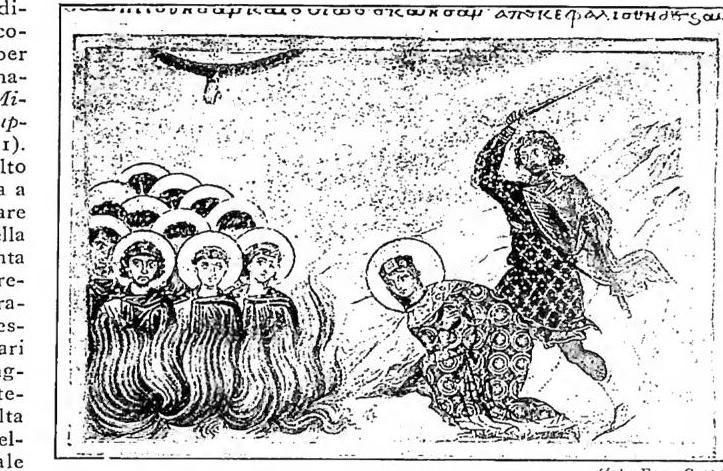
The Conversio, besides emphasizing the royal origin of C., contains among other things the account of her mystical espousal to Christ, which took place in the presence of the Blessed Virgin Mary on the first night after her baptism, during a vision. The Passio contains the discourses of C. to Maxentius [Maximinus], emperor of Alexandria, and to the learned men gathered there by him; their conversion and martyrdom by fire; the scourging and imprisonment of C.; the conversion of the empress; the breaking of the spiked wheel with which C. was to be tortured; and finally her death by beheading, which according to different recensions occurred on 24 or 25 November 305. The Passio ends with the account of the transport of C.’s body to Sinai by angels. The Alexandrian origin of this Passio is not certain, according to P. Delchaye. As for its date of composition, the discovery in the Claramontano manuscript of an index of a lost passionary containing the notice: Passio Ecaterine virginis (perhaps identical with BHL, 1657) is noteworthy.
A tutt'oggi è cosa certa che la più antica traccia di una qualche venerazione verso la martire C. è attestata da una pittura, ancora inedita, rinvenuta nel 1948 in un oratorio posto sul lato nord della basilica pelagiana di S. Lorenzo all'Agro Verano, rappresentante C. accanto al trono di Maria S.ma con la scritta S. Ecaterina. Tale pittura risale al sec. VIII, forse alla sua prima metà, epoca in cui i monaci orientali erano numerosi e influenti nell'Urbe. Seguono poi la pittura con S. Ecaterina della catacomba di S. Gennaro a Napoli, posta dall'Achelis alla fine del sec. VIII (la datazione fine sec. X-XI, proposta dal Weigand non è fondata) e la Passio contenuta nel ricordato manoscritto Claramontano. Il suddiacono napoletano Pietro (inizio sec. X) avrebbe fatto o riveduto una versione della Passio della Santa. C. è ricordata al 25 nov. nel Menologio di Basilio II (976-1025) e nei Sinassari.
Sul calare del sec. x, C. doveva essere particolarmente conosciuta, se non oggetto di culto, a Montecassino; infatti un calendario dell'abbazia (2ª metà del sec. x) la ricorda al 25 nov. (cod. CCXXX, cf. Bibliotheca Casinensis, IV: Florilegium [Montecassino 1880, p. 370]); un lezionario e un passionario del sec. xi (ibid., III, 1877, pp. 74, 184) contengono la sua Passio (BHL, 1658, 1662) e il monaco cassinese, Alfano, poi arcivescovo di Salerno (1058-86), compone in suo onore tre splendidi inni (PL 147, 1240-41). Anche in Francia il principale centro propulsore del culto della Santa è il monastero benedettino di La-Trinité-au-Mont, presso Rouen, dove tra il 1033 e il 1054 furono portate reliquie di C. che divennero presto conosciutissime per le loro virtù taumaturgiche (cf. Miracula in BHL, supplementum, p. 71). Col sec. xi il culto di C. incomincia a diventare popolare e l'inserzione della sua festa diventa sempre più frequente nei sacramentari, nei messali e nei breviari (dapprima in aggiunte, poi nel testo), come risulta dai cataloghi dell'Ebner (l'attuale orazione figura già in un Messale del sec. xii: p. 160) e del Leroquais. Col sec. xii, il culto di C. si può dire diffuso in tutta l'Europa. Non v'è città di qualche importanza o diocesi che non eriga chiese e oratori in suo onore, e talvolta la sua festa è preceduta da una vigilia (cf. Breviario di Beauvais del sec. xi, in V. JALABERT, LOUIS, Les bréviaires, III, p. 419). Il AUSILIATORI, SANTI (v.). L'Università di Parigi la volle per sua patrona, e oggi ancora è protettrice degli studenti, dei filosofi e delle giovani. Il Doyé enumera altre 30 categorie di persone che la invocano come loro patrona.
A. Pietro Frutaz
ICONOGRAPHY. — The characteristic iconographic motifs of Saint Catherine are: the broken wheel, sometimes with twisted spokes, placed to the side at the bottom or raised in her right hand; the book, symbol of learning; the crown, indicating her royal lineage; and also the episodes relating to her mystical espousal, her martyrdom, and her translation to Mount Sinai.
In the East, representations of Saint Catherine are very common, even in miniatures; one of the oldest is in the Menologion of Basil II.
In Italy, noteworthy examples include a 13th-century fresco in the church of the Santi Quattro Coronati in Rome; in Pisa, in the Museo Civico, a 13th-century polyptych with stories of the saint, still called Ecaterina. The same museum now houses another polyptych that Simone Martini painted in 1320 for the church in Pisa dedicated to the saint, in which Catherine appears in one of the side panels. She also appears in a compartment, now in the Kress Collection in New York, of a polyptych painted by Giusto de’ Menabuoni in 1363 for Sister Isotta Terzaghi in Padua.
The stories of the disputation, the conversion of the doctors and the empress, and the martyrdom were frequently the subject of entire pictorial cycles. Stefano da Zevio depicted them in the chapel of San Giorgio in Padua, Masolino in San Clemente in Rome, Mattia Preti in San Pietro a Maiella in Naples, and Guglielmo Borremans in the oratory of Santa Caterina attached to the church of San Francesco d’Assisi in Cosenza. A Mystic Espousal by Correggio is in the Louvre, another by Van Dyck is in the museum in Vienna, and a scene of the martyrdom appears in an engraving by Dürer.
Sculptors also often depicted her, always with the hooked wheel. Notable are the bas-reliefs from the school of Tino da Camaino (14th century) in Santa Chiara in Naples.
In some countries, as, for example, in France, girls used to celebrate this day with games and dances, during which they elected a “queen”; little girls awaited gifts of sweets and toys in a stocking or empty shoe, exposed in the evening of the vigil, as for the Befana. In Valtellina, besides traditional games, the “vampate,” bonfires lit in honor of the saint, are typical on the eve of the feast. In popular tradition, the day of St. C., around which some meteorological proverbs revolve, announces the beginning of winter and the Christmas season. From this day, in Emilia, among religious families, the recitation of Hail Marys begins, which must reach the number of a thousand by the vigil of Christmas. In Rome, as one reads in a famous sonnet by Belli, it was customary to remove the mats from the stairs, the light covers from the beds, and to begin lighting fires in the rooms, while from the mountains of Abruzzo the pifferari descended for the Christmas novena.
A reflection of the popularity of the cult of C. is offered by the numerous production of popular poems, inspired by her legend, which in their details present notable divergences due to their popular nature, tending toward the fantastic. In Italy the oldest of these poems were composed in the north, in strophes resembling the lassa. Noteworthy are: the anonymous Genoese of the 13th century, published by N. Lagomaggiore; a Veronese text, from a 14th-century codex of the Marciana in Venice, by Mussafia; a Tuscan-Venetian-Lombard redaction of the versified legend, by Ranier; another in Franco-Veronese language, by Beuer; an Abruzzese composition by Buccio di Ranallo of Aquila (d. 1363) in the meter and tone of the giullare (14th century). Somewhat later are certain “stories” in ottava rima, of which manuscripts and incunabula are known; noteworthy is incunabulum no. 1617 (O. VII, 26) of the Casanatense, and another attributed to a Johannes dictus Florentinus, in the Palatine collection of the National Library in Florence; a cantare in 110 ottave is preserved in ms. 2273 (parchment, 15th century) of the Angelica Library in Rome. Such “stories” continued to be printed for several centuries and to spread through popular booklets. There also exist songs still alive in the oral tradition of the people, which recount, in very brief strokes, the principal episodes of the legend. The legend has also been treated dramatically on several occasions. A grand representation of 204 stanzas (1,632 verses) in the ancient meter of the lauda is preserved in cod. I, II, 33 of the Communal Library of Siena (perhaps the laudario of the Company of St. C. of the Night): it is divided into three days and is “the only large-scale representation that Italian medieval theater produced in this form.” A sacred representation in ottava rima was composed in Florence in the 15th century. — See Pl. LXIII.