
JANUARIUS, bishop of BENEVENTUM, saint, martyr, and COMPANIONS. — These are: the deacon Sossius of Misenum, deacon of G., Festus and the lector Desiderius, all condemned “ad ursos” in the amphitheatre of Puteoli; however, due to the delay of the judge Dracontius, they were beheaded together with Proculus, deacon of Puteoli, and the two laymen Eutyches (Eutices) and Acutius. So states the Passio.
Uranius relates that Paulinus of Nola, in the last days of his illness, believed he had spoken with his two fellow bishops Martin of Tours and G., who “episcopus simul et martyr neapolitanæ urbis inlustrat Ecclesiam” (PL 53, 861). Gregory of Tours in 587 calls him “Genuarium Italicum” (In gloria confessorum, II, 107). But the details of the life and martyrdom of St G. and his companions are known only from his Passio, of which there are two recensions: the first from a single Latin manuscript preserved in Bologna and thus designated by Mazzocchi, its first editor, as the Acta Bononiensia (BHL 4132); Bede made use of this in his Martyrology (II. Quentin, Les Martyrologes historiques du moyen âge, Paris 1908, p. 75). They were written around the 6th century; a second recension is that known as the Acta Vaticana (BHL 4115-17). They were translated into Greek around the 10th or 11th century in one of the Greek monasteries of Italy, as shown by two manuscripts, Vat. 1608 from Grottaferrata and Vat. 2072 “olim monasterii Carbonensis”. This translation became known in the East because the Synaxaria provided an abridgement (Synax. Constantinop., col. 59).
A Greek life of St G., attributed to a monk named Emmanuel who is said to have written it at the command of Bishop Stephen, is the work of a forger of the 17th–18th centuries.
According to P. Franchi de’ Cavalieri, the Acta Bononiensia fused the first part of the Passio of Sossius with the second part of that of St G. from around the 6th century. The date of the martyrdom is 19 September, also recorded in the calendar of the Church of Carthage of the 6th century, in the Martyrologium Hieronymianum of the same century, and in the stone calendar of the Church of Naples of the 9th century.
It must however be borne in mind that the multiplicity of dates found in the Martyrologium Hieronymianum does not help to resolve the uncertainties of the Passio. Indeed, besides the date of 19 September, St G. is recorded in the same Martyrologium on 7 September at Beneventum, on the 29th of the same month without topographical indication, on 18 and 20 October at Puteoli, and on 19 October at Naples.
The deacon Sossius is noted in the Martyrologium Hieronymianum on 23 September at Misenum, on the 29th of the same month without topographical indication, on 16 October at Baiae, on 19 at Naples, on 20 at Puteoli, while in the calendar of Carthage he is given on 23 September.
Festus is commemorated in the Martyrologium Hieronymianum on 7 September at Beneventum, on 19 and 21 October at Naples. Desiderius on 7 September at Beneventum, on 19 October at Naples. Proculus on 19 and 21 October at Puteoli. Eutyches on 18, 19, 20 and 21 October at Puteoli. Acutius on 7 September at Beneventum.
While the Acts ascribe the martyrdom of St G., bishop of Beneventum, to the year 305, Achelis instead proposed to identify him with the homonymous bishop of Beneventum who in 342 took part in the Council of Serdica, was exiled and put to death. This thesis was justly opposed by D. Mallardo (La Via Antiniana e le memorie di s. G., Naples 1939).
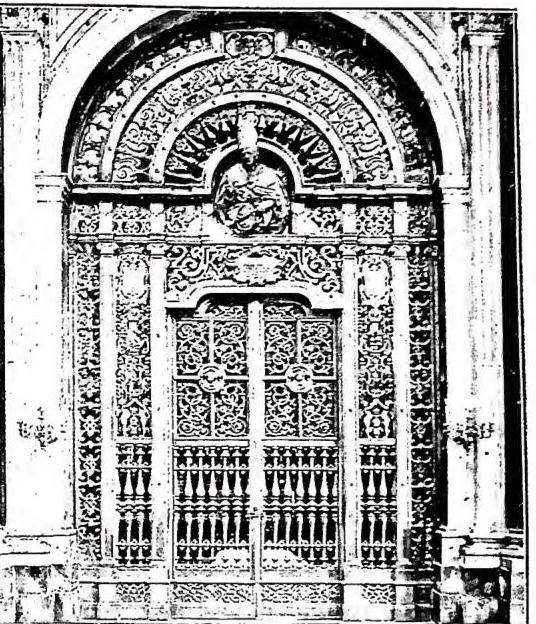
(photo: Anderson)
JANUARIUS, bishop of BENEVENTUM, saint, martyr and COMPANIONS — Cancel of the chapel of St G. by C. Fanzago (17th century). Naples, cathedral.
He is shown in tunic, pallium and sandals, between two lit candelabra; his head is surrounded by a large nimbus with the so-called Constantinian monogram and the two letters alpha and omega; the identification is given by the painted inscription between the words sancto martyri Ianuario (H. Achelis, Die Katakomben von Neapel, Leipzig 1936, pp. 48 and 68, pl. 38).
In Rome a church dedicated to St G., bishop and martyr, is recorded in the 7th century on the Via Tiburtina by the itinerary De locis sanctorum martyrum (G. B. De Rossi, Roma sotterranea, I, Rome 1864, p. 176).
Another testimony is provided by the subscription of the codex of the Excerpta of Eugippius, written at the command of Redux, bishop of Naples, in 581 (P. Knoell, Eugippii excerpta ex operibus s. Augustini [CSEL 9], p. XXVI).
A mutilated inscription with the name of St G.: Ianuario martyr(i)... aeterno flore... judged false by Mommsen (CIL, 10, 362), was considered genuine by De Rossi who supposes it metrical, by Garrucci, Galante, Kaufmann, Mallardo and dated to around the 6th century.
St G. is recorded twice in the Lindisfarne Gospels of around the 7th century and in that of Burchard, bishop of Würzburg (741–53).
The first deaconry (v. NAME) of Naples was attached to the basilica of St G. by Bishop Agnellus; in the episcopal palace of Naples a church “ecclesia S. Ianuarii” was built, which was restored and embellished by Bishop Athanasius (849–72); he placed there a veil on which was woven the scene of the martyrdom of St G. and his companions (Gesta episcoporum neapolit., in MGH, Scriptores rerum langobardicarum, ed. G. Waitz, p. 434).
As for the other companions in martyrdom of St G., the best known is the deacon Sossius. Pope Symmachus (498–514), in the sumptuous mausoleum of the Vatican which he transformed into an oratory of St Andrew the Apostle, erected an altar in honour of the martyr Sossius (Lib. Pont., I, p. 261) and appended a dedicatory poem preserved only in epigraphic collections; in it the merits of the deacon (minister), joined in martyrdom with Bishop G., are celebrated (cf. A. Silvagni, Inscriptiones Christianae urbis Romae, new series, II, Rome 1935, no. 4110).
Sossius, Eutyches, Festus and Desiderius were depicted in the 5th century in the mosaic of the church of St Priscus at Capua, destroyed in 1766 (R. Garrucci, Storia dell’arte cristiana, Prato 1881, pls. 254–57; G. B. De Rossi, I musaici della chiesa di S. Prisco ed il circostante cimitero, in Bull. arch. crist., 4th ser., 2 [1883], pls. 4–5; 3 [1884–85], p. 105).
In the second half of the 8th century, in the cemetery called that of St G. of the poor in Naples, above more ancient representations, they were depicted in groups of two, with their names, the saints “Ianuarius” and “Festus”, “Desiderius” and “Ecusius” (for Acutius), “Eutices” and “Proculus” (H. Achelis, Die Katakomben von Neapel, Leipzig 1936, pp. 38, 75, pls. 50–52).
For the catacombs of St Januarius, V. NAPLES.