
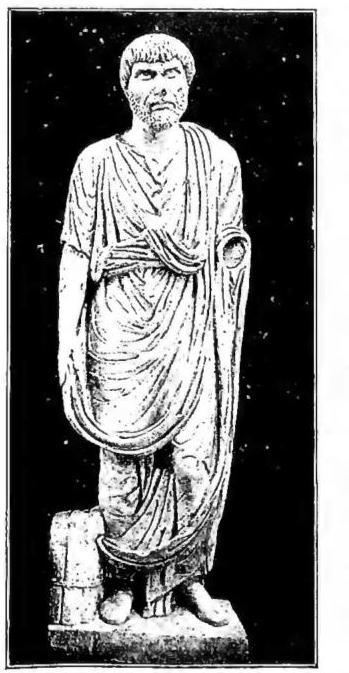
SYMMACHUS, POPE, saint. He is commemorated in the Roman Martyrology on 19 July, introduced by Usuard, but there is no evidence that he had any cult in antiquity. A Sardinian by birth, he was the son of a certain Fortunatus; he went to Rome where he was baptized and entered the clergy.
At the death of Anastasius II he was elected pope by the majority of the clergy and consecrated in the Lateran Basilica (22 Nov. 498), while a minority, supported by the Senate, elected the archpriest Laurence, who was consecrated in the basilica of St Mary Major. Disorders and disturbances then broke out, fomented by the senators Festus and Probinus, to such an extent that Theodoric decided to summon the two rivals to Ravenna. S. was easily recognized and returned to Rome, where in March 499 he held a synod at which it was decreed that no one could lawfully concern himself with the election of the pope while he was still alive, nor could form a faction. The synod was attended by Laurence, who subscribed as archpriest of St Praxedes, and shortly afterwards was appointed bishop of Nocera. Meanwhile S.’s enemies did not lay down their arms, and, unable to contest his election any longer, they resorted to accusations and calumnies; a libellus was sent to Theodoric accusing the Pope of squandering ecclesiastical goods, of living dissolutely, and of having violated the Nicene canon regarding the celebration of Easter. S. was summoned to Ravenna, but while he was at Rimini he learned the true intentions of his accusers. He therefore returned secretly to Rome and shut himself up in St Peter’s. Theodoric was ill-disposed towards him and sent an apostolic visitor to Rome, who again celebrated the Easter feast and took possession of all the churches and ecclesiastical goods. The situation became ever more tragic; to restore tranquillity a synod was summoned to judge the Pope’s conduct. It opened in May 501, and S. agreed to submit to its judgment but demanded that the apostolic visitor should meanwhile be removed from Rome. The second session was to be held in S. Croce, but while the Pope was going from St Peter’s he was attacked by a band of ruffians and some of the clerics in his train were killed and wounded. He then retired again to St Peter’s and refused to leave it despite all the pressure brought to bear on him. Meanwhile the synod held other meetings, and at the last (Oct. 501) it decreed that the Pope could not be judged by an earthly tribunal and must therefore be regarded as the legitimate pastor to whom all must obey. The synodal decisions did not please Theodoric nor the Laurentian party, nor the two senators, Festus and Probinus, who worked so hard that they obtained Laurence’s return to Rome. For four years the city was the scene of riots, massacres and bloodshed. Meanwhile the two parties were not idle, and while the schismatic side published a libellus against the decisions of the synod of 501, the Symmachian side produced a series of writings known as the Symmachian Apocrypha to justify, by fabricated historical precedents, the Pope’s conduct.
In Nov. 502 he himself held a synod in St Peter’s, attended by many Italian bishops as well as the Roman priests. At this synod the decree of 483 regarding the alienation of ecclesiastical goods, which had been the weapon of his enemies, was annulled, and Laurence and the apostolic visitor Peter of Altino were condemned.
Finally in 507 the Alexandrian deacon Dioscorus (v.) succeeded in persuading Theodoric to put an end to the strife; the senator Festus was ordered to cease his opposition to S.; Laurence was forced to surrender all the churches and goods he had occupied and retired to a private villa, and S. was universally recognized as the sole and legitimate pastor.
The last years of his pontificate were spent in tranquillity, and he was able to devote himself to works of piety and to the moral and material restoration of the city. He built several churches in Rome and embellished others: the oratory of SS Cosmas and Damian near St Mary Major, the oratory of St Andrew near St Peter’s, SS Sylvester and Martin, St Agatha and St Pancras on the Aurelian Way; he restored St Agnes, especially St Peter’s; he drove out the Manichees, whose writings he had burned in public; he helped bishops exiled or taken prisoner by the Vandals in Africa and Sardinia; he ransomed many prisoners in Liguria and Lombardy; he ordained that the Gloria should be sung at the Masses of rich women and on the feasts of martyrs. He died on 19 July 514 and was buried in St Peter’s.