
SCHISM. – Originally, s. (σκίωμα) means a tear or cleft, and hence divergence of opinion or dissent; in particular, a division separating the members of the same society. In ecclesiastical language, it means separation from the unity of the Church.
I. NOTION
St. Paul uses the term for the internal dissensions of the community of Corinth, caused by differing interpretations of Christian doctrine (I Cor. 1:10), by differences of class (11:18), and by natural selfishness (12:25). In II Cor. 18–19 heresy (v.) occur together, the latter apparently conceived as an aggravation of schism through doctrinal divergence.The Apostolic Fathers do not give the term schism a technical ecclesiological meaning. In St. Ignatius of Antioch we find the first formulation of a criterion for determining the meaning of the word schism, which he uses to indicate separation from the legitimate bishop. Schism therefore initially meant the rupture of unity within the local Church, in relation to the bishop. Hence, since all the local Churches were united with one another, breaking communion with a particular bishop constituted separation from the unity of the universal Church. St. Cyprian clearly insists on the universal character of schism. He does not, however, stop to distinguish schism from heresy, and against Novatianism he uses the two terms interchangeably. Yet he admits a certain distinction and regards heresy as more serious (Epist., 51, 1: PL 4, 352–53), in relation to teaching (Epist., 55, 1: PL 3, 822–23). St. Irenaeus too (Adv. Haer., IV, 33, 7: PG 7, 1076) had indicated by schism the rupture of unity, without detriment to the faith. St. Optatus of Milevis noted the difference, finding in heresy the corruption of faith and in schism separation from unity (De schism. donatist., I, chaps. 10–11: PL 11, 906–907). The clear distinction also occurs in St. Basil (cf. Epist., 188, canon 1: PG 32, 665). St. Augustine clearly distinguished between heresy, which violates the faith, and schism, which breaks fraternal communion (De fide et symb., chap. 10: PL 40, 193). In defending, however, the constitution of the emperor Honorius, which subjected the Donatists to the penalties enacted against heretics, he expressed the idea that every dissent, if prolonged, ends in heresy, and that this was precisely what had occurred in Donatism (Contra Cresc., II, chap. 7: PL 43, 471). St. Jerome likewise pointed out that every schismatic, in order to justify his secession, gives rise to a heresy (In epist. ad Tit., chap. 3, vv. 10–11: PL 26, 598). In the period of scholasticism, when a treatise on the nature and effects of schism began to be developed, schism came to be conceived as rebellion against the pope. The controversies of the sixteenth and seventeenth centuries confirmed the exclusive insistence on the concept of schism as defection from the pope. The controversies surrounding later schisms introduced no new elements.
II. IN DOGMATIC THEOLOGY
Schism is the voluntary separation from the unity of the Church insofar as it is a society consisting of the faithful as members and the Roman pontiff as its head. Schismatics are those who refuse to submit to the pontiff and to communicate with those subject to him (CIC, can. 1325 § 2). For Protestants, who deny the visibility and hierarchical constitution of the Church, the Catholic notion of schism is foreign. Separated Christians and Anglicans, owing to their different ecclesiology, conceive of schism as a rupture with the local or national Church, in relation to the bishop. Indeed, they regard the Church as a confederation of autonomous particular Churches. The Sacraments administered by schismatics are valid if their essential elements are intact.III. IN MORAL THEOLOGY
Schism, according to St. Thomas (Sum. Theol., 2ª-2ªc, q. 39), is a sin against the virtue of charity. For it directly opposes ecclesiastical communion and unity, which is an effect of charity.Schism is divided into mixed and pure, according as separation from unity is or is not accompanied by heresy. After the First Vatican Council defined the primacy of the Roman Pontiff as a truth of faith, schism without heresy is no longer possible. Theoretically, however, they are two distinct sins, owing to the difference in their formal object. Schism, in fact, opposes unity, an effect of the virtue of charity, whereas heresy opposes the virtue of faith. The sin of schism signifies more than simple disobedience, because it entails rebellion and denial of legitimate authority. This sin is in itself mortal and does not admit of parvity of matter—that is, it cannot be venial—except through lack of advertence.
Like heresy, the sin of schism is divided into: 1) formal and material, according as it is or is not joined with pertinacity; 2) internal and external, according as it resides only in the soul or is outwardly manifested; 3) public or occult, according as it is manifested to a considerable number of persons or not.
The consequences of this sin are extremely grave. The schismatic, being voluntarily outside the Church, does not participate in the divine life of the mystical body and is deprived of the means of sanctification. Indeed, even if he is in good faith, the Sacraments may not be administered to the schismatic unless he has first been reconciled with the Church (can. 731 § 2). An exception may be made in the event of danger of death, in which case, to ensure the salvation of the soul, after every danger of scandal has been removed, the Sacraments of Penance and Extreme Unction may be administered, at least sub condicione, if the schismatic is without consciousness, or, if he has the use of his senses, if it seems advisable to leave him in good faith.
IV. IN CANON LAW
Schism is placed on the same footing as heresy (can. 1325 § 2). According to can. 2242 § 1, it is a delict that requires in the subject full awareness and obstinacy in a grave matter, in addition to public manifestation or at least a character that is external and objectively ascertainable in itself. Therefore, if an act that may appear to be schismatic is performed without awareness, there is no delict. If someone, for a grave delict, invitus, were separated from communion with the faithful by excommunication, he would be excommunicated but not schismatic. For schismatics, the ecclesiastical penalties are the same as those established for heretics (v. ERESIA).V. IN THE HISTORY OF THE CHURCH
The principal schisms are mentioned here, while referring the reader to the respective entries for a fuller treatment. From the time of the Apostles onward there were dissensions, which nevertheless did not possess the character of schism in the present sense of the word. They concerned internal disagreements within the communities, such as those to which St. Paul and, at the end of the 1st century, St. Clement (v.) allude. In the 2nd century, the differing Easter (v.) threatened a schism between the Church of Rome and those of Asia, which was successfully avoided. But a party of converted Jews began to celebrate Easter in the Jewish and Ebionite manner, with(phot. Estel)
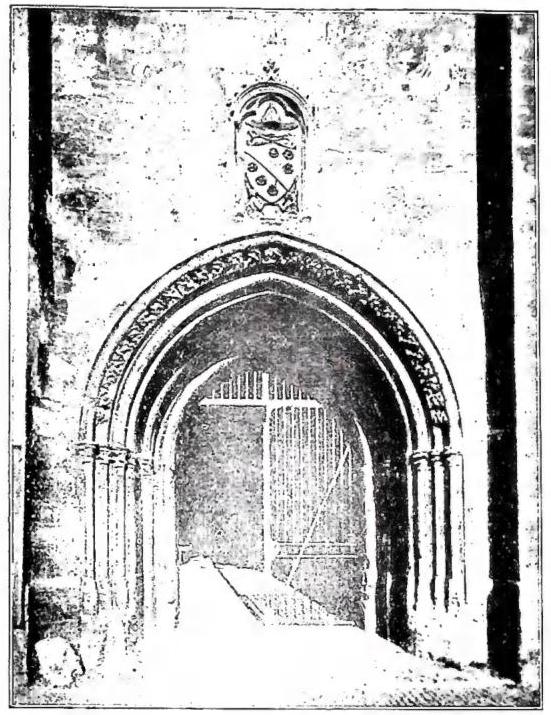
WESTERN SCHISM — The “des Champeaux” Gate surmounted by the coat of arms of Pope Clement VI (1342–52) — Avignon, Palace of the Popes.
As Trinitarian doctrinal controversies (v. ERESIA) intensified, schismatic groups also arose, such as, for example, the Meletian (v. MELEZIO) and Luciferian (v. LUCIFERO DI CAGLIARI) groups. Three Chapters (v.) at the Fifth Ecumenical Council caused serious disturbances in the West, which in northern Italy ended in schism. In the 11th century, with Michael Cerularius, the Schism of the East took place, separating the Byzantine Church from communion with Rome. In the West, during the Middle Ages, the elections of Innocent II and Alexander III provoked schisms. Particularly extensive Western Schism (v.), followed by that of the Council of Basel (v.). During the Jansenist controversy, the schismatic Church of Utrecht was established; and after 1870, that of the Old Catholics (v.), who must in any case be counted among the true heretics.
Schisme, in DThC, XIV, I, col. 1286 ff.; H. Lesêtre, Schisme, in DB, V, 1529 f.; P. Hayot, Les délits d'hérésie, d'apostasie et de schisme, in Rev. dioc. de Tournai, 5 (1950), p. 134 ff. For the study of individual schisms and of the entry CONCILIO V. the bibliography of the respective entries. Vincenzo Carbone