
TENTAZIONI DI GESÙ CRISTO. - Jesus was tempted by Satan in the Judean desert, between Jericho, Jerusalem, and the Dead Sea. The exact location can no longer be determined. A tradi-
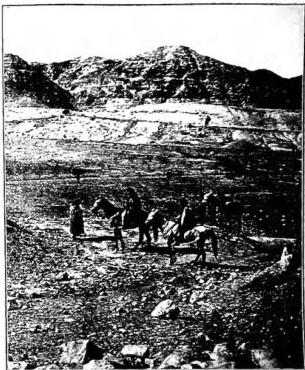
The first temptation starts from hunger and seeks to induce Jesus to the vain display and useless use of supernatural power for sustenance. The disordered recourse to miracle is rejected by Christ, who shows trust in God. The devil repeats the attack. Quoting a biblical verse inappropriately (Ps. 90, 11-12) he seeks to push Jesus to vainglory and to the ostentation of His power: let Him throw Himself down from above, the Angels will support Him and the people, seeing Him fall unharmed, will acclaim Him Messiah. With a quotation (Deut. 6, 16) Christ rectifies the scriptural absurdity of Satan: it is not licit presumptuously, without necessity, to await or provoke a miracle of God. The tempter reaches the height of audacity, asking Jesus for adoration with the promise, in exchange, of dominion over the world; but Christ commands him to withdraw, since only God must be served (Deut. 6, 13). Satan withdraws, but to return at an opportune time (Lc. 4, 13), that is, when, in the Passion, he will unleash the final attack.
The t. of J. C. is literary and historically united to His Baptism. The two facts are the preamble to the public ministry of Jesus. The ancients considered the t. of J. C. in a moral sense, as an example in the struggle against common temptations of gluttony, vainglory, and greed. Today the messianic meaning is accepted. The devil saw in Jesus an extraordinary man, and suspecting, from the episode of the Baptism, that He was the Messiah, tempted Him to induce Him into a temporal and political messianism, accompanied by empty thaumaturgical exhibitions.
Outside of Catholics, almost no critic fully admits the historicity of the account. G. H. Venturini and Lange mistook the tempter for a Pharisee, first a friend and then an enemy, or for an envoy of the Sanhedrin. Fr. Schleiermacher considered the t. of J. C. an instructional parable transformed into history by the disciples. The myth school spoke of a myth, arising from the influence of Old Testament texts concerning the trials of the people of Israel, the collective son of God (Fr. Strauss), or from the influence of the Old and New Testaments together (H. J. Holtzmann). Practitioners of the comparative history of religions explained the origin of the myth through analogous facts from pagan and Babylonian mythologies (R. Seydel, H. Gunkel, W. Bousset, A. Meyer). The t. of J. C. has also been seen as the symbol of apostolic struggles. For A. Loisy they are visions, psychological struggles, concretized by tradition into an exterior scene.
These rationalist, subjective, and arbitrary interpretations stem from an aprioristic denial of the supernatural, the divinity of Christ, and the value of the sources. External and internal criticism demonstrates the authenticity and historicity of the event. For the t. of J. C. as well, primitive catechesis, whose informant could be none other than Jesus, has transmitted the truth.
Unlike man, in Jesus there was no inclination to evil. Hypostatic Union (v.) He did not have, nor could He have, either sin or concupiscence. The lower part, without disordered motions, was entirely subject to reason. The temptation therefore could come only from the exterior; it could also be proposed, in addition to sight and hearing, to the imagination, thus indirectly investing the intellect. It cannot be established whether the suggestion was operated by Satan in the imagination directly or indirectly, since the texts do not specify. The ancients and some more recent writers (Maldonato, Knabenbauer) judge that the t. of J. C. were external and sensible. Almost no one today fully follows such a position. Many, with E. Le Camus, explain the t. of J. C. as real but internal suggestions of the devil. The presence of the devil was invisible and the kingdoms of the world were shown to Christ in a vision. According to some, however, corresponding to the suggestion there was a local mutation of Jesus, who spontaneously followed Satan (Lagrange). The suggestion could not be accompanied, in Jesus, by instinctive defect, due to His perfect nature, nor by consent, due to His impeccability, but it provoked aversion and horror. There was nevertheless struggle and therefore victory and merit. St. Paul shows the fittingness for men of the t. of J. C., who can thus better sympathize with human weaknesses (Hebr. 2, 18; 4, 15). – See pl. CXXXVII.