
ALESSANDRO III, POPE. — Rolando Bandinelli, of very humble origin, born in Siena at the beginning of the twelfth century, became famous in Bologna for his teaching of law. From there he entered the service of the Curia, was made cardinal of S. Marco, and assisted Adrian IV in the controversies concerning the Empire. He was chancellor when, in 1157, at the Diet of Besançon, as papal legate, he incurred the anger of Frederick Barbarossa and the imperialists because of his doctrine concerning the relations between the Church and the Empire. When Adrian IV died on 1 September 1159, the disturbances in Rome between the two opposing parties, which the deceased Pope had managed to restrain, broke out again. On 7 September the cardinals, by a large majority, cast their votes for Bandinelli, who took the name A. III. The dissenting cardinals, who favored the imperial party and were supported by part of the lower clergy and the populace, proclaimed Cardinal Ottaviano di Monticelli, of a powerful Roman family, elected; he took the name Victor IV. A. and his supporters were forced to seek refuge in a tower near S. Pietro and then in Trastevere; subsequently, with the help of Ottone Frangipane, he left Rome and took refuge in Ninfa (near Velletri), where he was consecrated; from there he went to Terracina, where on 27 September he excommunicated his adversary. Victor, for his part, was consecrated at Farfa on 4 October. Since at that moment Frederick Barbarossa was in Italy, he had to take a position as emperor, but he was hostile to A., whereas Victor belonged to his party; in any event, he referred the matter to a council to be held at Pavia, where he himself was staying, on 13 January 1160, and invited the two adversaries to appear. Yet in his letter he had already made his view known, giving A. the name of Chancellor Rolando, while calling Ottaviano Victor IV. The former did not appear and protested against Barbarossa’s illegitimate procedure; the latter, instead, went to Pavia. The Council opened on 5 February with about fifty German and Italian prelates and, only after lengthy discussions and under imperial pressure, Victor IV was recognized as pontiff (11 February). England, France, Spain, and a large part of Italy, however, recognized A. as pontiff almost unanimously. Thus the schism was opened. From Anagni, on 24 March, A. pronounced excommunication against Barbarossa and the principal supporters of his adversary, and renewed the excommunication already pronounced against the latter and his adherents. The supporters of Victor worked strenuously to expand their influence and following; they held new assemblies at Cremona and Lodi and excommunicated the archbishop of Milan and other adversaries.
A. succeeded in returning to Rome on 6 June, but his enemies gave him no peace, all the more because imperial power was becoming established in the Patrimony; consequently, he went aboard the ships of the king of Sicily and proceeded to Genoa (January 1167). But since Barbarossa had made himself absolute master of northern Italy by the capture of Milan, on 25 March he went to France, where in May 1163 he presided over a great council at Tours.
When Victor IV died at Lucca on 20 April 1164, Cardinal Guido of Crema, one of his most convinced adherents, was given there as his successor, under the name Paschal
III; Barbarossa approved this election and, at a synod in Würzburg (May 1165), swore that he would never recognize A. but would support Paschal; many of the princes and bishops present swore likewise, with the exception of the two archbishops of Mainz and Salzburg and the patriarch of Aquileia. Meanwhile, the situation changed in Rome, so much so that A., after leaving France and having touched at Messina and Salerno, entered the city on 22 November 1165. But Barbarossa, taking advantage of the death of William I of Sicily (7 May 1166), sent his armies into Italy, then himself descended against Rome (1167), and, having overcome the resistance of A. and his supporters with the help of the Romans, made himself master of the city, forcing A. to flee in disguise to Benevento; he was crowned once more by Paschal III in S. Pietro on 1 August 1167. The triumph did not last long, because, when the plague entered his army, Barbarossa was forced to leave Rome and take refuge in Germany.
As early as 1164, some Venetian cities, in agreement with Venice, had joined in a league for defense against imperial power; another league with the same purpose was formed in December 1167 by thirteen Lombard cities. All naturally sided with A.; indeed, on 1 July 1168 they recognized him as their leader. More than the material interests of the moment, it was the common interest of freeing themselves from imperial domination that favored this union. A symbol of this concord was the new city that the allied forces founded to confront the Piedmontese feudatories and that, in honor of the Pope, was called Alessandria. A. did not return to Rome. Barbarossa, having descended into Italy in 1174, attempted without success to conquer Alessandria; then, on 21 May 1176, he was defeated at Legnano by the allied forces, and although he had recognized the new antipope Callistus III, successor to Paschal III, in 1168, he finally decided to enter into negotiations with A. After the initial mutual distrust had been overcome, these negotiations took place in Venice, where A. arrived on Sicilian ships and where Barbarossa also went (1177); bishops, princes, and envoys of the allied cities assembled there. Barbarossa finally recognized A. as the legitimate Pope and restored to the Church what he had taken from it; the dispossessed bishops recovered their sees; a six-year truce was negotiated with the allied forces in preparation for the peace that was later concluded at Constance. After this solemn meeting, Barbarossa returned to Germany; A. set out toward Rome, where in March 1179 he held the Third Lateran Ecumenical Council, attended by more than 300 bishops and many representatives. Twenty-seven disciplinary canons were promulgated, the first of which required a two-thirds majority of the voters for the legitimate election of the Pope. These canons
were almost a solemn complement to the remarkable activity displayed by A. in resolving the complicated juridical questions brought before his judgment, and were later included in the Decretals. Particular resonance at that time was given to the role played by A. in the controversies that Thomas Becket, archbishop of Canterbury, had with his king, Henry II, in defense of ecclesiastical freedom. When he was killed in 1170, A. defended his memory, forcing the king to repudiate the actions of the murderers, swear obedience to the Apostolic See, and abolish the laws enacted against ecclesiastical freedom.
A. died at Civita Castellana on 30 August 1181. One of his distant descendants in the seventeenth century had a commemorative monument erected to him in the Lateran Basilica.
BIRL.: I. M. Watterich, Pontificum Romanorum Vitae, II, Lipsia 1862; Hefele-Leclercq, V, p. 916 ff.; G. Hergenrother-G. P. Kirsch, Storia universale della Chiesa, IV, Firenze 1903, p. 145 ff.; P. Brezzi, Lo scisma inter regnum et sacerdotium al tempo di Fed. Barbarossa, in Archiv. Soc. Romana di Storia patria, 63 (1940), pp. 1–98.
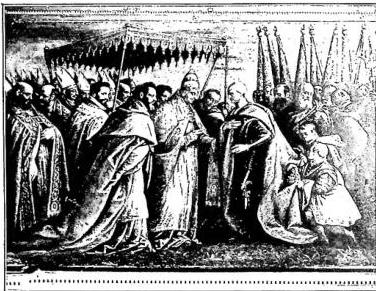
(Alinari photograph) ALESSANDRO III, pope - Meeting of A. with Doge Sebastiano Ziani, by Leandro Bassano (16th–17th century) - Venice, Hall of the Great Council.
The Sententiae, edited by P. Gietl (Die Sentenzen Rolands, nachmals Papstes Alexander III, Freiburg im Breisgau 1891), were composed after 1142 and constitute a notable document of the influence exerted in the 12th century by the school of Abelard (v.). It should be noted, however, that on certain questions of no minor importance—as, for example, those concerning the necessity of faith and baptism for salvation and the nature of original sin—the author finds himself in open disagreement with the opinions of his teacher.
BIRL.: J. F. von Schulte, Die Geschichte der Quellen und Literatur des kanonischen Rechts von Gratian bis zur Gegenwart, Stuttgart 1875–80; St. Kuttner, Repertorium der Kanonistik, I (Studi e Testi, 71), Vatican City 1937, p. 127 ff.; B. Kurtscheid-F. A. Wilches, Historia iuris canonici, I: Historia fontium et scientiae i.c., Rome 1943, p. 239 ff. Ferruccio Liuzzi