
LODI, DIOCESI di. — City and diocese in the province of Milan. Covering an area of approximately 700 sq km,
it has 205,491 inhabitants, of whom 205,400 are Catholics; 115 parishes and 23 vicariates served by 320 diocesan priests and 31 religious priests, one seminary, 3 male and 89 female religious communities (Annuario Pontificio, 1951, p. 251).
The ancient name was Lauda, Latinized as Laus Pompeia. The city is considered to have been founded by the Gauls known as the Boii, who came down in the 3rd century B.C. and settled in the final stretch of Insubria, bounded by the Adda to the east, the Lambro to the west, and the Po to the south. In 89 B.C., L. was made a Latin colony by Pompey Strabo, and in 49 it obtained Roman citizenship from Julius Caesar. At Laus Pompeia the saints Nabore, Vittore, and Felice were martyred.
The first bishop to embody the entire religious and civil history of the people of Lodi was St. Bassiano, who governed the diocese from 378 to 413. He died on 19 January and was buried in the basilica he had erected to the Twelve Apostles, which was subsequently named after him. The archives of ancient L. were largely lost during the barbarian invasions and the two destructions carried out by Milan in 1111 and 1158; in the latter year ancient L. was moved farther south along the Adda, where it had its commercial port. The body of St. Bassiano was transferred there on 4 November 1163. The commune of L. arose in the 11th century; it took part in the First Crusade, in which it earned the coat of arms consisting of a red cross on a gold field. Its wealth derived from the fact that the city and its territory lay amid three great waterways and the Muzza, an irrigation canal running through the entire Lodi region, dug in 1220.
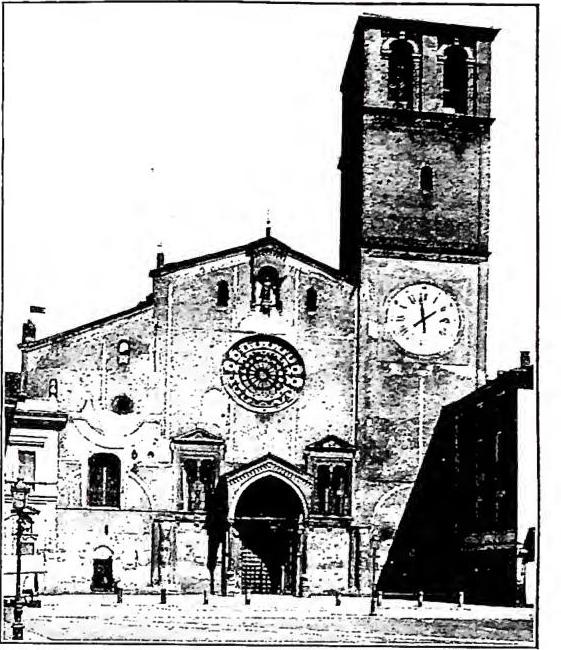
(phot. Anderson) LODI – Façade of the Cathedral (12th–17th centuries). The bell tower dates from 1550 and was designed by Calliato Piazza.
Religious monuments: the Cathedral, erected in 1158 and extensively remodelled in 1761; S. Lorenzo (12th century); S. Francesco (1252), rich in frescoes from every century; the Incoronata, begun following a miracle in 1487, a true jewel of art, rightly admired; S. Filippo (17th century), with its adjoining monastery, now the civic library; S. Maria Maddalena (1720), a grandiose temple and school of Juvara; S. Cristoforo (1565), by Pellegrini. Outside L. are the basilica of S. Bassiano, in ancient L., and the abbey church of Abbadia Cereto (c. 1136).
Notable persons: Ottone Morena and his son Acerbo, who wrote the chronicle of Lodi for their own time (1111–64); Oldrado da Ponte, papal jurist (d. 1335); Maffeo Vegio, canon of S. Pietro and Christian humanist (d. 1458); Franchino Gaffurio, theorist of music (d. 1522); Defendente Lodi, known as the Lodi Muratori for his historical expertise (d. 1656); Fr. Francesco Quaresimi, a Minorite, author of writings on the Holy Land (d. 1656); Fr. Pietro Codazzo (d. 1549), who was the first Italian Jesuit and whose possessions made it possible for s. Ignazio to establish himself in Rome; Francesco De Lemene, poet (d. 1704); Fr. Cesario Tondini, a Barnabite, who devoted himself to the return of Orthodox Russia to the Catholic Church (d. 1897); s. Francesca Saverio Cabrini (v.), founder of the Missionaries of the Sacred Heart of Jesus.
Shrines: the shrine of the Madonna dei Cappuccini in Casalpusterlengo is famous; it was erected following apparitions documented in 1574.