
CRISTOFORO, saint, martyr. — Venerated by the Greeks on 9 May; by the Latins on 25 July. The information concerning his life and martyrdom is uncertain and obscure. According to the Passio, C., called Reprobus before his baptism, was of Canaanite origin; under the rule of a certain King Dagno he went to Samon in Lycia, where he brought about many conversions to Christianity. When his faith was discovered, he was arrested and, having refused to venerate the idols, was imprisoned. There he converted two women who had been sent to him to induce him to sin and apostasy, leading them even to martyrdom, since, after leaving the prison, they began to overthrow the statues of the gods. Brought before the king, C. was tortured and made the target of the soldiers’ arrows, but remained unharmed; indeed, one arrow went so far as to blind the king, to whom C. foretold that he would be healed if, after his imminent death, he touched the injured eye with C.’s blood. This came to pass: Dagno converted and promulgated an edict in favor of the Christians.
This is evidently a hagiographical fable, but the existence of the martyr is beyond all doubt; evidence of his cult reaches back to the 5th century: an inscription discovered in Bithynia recalls the consecration of a church in his honor in 452; in the 6th century there was a monastery dedicated to his name at Taormina. Subsequently, few saints enjoyed as much veneration in the Middle Ages as C.: churches and monasteries arose in his honor, and confraternities and sodalities were established, especially to help pilgrims who had to cross the Alps; his relics are preserved in many churches of Eu-
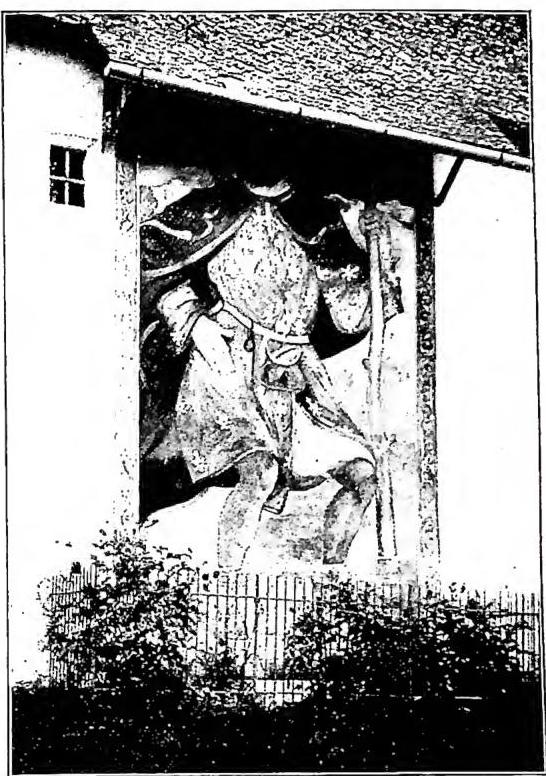
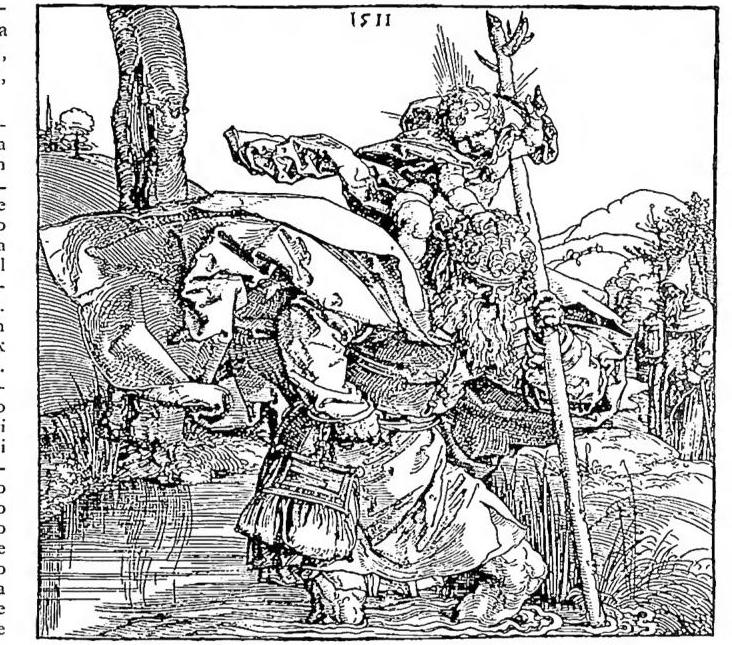
rope, and the spread of his cult is attested by numerous missals and breviaries from every period and place. Popular imagination gave free rein to the creation of legends concerning the personality of C., enlarging or falsely interpreting information or traditions already established. Among Eastern peoples, the allusion to C.’s ethnic origin was taken literally, and he became a barbarian of terrifying appearance with the head of a dog. In the West, on the other hand, the legends began with the etymology of the name and the iconography of the martyr. C. is a giant in the service of the king; one day he discovers that the devil is stronger than his sovereign: he leaves the latter to serve the former; but soon realizes that there is another who is stronger than the demon: Jesus Christ. He then decides to place himself in Christ’s service; he meets a hermit who instructs him in the Christian religion and baptizes him. In order to make himself acceptable to his new lord, he establishes his dwelling by the bank of a river and helps travelers cross II. One night he is awakened by a child who wishes to cross. C. takes him on his shoulders and enters the water; as he advances, the burden becomes increasingly heavy, and he can scarcely reach the bank. There, astonished, he asks the child why he weighs so much, and the latter replies that he is the creator of the world, Jesus Christ. Later C. abandons his post and goes to Lycia, where he obtains martyrdom. This legend, evidently constructed on the etymology of C.’s name, is recorded for the first time, in the literature known to us, in the Leggenda aurea of Giacomo da Varazze, and arose from the iconography of the martyr as a concrete expression of that interpretation. On the façades of medieval churches it was customary to place an image of C., since it was believed that whoever looked upon it would be preserved that day from sudden death and every other evil; hence the practice of making the image highly visible and therefore of gigantic proportions. The legend, in turn, became the source of inspiration for the later iconography of C.
The existence of an image of him in a temple erected by Justinian on Mount Sinai is not certain, but there is evidence of churches dedicated to him as early as the eighth century. The oldest image of s. C. in Rome is in a ninth-century fresco at S. Maria Antiqua. Other medieval representations are found in stained-glass windows and wall paintings in France and Germany, where the cult of s. C. became so widespread as to give rise to the belief that the Saint had passed through those lands. The medieval legend of Jesus asking the giant C. to help him cross the river gave rise to a votive cult that seems to derive from a similar pagan cult of Hercules: in fact, painted or sculpted effigies of s. C. were customarily placed in large dimensions at the entrances of churches, houses, and cities. Related to this practice are the wooden giant in the cathedral of Barga, the stone statue on the façade of the cathedral of Cremona, the fresco by Andrea Delitio at Guardiagrele, and that by Masolino on the outer arch of the chapel of S. Caterina in the church of S. Clemente in Rome.
An iconography restricted to the simplest hagiographical subject, on the other hand, is found in very many Renaissance paintings. At Padua, the now-destroyed frescoes of the Ovetari chapel in the church of the Eremitani, painted by Andrea Mantegna, Pizzolo, and Girolamo di Giovanni da Camerino between 1448 and 1460, represented episodes from the life and martyrdom of s. C.
Among the many representations in easel paintings, mention may be made of those in the polyptych by Giovanni Bellini at SS. Giovanni e Paolo in Venice (ca. 1464), by Pinturicchio in the Galleria Borghese, by Tiziano in the Palazzo ducale of Venice, by Lotto, and finally by Pietro Novelli, called il Monrealese (1603–47), in the Museo comunale of Catania.
in numerous circumstances. He is venerated as the protector of travelers, particularly at difficult points along the journey, both in the mountains and when crossing waterways, with an evident reference to the most famous episode of the legend and to its related iconography: adapting to the times, this protection has extended to motorists, also because the Saint protects against fatal accidents. In recent years
this devotion has spread extraordinarily, and new cars already bear the image of the patron saint on the instrument panel. There has even been a sporting pilgrimage to the shrine of St-Christophe-le-Jajolet near Argentan (France). In addition, s. C. is the protector against sudden death, which may overtake the faithful before he has been able to repent. This aspect of the cult gave rise to superstitious distortions that were opposed by the Church (Synod of Cambrai, 1565).
In relation to his gigantic figure and exceptional strength,
he is also venerated as the patron of athletes and of those who practice sports, as well as of porters, stevedores, and all those who pursue an occupation requiring great strength. Formerly, and especially in the 14th century, the Saint was invoked against the plague and epidemics in general: his relics were carried in procession, and those who had escaped the scourge had his image painted on the walls of churches.
The Saint is also the protector of fruit trees and is therefore venerated by fruit sellers, again with a clear reference to one of the characteristic features of his iconography (the tree against which he leans) and of his legend.
Finally, s. C. is invoked as a universal patron, against every illness or misfortune, as well as against hurricanes and storms. Hence the verses often read beneath his image, which was also disseminated through popular prints from the fifteenth century onward: «Christophorum videas, postea tutus eas»; and also: «Christophore Sancte virtutes tuae sunt tantae / qui te mane videt, nocturno tempore ridet»; these and similar verses are found paraphrased in various languages.
In some parts of France, a cock is offered to him on his feast day: this survival, together with numerous analogies between the legend and iconography of the Saint and the myths, rites, and representations of Anubis, Hermes, and Heracles, led Saintyves to imagine an influence of elements of the Egyptian
The legends have also been brought to the stage. In France, a mystery play by Antonio Chevalet was performed in 1527. A Rappresentazione di santo Christophoro Martire ridotta ad uso di commedia was composed by the Bolognese Cesare Sacchetti and published in Florence in 1575. A Spanish mystery play, San Cristofol, was brought to light in a diplomatic edition through the efforts of II. Corbato (Berkley Cal. 1932). A musical work by Vincent D'Indy was performed in Paris in the spring of
1939. The theme was also developed in literature by Giosuè Borsi (Novelle, Florence 1921)
Vedi tav. LIN.from the Atti della Società Colombaria, Florence 1935; P. Saintyves, (pseudonym of E. Nourry), S. Christophe successeur d'Anoubis, d'Hermès et d'Héraclès, Paris 1936; U. Cianciolo, Contributo allo studio dei cantari di argomento sacro, extract from Archivum Romanicum, Florence 1938; G. Giannini, La poesia popolare a stampa nel sec. XIX, I. Udine 1938, pp. 157-61. For the iconography: Anon., S. C. nell'arte, nella leggenda e nella storia, Rome 1939, Paolo Toschi