
CONFRATERNITA. — An ecclesiastical corporation composed predominantly of lay faithful, canonically erected and governed by a competent superior, with the aim of promoting Christian life through special good works directed toward divine worship or charity toward one’s neighbor. Very often worship and charity are associated aims in the statutes of the confraternities. Thus understood, they are genuine and stable ecclesiastical foundations with their own organization, capable of having particular statutes, accepting bequests, administering their funds, and owning immovable property exclusively, at least where civil laws do not prevent this.
They must not, however, be confused with those institutions known as charitable foundations (hospitals, shelters, orphanages, conservatories), which have a more complex purpose; nor with those occasional pious unions held together simply by the will of their members. Indeed, the abandonment by even most or all of its members does not in itself extinguish the
confraternity, which subsists instead by virtue of its canonical erection. Confraternities depend upon the diocesan bishop or upon the superiors general of certain religious Orders to which, by original foundation, they are aggregated or by whom they were founded. They are called arch-confraternities if they have obtained the faculty of aggregating to themselves particular confraternities lawfully erected with the same aims and uniform regulations.
Confraternities must also be carefully distinguished from the secular Third Orders, which are closely linked to the religious Order from which they take their name, and also from the associations of arts and crafts which in the past pursued a predominantly social and economic purpose, although these too placed themselves under the protection of special patron saints. It should nevertheless be noted that genuine confraternities sometimes consisted exclusively of persons recruited from among those engaged in the same trade or profession, without thereby being organized into guilds in the proper sense.
I. HISTORY
Traces of associations of laypeople can be discerned as early as the Carolingian age, but a genuine movement in this regard can be observed only later, when the common people of the cities and towns had attained greater associative maturity. Indeed, the earliest c. attested by documents are those which, from the 10th century onward, comprised all the clergy of a city, independently of their disciplinary relations with the bishop; by contrast, there is no certain evidence of those composed of laypeople before the 12th century, by which time communal life, at least in Italy, was already in full flower. There is, however, no example of c. that comprised all the laity of a place. Each c., according to its importance and development, had an altar, a chapel, or a church in which to carry out its religious practices (Masses, processions, special prayers), as well as a place in which to meet under the guidance of a leader and with the assistance, as the case might be, of a secular or regular priest. Their aims were, in addition generally to the practice of these observances and of the Christian virtues, assistance to sick confraternity members, prayers for the dead and funerals, aid to the poor, including those outside the confraternity, and the provision of dowries for young women. At their meetings, sacred laude were often sung in the vernacular (Compagnie di laudesi), sometimes in dialogue form, and on certain days sacred performances were also held for the edification of the people. At other times, the confraternity members undertook to collect alms for some extraordinary need or to assist those condemned to death or prisoners.The great movement of the Flagellants, or Battuti or Disciplinati, which arose in Perugia in 1260 and spread throughout Italy, gave rise to very numerous c., which combined the practice of self-flagellation, in private or publicly during processions, with charitable activity by promoting aid to the poor, particularly in hospitals; many of these owe their foundation and more effective care to the Flagellants’ zeal. A similar movement is that
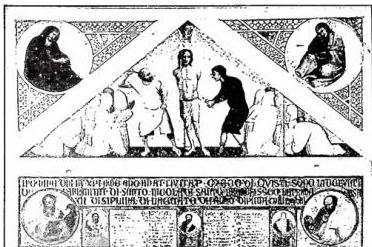
(from Le Arti, 3 [1812], p. 57) CONFRATERNITA – Panel of the Confratres by Antonio Veneziano (1388), restored in 1941 – Palermo, Oratory of S. Niccolò Reale.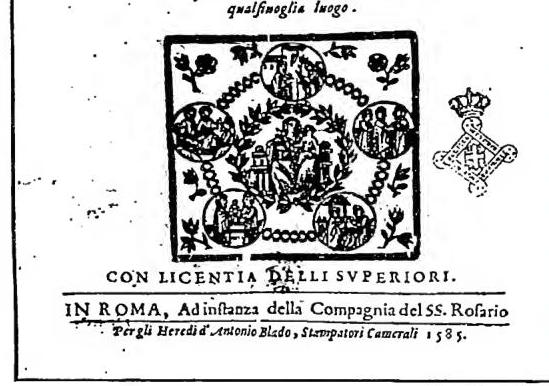
WITH THE PERMISSION OF THE SUPERIORS.
IN ROME, At the expense of the Company of the Most Holy Rosary
Printed by Meredi d’Avvio Bido, General Printers, 1585.
(photograph: Enc. Catt.)
CONFRATERNITA — Frontispiece of the Capitoli Statuti et ordinazioni della Venerabile Compagnia del S.mo Rosario, Rome 1585.
Rome, copy in the National Library.
of the C. of the Gonfalone, which arose in Rome in 1264, and the other of the Bianchi in 1399 in Upper Italy. Other c. that arose with the specific purpose of providing for the expansion of hospitals for the sick or pilgrims soon changed into genuine hospitaller Orders, such as that of S. Spirito in Sassia in Rome, that of S. Giacomo di Altopascio in Tuscany, and that of S. Antonio abate at Vienne in France. Of particular importance in Rome, especially during the fifteenth century, were the c. established there among members of the various nations, for the assistance of the poorest among them or of those who arrived there as pilgrims; noteworthy are the C. of S. Maria dell’Anima and of S. Maria dei Teutonici for the Germans, that of S. Giuliano dei Belgi, that of S. Luigi dei Francesi, etc. There are also examples of similar institutions along the roads used by these foreigners in their travels, such as a c. of Germans at Udine. With the spread of all these c., and especially following the practices of the Battuti, the custom became more widespread whereby members of the c., at their meetings and processions, wore a long, cassock-like linen garment of various colors, with a hood that sometimes descended to cover the face, leaving only two openings in front of the eyes.
The Companies of Charity, and particularly the Companies of Divine Love, contributed greatly to the renewal of Christian life in Italy at the beginning of the sixteenth century. They were founded in the principal cities with the aim of providing for a more intense Christian life through enlightened charity toward one’s neighbor. Indeed, through their members they promoted the foundation of hospitals for the Incurabili, shelters for Convertite and Pericolanti, orphanages, and assistance for the vergognosi poor.
Of a different nature and almost exclusively devotional in character are the C. of the Carmine, governed by the Carmelite friars; those of the Cintura, promoted by the Hermits of S. Agostino; those of the Rosario, spread everywhere by the Dominicans; and especially those of the S.mo Sacramento, which, already numerous in the fifteenth century, underwent particular growth and diffusion from the sixteenth century onward, especially after Paolo III endowed them with special privileges in 1539. By promoting attendance at Mass and Communion, by encouraging the practice of accompanying the Sacrament in the theophoric processions, which they made more frequent, and when it was publicly carried to the sick, they soon became in the parishes, under the direct governance of the parish priests, an element of the first importance in the reform of popular life.
The Congregations of Mary (v.) for young people, which the Jesuits organized and generally assisted alongside their colleges, also have the character of c. In this field they were later imitated by the secular clergy. The same must be said of the Congregations that the Jesuits themselves established in the churches officiated by them for adults of the various social classes.
The Pious Daughters of Mary (v.) for young women, and those of Christian Mothers (v.) for married women, established in the various countries with their respective statutes, are likewise equated with the c. Nor should the associations established for the benefit of missions among infidels be forgotten, the first of which were those called the Propagation of the Faith and those of the Holy Childhood. But with these institutions and other similar ones, we approach ever more closely the pious unions mentioned above, although in them a general organization predominates, standing above the simple c. and arch-c.
Their first adversaries were the reforming princes of the end of the eighteenth century, who, like Giuseppe II of Germany, hampered their particular activity in the field of charity by confiscating their assets for the benefit of state charity. The Napoleonic laws admitted only the parish c. of the S.mo Sacramento, and, wherever these laws were applied, the c. lost their assets.
Italian legislation generally showed itself hostile to the c.: without directly concerning itself with those that pursue a purely spiritual purpose and possess no real property, it subjected them outright to the authority of the State. Among them, those intended for charitable purposes must conform to the legal provisions concerning charitable foundations; the others, whose purpose is worship, have not been made the object of a special law, and the authorities limit themselves to keeping their activity within the bounds assigned by law and granting those authorizations that legal entities require for the various acts of their activity.
(from Emporium, July 1939, p. 33)
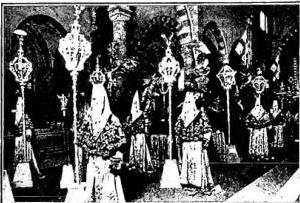
CONFRATERNITA — Reconstruction of an eighteenth-century procession in traditional costumes, at the Exhibition of the Casacce (1939). Genoa.
CONFRATERNITA - CONFRATERNITE DEL S.MO SACRAMENTO
II. JURIDICAL NATURE
sodalizio (v.), erected by formal decree of the Ordinary (or by religious who possess the privilege), having as its purpose, even if not exclusively, the advancement of public worship (cann. 707–708 and 713).In addition to the general norms established in the CIC for associations of the faithful (cann. 684–699; V. ASSOCIAZIONE), and the special norms concerning c. (cann. 707–725), each c. is governed by statutes approved by the Ordinary.
Each c. must have its seat in a church or in a public or semipublic oratory (can. 712 § 1; for changes of seat cf. can. 719); it must also have a name or title, derived either from the attributes of God, or from the mysteries of the Christian religion, or from the feasts of the Lord or of the Madonna, or from the Saints, or finally from the pious purpose of the c. itself (can. 710); and normally more than one c. with the same title or purpose may not be established in the same place (can. 711 § 1).
All Catholics may belong to a c. provided that they are not enrolled in condemned sects, or notoriously under censure, or public sinners (can. 693), and provided that they possess the qualifications prescribed by the statutes. But c. are in themselves associations of men; women may belong to them only in order to gain the indulgences and other spiritual favors granted to the confraternity members (can. 709 § 2).
The confraternity members may not take part in the religious functions of the c. unless they wear the habit or insignia proper to the association (can. 709 § 1; cf. also cann. 713 § 2 and 714).
The c., under the authority and supervision of the Ordinary of the place, may hold assemblies, appoint officers, administer its own property (the c. is always a juridical person), and carry out non-parochial religious functions (cann. 715–17); and, unless the Ordinary provides otherwise, it must take part in public processions with its own insignia and banner (can. 718).
C. possessing the faculty of aggregating other c. are more properly called arci-c. (cann. 720–21). Can. 711 § 2, recommending that the Ordinaries erect in every parish the c. of the Most Blessed Sacrament and of Dattrina cristiana, establishes that, as soon as they are constituted, they are by law to be aggregated to the respective arci-c. erected in Rome by the cardinal vicar. Aggregation generally has the effect that the aggregated association enjoys the indulgences, privileges, and other spiritual graces directly and specifically granted by the Holy See to the aggregating association (can. 722).
In addition to these arci-c., there are others which, by concession of the Holy See, bear this designation as a merely honorific title.
The c. soon acquired considerable assets, which attracted the appetites of the various governments that, inspired by eighteenth-century jurisdictionalism, sought to intrude ever more aggressively into their life. After the French Revolution and during the upheavals of the nineteenth century, the c. were for the most part destroyed and their property confiscated; in the case of those that survived, the State claimed the right to dispose of it at will. The same occurred in Italy, with considerable differences among the various regions, through various suppressive laws. If the c. were charitable, their property was absorbed by the Charitable Congregations; if they were devoted to worship, their purpose could be transformed (cf. especially law of 17 July 1890, no. 6972). The implementation of these laws, however, was far from uniform and complete throughout the territory of the State.
The Concordat of 11 February 1929 (art. 29, letter c) established that c. whose exclusive or predominant purpose is worship are no longer subject to further transformations of their purposes and depend upon ecclesiastical authority for their operation and administration; those with a predominant charitable purpose, on the other hand, are subject to strict supervision by the governmental authority (cf. decree of 2 December 1929, no. 2262, arts. 52 and 53).
Among the Roman arci-c., particular mention should be made of: the Arci-c. del Gonfalone, whose origins are traced back to 1263 and to s. Bonaventura; it was enriched by the pontiffs with eminent privileges and has its seat in its church of S. Lucia del Gonfalone in Banchi Vecchi; the Arci-c. di S. Spirito in Sassia: its seat is in the church of the Annunziata near S. Spirito and it dates back to the time of Pope Innocent III, who approved it in 1198 together with the Hospital Canons of S. Spirito; the Arci-c. del S.mo Salvatore: it has its seat at the Sancta Sanctorum of the Scala Santa and was instituted during the Avignon exile to guard the Acheropita; the Arci-c. di S. Anna del Palafrenieri (now the parish church of the Vatican City): it was erected in 1378 by Urban VI for the palafrenieri of the Pontifical Palace; the Arci-c. della Pietà del Fiorentini in S. Giovanni dei Fiorentini, erected during the plague of 1448; s. Filippo Neri and Baronio served there as chaplains; the Arci-c. del SS. Ambrogio e Carlo dei Lombardi, erected in 1471 by Sixtus IV: it has its seat in S. Carlo al Corso; the Arci-c. della Misericordia or of S. Giovanni Decollato, erected in 1488 by various Florentines to assist condemned prisoners: it has its seat in the oratory of S. Giovanni Decollato; the Arci-c. del SS. Rocco e Martino, at the port of Ripetta, erected under Alexander VI in 1499: it still has its seat in that church, rebuilt in 1697 and in the nineteenth century; the Arci-c. della Carità, instituted by Cardinal Giulio de’ Medici in 1520 (who later became pope under the name of Clement VII) and seated in S. Girolamo della Carità, to which s. Filippo Neri was attached; the Arci-c. del S. Crucifisso di S. Marcello, erected during the plague of 1522: it received very extensive privileges, including that of freeing a person condemned to death; the Arci-c. dell’Orazione e Morte: it began in 1538, especially to provide burial for the dead found abandoned in the Roman countryside, and has its seat in its church on Via Giulia; the Arci-c. del SS. Bartolomeo ed Alessandro dei Bergamaschi: it began under Paul III in 1538 for the Bergamasque nation and still has property and its seat in S. Maria della Pietà in piazza Colonna; the Arci-c. di S. Giuseppe del Palegnami: at the foot of the Capitoline Hill toward the Forum, it was erected in 1539; the Arci-c. della S.mo Trinità del Pellegrini: instituted by s. Filippo Neri in 1548, it still flourishes in the magnificent church near Ponte Sisto and in the past acquired outstanding merit during the great pilgrimages of the Holy Years; the Arci-c. degli Agonizzanti, erected in 1616 in the church of the Nativity of Jesus, with its seat in piazza Pasquino; the Arci-c. del S.mo Nome di Maria: in the church of that name at the Forum of Trajan, erected in 1688 during the siege of Vienna; the Arci-c. del S.mo Cuore di Gesù, popularly called that of the « Sacconi », founded in 1729, with its seat in S. Teodoro at the foot of the Palatine; the Arci-c. degli Amanti di Gesù e Maria al Monte Calvario or of the Via Crucis, founded by s. Leonardo da Porto Maurizio in 1751 under Benedict XIV; it guarded the Colosseum, where it conducted the Via Crucis, has the Pontiff pro tempore as its protector, and a cardinal as perpetual director; the Arci-c. del Preziosissimo Sangue, of b. Gaspare del Bufalo, in S. Giuseppe a Capo le Case. — Vedi tav. XI.
Pio Ciprotti — Vittorio Bartoccetti
CONFRATERNITIES (COMPANIES) OF THE MOST HOLY SACRAMENT. — Pious associations duly recognized by ecclesiastical authority whose purpose is to honor the Most Holy Sacrament publicly through particular devotional observances. In their constitution they do not differ from the other confraternities, (v.), which the spirit of association caused to arise throughout the Christian West beginning in the 13th century, except in the object of their particular veneration.
In the German cities, during the 14th and 15th centuries, they are also found constituted exclusively of priests; in Italy, solely of laypeople, with the assistance of priests or of
CONFRATERNITE DEL S.MO SACRAMENTO - CONFUCIANESIMO
THE DECREES, OR CONSTITUTIONS,
of the venerable and most illustrious Archconfraternity of the Most Sacred Body of our Lord Jesus Christ, established and founded in the devout Church of S. Lorenzo in Damaso in the City of Rome.
With its Privileges, Exemptions, and Indulgences.
Collegii


CONFRATERNITE (COMPAGNIE) DEL S.MO SACRAMENTO - Frontispiece
from the Book of Decrees, or Constitutions, etc., Romae in
aedibus Balthasariis Chastularii 1541 - Rome, copy of the
Pontifical Lateran Athenaeum.
religious. In Italy they gradually became more
frequent during the 16th–15th centuries; the Franciscans Che-
rubino da Spoleto and, above all, b. Bernardino da
Feltre, toward the end of the 15th century, became zealous
promoters of them, insisting particularly on the practice
of accompanying the Most Holy Viaticum when it was car-
ried to the sick. The C. erected in Rome in 1501 at
S. Lorenzo in Damaso by humble devotees acquired
particular importance for this specific purpose; another
was established a few years later at the parish of
S. Maria della Traspontina, which obtained the
church of S. Giacomo a Scossacavalli. In 1538 the
Dominican friar Tommaso Stella established a new
C. in the church of S. Maria della Minerva, which Pao-
lo III approved by a bull of 30 November 1539, so that
it might serve as a model for the others that were springing up,
granting special indulgences to all of them. Indeed, they
were founded in nearly all the parish churches of Italy,
also thanks to the spirit of piety that spread after
the Council of Trent. Some of them had special regu-
lations: they were composed of men (who wore
a distinctive cloak during services) and women.
They possessed their own patrimony, sometimes
quite considerable, and were governed by a prior,
subprior, procurator, treasurer, and other
officials, as needed; they therefore held their
meetings with the assistance of their priest.
They rendered great service in promoting devo-
tion to the Most Holy Sacrament. The Italian law of
1807, which suppressed all the other c., respected those
of the Most Holy Sacrament in the individual parishes;
today they follow the common laws.
The most common obligations of individual members
were: to accompany the viaticum to the dying with
a lighted torch; to attend a solemn Mass on the
third Sunday of the month, with a light burning during
the elevation; to take part in a solemn Eucharistic procession
on the first Friday after the feast of Corpus
Domini; to prepare sick confraternity members
for Communion; and to recite each week a Pater, Ave, Gloria.
All this was under penalty of deprivation of spiritual
graces.