Machine translation of the 1948–1954 Italian original. The original text is authoritative.
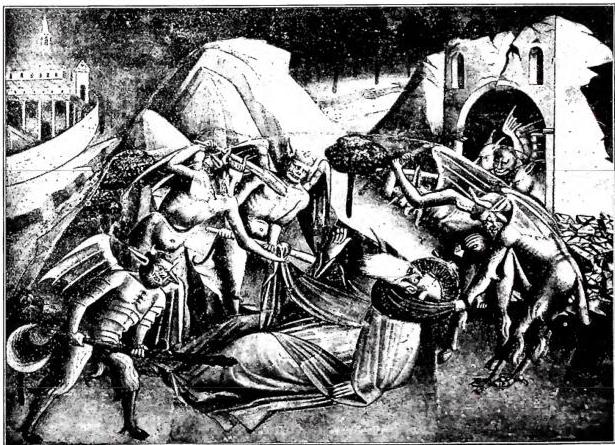
SAINT ANTHONY THE ABBOT. — Defined by St Athanasius as the founder of asceticism, he was born about the year 250 at Coma (now Qeman) on the western bank of the Nile in Middle Egypt, of well-to-do Christian parents. When he was eighteen and his sister still younger, he was left an orphan, and soon afterwards felt himself called to a more perfect life, which he resolved to follow after distributing his goods to the poor and entrusting his sister to a community of virgins. Leaving his native village, he first took up his abode in an ancient Egyptian tomb, then in an abandoned castle beyond the Nile near Aphroditopolis. In this new retreat he shut himself in for twenty years without going out, and during this time he suffered terrible temptations from the devil.
The ever-increasing number of visitors, especially those who wished to follow his example, led him to open his retreat, which in the neighbourhood became populated with hermits, of whom A. became the father and teacher. Such a movement probably dates from about 305. During the persecution of Maximian (311), A. went to Alexandria to succour the Christians and comfort the martyrs. When peace returned, he resumed his austerities, making them even more severe, and isolated himself completely by the Red Sea, three days’ journey from his former abode. At intervals he returned to his disciples on the Nile, but visitors, attracted by his miracles, managed to trace his new dwelling.
In 335 he returned to Alexandria at the urgent invitation of St Athanasius to combat the Arians. The entry of the famous solitary into the city bore fruit, and many heretics were brought back to the faith. Soon, however, he returned to his retreat by the Red Sea, where he lived for another twenty years. Shortly before his death he foretold his approaching end to two disciples, who had been permitted to share his life during the last fifteen years, and from them he exacted the promise that they would reveal to no one the place of his burial, so as to keep it hidden from honours. From the 5th century the liturgical tradition fixed the day of his death as 17 January. According to legend his tomb was discovered in 565, and his body was taken to Alexandria and thence to Constantinople (635); from there the relics passed into France in the 9th–10th centuries to St-Didier-de-la-Motte, and from there to St-Julien of Arles in 1491.
The life of A. was woven of miracles and struggles with the devil, which made him one of the most popular saints of antiquity. He took a lively part in the affairs of the Church in Egypt and was in touch with St Athanasius and Constantine the Great. But A.’s importance is even greater with regard to eremitical life, which under his influence took on a new direction, namely the formation of eremitical communities in which one lived either in solitude or in groups of two to ten, with a similar manner of life and common practices, though without a fixed rule. His fame for holiness soon spread beyond the borders of Egypt; the Greek Church began to venerate him from the 5th century, but it was in the West that the cult of A. developed greatly in the Middle Ages. He became the saint of the people, to whom recourse was had in epidemics, especially against the so-called “St Anthony’s fire,” against the plague and other contagious diseases.
The numerous confraternities founded in his honour (the principal one being that founded in France on the spot of his relics, which is at the origin of the Order of the Antonines), the poorhouses and hospitals dedicated to him, as well as the extraordinarily rich Antonine iconography, all bear witness to the extraordinary popularity enjoyed in the West by the holy hermit.
Manuscript tradition has preserved under A.’s name two small collections of letters: the first of 7, the second of 20, which includes the preceding ones (PG 40, 978–99; 999–1066). The relationship of dependence between the two is not clear, nor do we know the manuscript source of the smaller collection. Today it tends to be identified with the seven letters of A. written in Coptic and translated into Greek, of which St Jerome speaks (De Vir. ill., 88).
The life of A. was written by St Athanasius in 357 according to some, in 365–73 according to others, and translated into Latin by Evagrius of Antioch in 388 (both texts in PG 26, 835–976). The objections raised by Weingarten (Der Ursprung des Mönchtums, in Zeitsch. für Kirchengeschichte, 1 [1877]) against the Athanasian document were refuted by A. Eichhorn (Athanasii de vita ascetica testimonia collecta, Halle 1888) and J. Mayer (in Der Katholik, 1 and 2 [1888]), and more recently by Loop, Reitzenstein, Schwartz and others. The authenticity of the Vita Antonii is today commonly admitted by criticism as a matter beyond dispute.
BIBL.: Tillemont, VII, Venice 1732, pp. 101–44; St. Schiwietz, Das morgenländische Mönchtum, I, Mainz 1904, pp. 68–79; A. Ronzon, S. A. A., Rome 1906 (critical study); O. Bardenhewer, Geschichte der altchristlichen Literatur, III, Freiburg in Br. 1912, pp. 79–82; G. Grupp, Kulturgeschichte des Mittelalters, III, Paderborn 1923, p. 171; IV, ibid. 1924, p. 256; N. Hovorka, Leben und Versuchungen des hl. Antonius, Vienna 1925; L. von Hertling, Antonius der Einsiedler, Innsbruck 1925; G. Garitte, A propos des lettres de s. Antoine l'Ermite, in Muséon, 52 (1939), pp. 11–31; id., Une lettre grecque attribuée à s. Antoine, ibid., 55 (1942), pp. 97–123; P. Nooderloos, La translation de s. Antoine en Dauphiné, in Analecta Bollandiana, 60 (1942), pp. 68–81; P. B. Lavaud, Antoine le Grand père des moines, Lyons 1943. Mario Scaduto
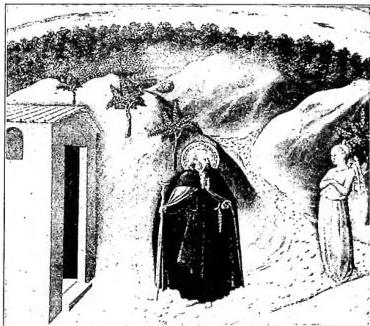
ICONOGRAPHY. — A. is always depicted as an old man with a long beard and a wide habit, with or without a hood. His principal attributes are: the hermit’s staff, often T-shaped, the bell, and the pig, which recall certain privileges of the Order of the Antonines, founded in 1095; the torch or flames, which allude to St A. as protector against the disease known as “St Anthony’s fire,” as well as against erysipelas in cattle. The greatest number of representations of A. comes from late German Gothic painting, sculpture, and woodcut; in Italy, he also recurs frequently in the figurative arts, especially in works of a popular character. The most significant models, from the late 14th century onward, include works by Bartolo di Fredi, Pisanello, Filippo Lippi, Alvise Vivarini, Gregorio Schiavone, Moretto, and others.
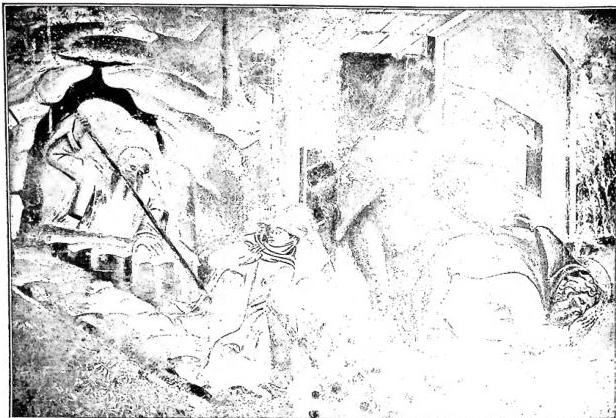
Among the most frequently depicted episodes of his life is that of his manifold temptations, to which the exuberant imagination of Northern artists responded well; notable examples include the engraving by Schongauer, the paintings by Bosch, Brueghel, and Teniers. For Italy, one may cite the fresco by the school of A. Gaddi in the Castellani chapel in Santa Croce, Florence, and the two panels by Bernardo Parentino in the Doria Pamphili collection. The highest glorification of St A. is found in the Isenheim altarpiece, which unites the well-known paintings by Grünewald (The Temptations; The Visit to St Paul the Hermit; the image of the Saint) with the monumental statue by Niccolò da Hagenau. At times, with clear allusion to the shrine of Compostela, he is depicted with St James, to whom St A. entrusts a pilgrim.
BIBL.: K. Künstle, Ikonographie der christlichen Kunst, II: Ikonographie der Heiligen, Freiburg im Br. 1926, pp. 66-72; Cl. Champion, S. Antoine Ermite, Paris n.d.; I. Errera, Répertoire abrégé d'Iconographie, Wetteren 1929; J. Braun, Tracht und Attribute der Heiligen in der deutschen Kunst, Stuttgart 1941, p. 1944. Kurt Rathe
POPULAR TRADITIONS. — The popular cult of St ANTONY the Abbot is one of the most widespread and intense and one of the richest in manifestations. He is credited with the protection of pigs and domestic animals in general. For this reason, on the day of his feast animals are brought for blessing. Donkeys, mules, horses, sheep, goats, cats, monkeys, parrots, etc. are taken to church by their owners to be blessed. In Rome, for centuries the ceremony has taken place in the church of St Eusebius on the Esquiline: in ancient times a parade of teams or sets of horses (up to 24) harnessed to a single carriage took place; even the Pope would send the horses from the Apostolic Palaces all decked out “with little pennants on their heads, with roses on their bridles, with silk reins” (P. Bresciani). In Pinerolo, after the blessing there is still celebrated the gallop, a kind of race of barberi, a remnant of a custom of which traces are also found in other regions, for example in Abruzzo. In Turin the ceremony took place in the church of
(photo Alinari)SAINT ANTONY THE ABBOT — The Temptation of the Saint — Fresco by the School of A. Gaddi in the Castellani Chapel in Santa Croce, Florence (14th century).
Cite this article
“ANTONIO ABATE, SANTO.” Enciclopedia Cattolica, vol. I (1948), p. 919. Azione Romana digital edition, https://azioneromana.com/article/antonio-abate-santo.