
PAOLO di TEBE, saint. — First hermit, born
around 234 in the Thebaid to well-to-do parents.
According to his biographer, St. Girolamo, during the
persecution of Decius, fearing that he might be denounced
as a Christian, he fled to the mountains, taking up resi-
dence in a cave formerly belonging to counterfeiters of
coins.
There he led, for almost one hundred years, a com-
pletely solitary life of prayer and penance, feeding on
the fruit of palm trees and covering himself with a tunic
woven from their leaves. At the age of 113
he received a visit from St. Antonio, then a man in his
nineties, who had learned of his dwelling through a reve-
lation. He died shortly after this visit, around 341, and it
was St. Antonio who buried him, wrapping him in the cloak
given to him by St. Atanasio, while he took possession of
P.’s tunic, which he thereafter wore on the solemn feasts
of Easter and Pentecost.
This is the substance of the Vita Pauli written by St. Gi-
rolamo, which, although a literary jewel, shows that
the author knew very little about his protagonist and, be-
yond a few characteristic details — P., a hermit unknown
to the world, holier than Antonio — filled it with fantastic
and commonplace elements, so that even at that time
doubts were raised about P.’s historical existence. P.’s
existence, however, should not be regarded as a mere
literary invention of St. Girolamo.
The question remains uncertain whether the P. who
brought about the schism of Oxyrhynchus, mentioned in
the petition addressed in 383–84 to the emperors Valen-
tinian, Theodosius, and Arcadius by the two Roman Luci-
ferian priests Marcellinus and Faustinus, should be identi-
fied with our P., or whether another Paul the hermit of
Oxyrhynchus should be admitted. The first hypothesis
would have the advantage of showing that P. was not
quite as unknown as St. Girolamo describes him, but led
an eremitical life very similar to that of Antonio, receiving
some visits from disciples and admirers and occasionally
occupying himself with the affairs of the Church. Chrono-
logy and topography, however, seem rather to support
the distinction.
(fot. Alinari)
PAOLO UCCELLO – Equestrian monument of the English captain
Giov. Acuto. Fresco (1436) – Florence, Cathedral.
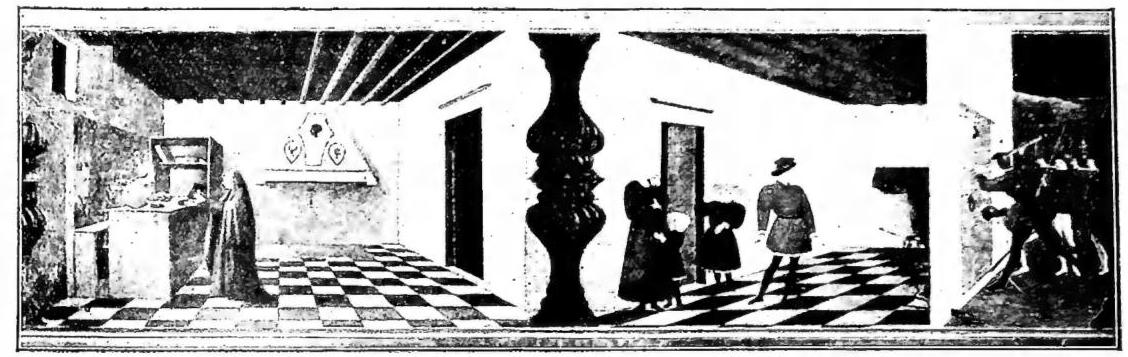
(photo Alinari)