
BARTOLO di FREDI. — Sienese painter, b. ca. 1330. In 1353 he rented a workshop in Siena in which to practice his art together with Andrea Vanni (v.) and was recorded in the statutes of 1355. He married in 1356, and from 1368 to 1400 took an active part in the public life of Siena; he was elected several times captain of the people and prior for the third of Camollia. In 1376 he was appointed castellan of Massa. The will dictated by him in 1407 serves to dispel the belief that he was the father of Taddeo di Bartolo: the painter Andrea (v.) was instead his son. D. in 1410.
Of the numerous works mentioned in documents and in contracts for their “commissioning,” not a single one has survived; on the other hand, we possess several panels and frescoes by him bearing a signature and date, which not only enable us to follow the development of his art from the Madonna di Misericordia in the museum of Pienza, dated 1364 (his first dated work), to the large altarpiece of 1388, now divided between the museum of Montalcino and the picture gallery of Siena, but also allow us securely to attribute many others to him in Siena, Poggibonsi, S. Gimignano, Torrita, Lucignano, and in the museums of Paris and Boston. A decisive contribution to the reconstruction of B.’s chronology was provided by the very recent discovery of the date of the great fresco cycle with Stories from the Old Testament in the collegiate church of S. Gimignano, the painter’s most important and extensive undertaking. Rather than dating from 1356, as was unanimously believed on the basis of Vasari, these frescoes date from 1367 and thus conclude the first period of B.’s activity. The most significant works of B.’s second period are, besides the aforementioned altarpiece of 1388, the Deposition, signed and dated 1382, and other panels with Stories of s. Filippino, also in the museum of Montalcino. B.’s painting, inspired by a graceful eclecticism that enabled it to assimilate both the tradition of Simone Martini and that of the Lorenzetti, is distinguished by its narrative liveliness and perhaps has its chief merit
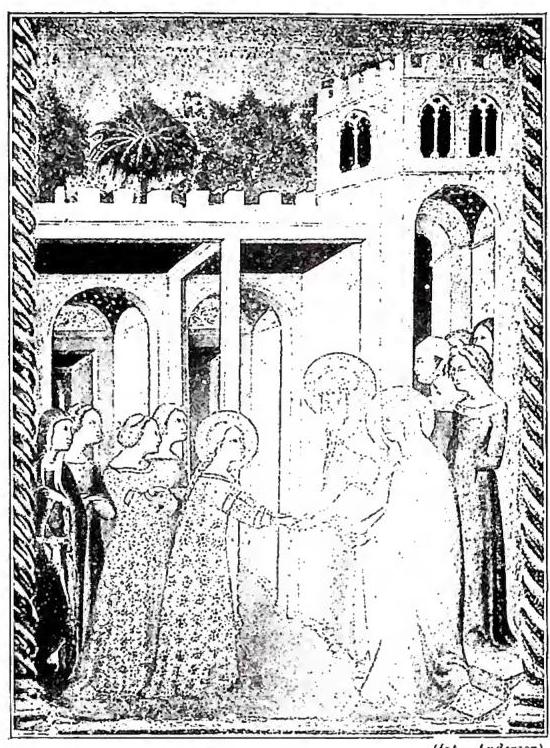
(phot. Anderson) BARTOLO DI FREDI – Return of Mary to her Paternal Home. Siena, Pinacoteca.