
PIENZA, DIOCESI di. - Diocese united with that of Chiusi, immediately subject, it belongs to the conciliar region of Etruria; it comprises 5 comuni in the province of Siena. It has a population of 30,282 inhabitants, distributed across 36 parishes and 6 vicariates forane,
I. ORIGIN AND DEVELOPMENT OF THE DIOCESE
P., a small town in Tuscany, in the province of Siena, from which it is 52 km away, about 8 km from the Via Cassia, on a hill (491 m.), is one of the most characteristic towns of the region, a true gem of the early Renaissance. "Born from a thought, from a dream of beauty" (Pascoli) of Pius II (E. S. colomini [v.]), who was born there on Oct. 18, 1405, when P. was the modest village of Corsignano; it arose as if by enchantment in little more than three years, from 1459 to 1462, after Pius II, returning for the first time to Corsignano on Feb. 22, 1459, conceived the bold plan of transforming his birthplace into a city. Having been entrusted with the task, Rossellino immediately set to work, assisted by the most talented Sienese of the period.The Pope returned there in passing on his return from Mantova to Rome in Sept. 1460. In Aug. 1462 the works were almost completed, and the Pontiff returned to inaugurate the realization of his dream. With the bull Pro excellenti of Aug. 13, 1462, he named P. the old Corsignano and elevated it to an episcopal see. On the following 29th, the Cathedral was consecrated, and on Oct. 7 P. received its first bishop in the Sienese nobleman Giovanni Cinughi.
With P., Pius II elevated Montalcino to a city and diocese, uniting them aeque principaliter under the direct jurisdiction of the Holy See; they were formed with parishes detached from the dioceses of Arezzo, Chiusi, and Grosseto. They remained sometimes united, sometimes separated, until Clement VIII separated them definitively on Oct. 23, 1594. On June 17, 1772, Clement XIV united P. aeque principaliter with Chiusi; a union that still continues, preserving its direct dependence on the Holy See. The diocese of P. was long PICCOLOMINI, FAMIGLIA (v.).
II. RELIGIOUS MONUMENTS
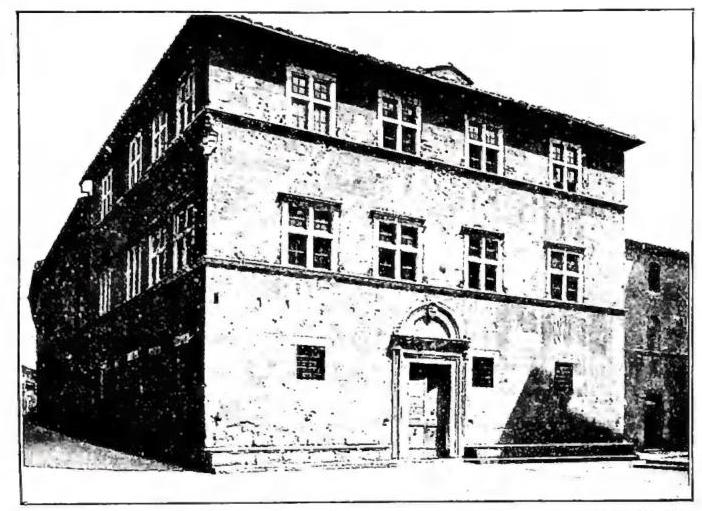
Pieve dei SS. Vito e Modesto. About 1 km from the center (to the west). The church of ancient Corsignano: an 11th-12th century Romanesque building in rough blocks of tufa, restored in 1925. Pius II and Pius III were baptized here. S. Francesco, a Romanesque-Gothic church predating the creation of P., restored in 1905. The Cathedral (dedicated to the Assumption), built over the old church of S. Maria, vestiges of which were found in 1932. It is a combination of classical and Alberti-style forms in the façade, and Gothic and Renaissance forms in the interior, with a radiating apse and three naves of equal height, supported by tetrastyle columns. Such was it desired by Pius II in imitation of churches seen in Austria. The church is so bright that the Pontiff himself called it a "domus vitrea". Perhaps uniquely in history, on September 16, 1462, the Pope, in order to prevent any alterationof the church, with which he had become enchanted, issued a bull of excommunication against anyone who should in the future dare to disfigure it in any way. Unfortunately, the haste of construction prevented Rossellino from ensuring the stability of the foundations, which in the apse section began to yield as early as the time of construction: thus Gregory XIII on March 1, 1583 had to repeal the bull of Pius II. Over the centuries, various consolidation works have been carried out on the apse. The most important were those begun on September 10, 1911 and finished in 1934, which ensured the stability of the church and restored its original beauty. To the right of the Cathedral stands the Papal Palace, inspired by L. B. Alberti's Rucellai Palace in Florence, which is Rossellino's masterpiece. On the Piazza, together with the Cathedral and the Papal Palace, also stand the Bishop's Palace, a pre-existing Gothic palace adapted to the new style by Card. Borgia, later Alexander VI, and upon an Ionic portico the Town Hall, elegant in its austere power; further on is the Palazzo Ammannati. To the left of the Cathedral, near the slender octagonal cuspidated bell tower, is the rectory, with the small but rich museum, where one can admire the famous cope, rich Flemish tapestries, choir books, panel paintings by
Sano di Pietro, Bartolo di Fredi, Sassetta, Matteo di Giovanni, Giovanni di Paolo, and Vecchietta (whose masterpiece, The Assumption, is in the Cathedral). Attached to the museum is a valuable archaeological room containing Etruscan-Roman excavation objects.
In the surroundings, the former monastery of S. Anna in Camprena is of interest, with the early frescoes by Sodoma, the Castle of Spedaletto (15th century), and Monticchiello for its historical and artistic importance. - See pl. XC.