
AMMANNATI, BARTOLOMEO. — Architect and sculptor, born at Settignano on 18 June 1511, died at Florence on 22 April 1592; a pupil of Baccio Bandinelli, he benefited from the influence of Jacopo Sansovino and was a devoted follower of Michelangelo. His activity as a sculptor took place chiefly in Florence, Pisa, the Veneto, Rome, and Naples: his Neptune (popularly called the Biancone) for the Florentine fountain in Piazza della Signoria is famous, as are, for their Mannerist and decorative character, the statues executed for the Boboli Gardens. Vasari introduced him to Julius III, who, having received a favorable opinion from Michelangelo, entrusted him with the Dal Monte tomb in S. Pietro in Montorio in Rome.
As an architect, he left his most important works in Florence (the Giugni, Grifoni, and Ramirez palaces, etc., as well as the destroyed Ponte di S. Trinita, which some would attribute to Michelangelo), in Lucca (the palazzo and palazzetto of the Province), and in Rome, where he worked together with Vasari and Vignola on Pope Julius’s villa, for which he also executed the fountain, later enlarged and incorporated into the palazzetto of Pius IV on the Via Flaminia. Other Roman works include the arcaded façade of the courtyard of Palazzo Firenze, the Caetani and Ruspoli palaces, and, in all probability, the inner façade of Villa Medici. Tradition and the testimony of his principal biographer, Baldinucci, attribute to him at least the design of the façade of the Collegio Romano, which authoritative studies (Pirri) Valeriani (v.). This building is important not only for its architectural typology (it establishes the type of the large educational building), but also for the history of the art of the Counter-Reformation period (v. CONTROHFORMA, Arte della). The Society of Jesus, which held him in high esteem, entrusted him with the Casa and the S. Giovannino in Florence, and often sought his advice and works, which he provided generously in a disinterested and devout spirit.
A typical artistic personality of the second half of the sixteenth century, he directed his original investigations toward the composition of architectural elements already established in practice and by then included in the common repertory; he also took up the theoretical themes then in vogue, compiling, for example, the unfortunately lost drawings of the ideal city. He matured his distinctly Mannerist style, often characteristically discontinuous, through contact and familiarity with the artists and learned men of his time, aided also by the sagacious culture of his wife Laura Battiferri, as is demonstrated by her extensive correspondence with Annibal Caro. He was so highly esteemed by Michelangelo that he was commissioned to complete the staircase of the Laurentian Library.
The lively Catholic spirit of his time marked the second half of his life, which he spent in the strictest religious observance, even when, in old age, the power of his ingenuity and intellect failed him. His artistic convictions were likewise devoted to the religious spirit, always within the historical climate and taste of his age; thus, on 22 August 1582, he addressed a lengthy letter to the Accademici del Disegno that amounts to a clear position regarding the relationship between art and morality: in it, in the tone of a public confession, he repudiates his earlier production as a sculptor because of the figures he had represented nude, following the practice of the High Renaissance, and lays down the norms for the Catholic artist of his time. — Vedi Tavy. XCI-XCII.
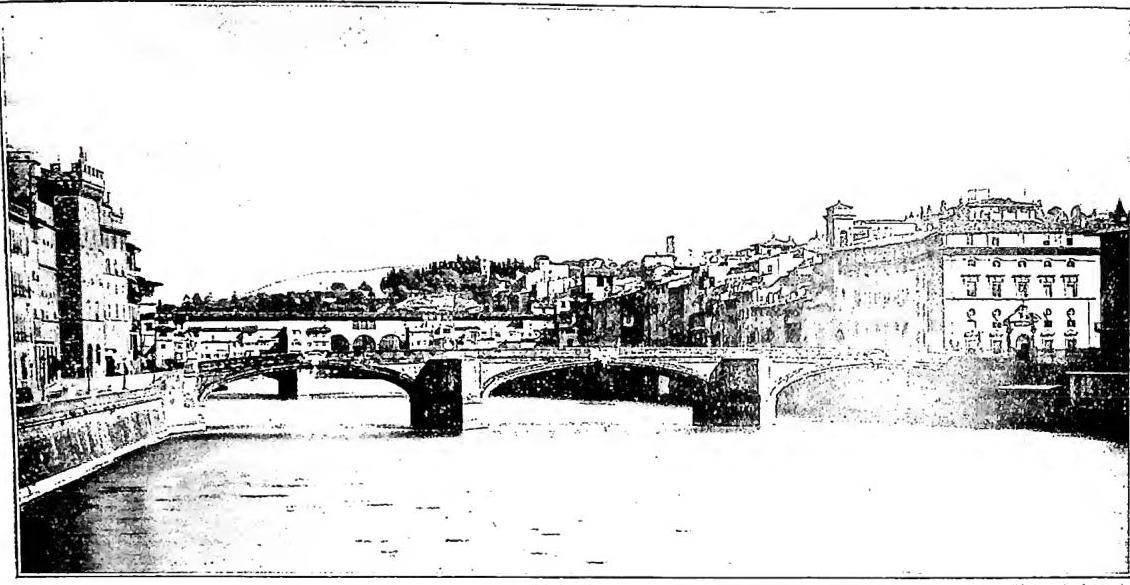
AMMANNATI, BARTOLOMEO – Ponte Santa Trinita, before its destruction – Florence.
(Anderson photograph)
legio Romana? Note sopra il p. Valeriani, in La Civiltà Cattolica, (1932, III), pp. 251–64; A. Prandi, Il Palazzo del Collegio Romano, in Memorie del R. Liceo Ginnasio E. O. Visconti, Turin 1939, pp. 23–32 (with bibliography and a survey of the building); S. Bettini, Note sui soggiorni veneti di B. A., in Le Arti, 3 (1940–41), pp. 20–28; F. Kriegbaum, Michelangelo e il Ponte a S. Trinita, in Rivista d’Arte, 23 (12th series, 13) 1941, pp. 137–44; O. Morisani, Una statua del Montorsoli e una dell'A. a Napoli, ibid., pp. 145–48; P. Pieri, L'architetto B. A. e i Gesuiti, Rome 1943 (excerpted from Arch. Hist. Societatis Iesu, 12 [1943]). La Lettera agli Accademici del Disegno is in G. Bottari–S. Ticozzi, Raccolta di lettere sulla pittura, scultura ed architettura etc., III, Milan 1822, pp. 529–39.