
ANNUNCIATION. – It is the angelic message of the incarnation of the Word of God to the Virgin Mary.
1. IN HOLY SCRIPTURE
The episode (Lk. 1:26–38) takes place in Nazareth, far from Jerusalem and its Temple, where, six months earlier, the other announcement of the birth of the Forerunner had occurred (Lk. 1:5–25). To “a virgin betrothed to a man named Joseph, of the house of David—and the name of the virgin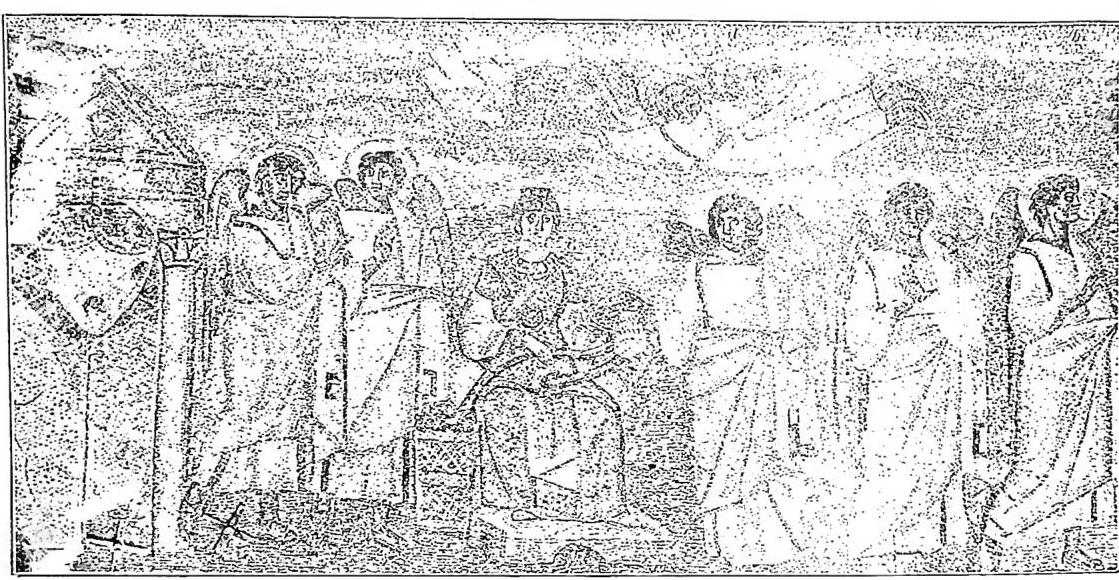
Maria, reassured by the Angel (“The Holy Spirit shall descend upon you and the Power of the Most High shall overshadow you”; cf. Gen. 1, 2), gives her assent, declaring herself “the handmaid (ἀνδός) of the Lord.” And at that instant, according to the unanimous judgment of theologians, “the Word became flesh and dwelt among us” (Io. 1, 14), thus fulfilling the oracle of Is. 7, 14 concerning the ALZON, EMMANUEL D' (v.).
From a literary standpoint, the Gospel episode, which in its dialogued portion displays characteristics of Hebrew style, is among the most gentle and dramatic. The angel gives the announcement, and our cause is pleaded; Maria seems to hesitate, and our fate remains suspended; she consents, and our salvation is assured.
The theological importance of the account is supreme, as the foundation of all Mariology. An antithetical counterpart to the human Fall and the fulfillment of the divine promise in Eden (Gen. 3), the mystery of the A. marks the “fullness of time” (Gal. 4, 4; Eph. 1, 10) and the beginning of the “New Testament” (Jer. 31, 31). “Fixed term of eternal counsel” (Dante, Par., 33, 3), cooperating in the divine plan of Redemption, “new Eve,” Maria rises above the world like aurora consurgens, herald of the “Sun of justice” (Mal. 4, 2). Dante depicts the A. as a sublime example of humility (Purg. 10, 28–45).
Rationalist criticism rejects the Gospel of the Infancy in its entirety (v. SALVATORE, VANGELO DELLA), but its particular target is verses 34–35 concerning the virginal conception: A. Loisy, H. Usener, and A. Harnack regard them as interpolations by Luke into the primitive document or by a later redactor. The arguments they derive from style and content are insubstantial (cf. E. Ruffini, Introductio in S. Scriptorum, N. T., Roma 1925, pp. 118–24).
2. IN THE LITURGY
In the Roman liturgy, “Annuntiatio B. Mariae Virginis,” and in the Byzantine, ὁ Εὐαγγελισμὸς τῆς ὑπεραγίας. Μαχίας, it was formerly also called Annuntiatio Domini, Annuntiatio Christi, Conceptio Christi. The date of 25 March, in relation to that of Christmas, depends on the ancient opinion according to which the Lord became incarnate and died on 25 March: Octavo enim Kalendas aprilis conceptus creditur, quo et passus (s. Agostino, De Trinit., 4, 5; PL. 42, 894).It is one of the earliest Marian feasts, but does not seem to predate the Justinian era. The Chronicon Paschale, from the first half of the 7th century, speaks of the A. as a feast that had already long been established in the ecclesiastical calendar (Olimp., 194; cf. 351; PG 92, 488, 1001); and the Council in Trullo of 692 prescribed that the day of the A., even when it fell during Lent, should never be aliturgical (can. 52; Mansi, XI, 968). The Liber Pontificalis (cap. 86, § 14; ed. Duchesne, I, 376) assures us that the feast was celebrated at this time in Rome as well, since Sergio I (687–701) decreed that it be solemnized with a great stational procession from the diaconia of s. Adriano to s. Maria Maggiore.
It would seem that the Visigothic Church of Spain adopted the feast as early as the first half of the 7th century, with considerable variation as to the day of celebration. The Tenth Council of Toledo (656) excluded the date of 25 March because of Lent and its coincidence with Easter, and decided, following the example of other “distant” Churches, on 18 December, eight days before Christmas (can. 1: Mansi, XI, 33). But this interpretation of the Toledan canon is disputed: according to M. Jugie, the feast of the A. was introduced into Spain following the example of Rome.
The Ambrosian Church admitted a twofold celebration of the mystery: on 25 March and on the sixth Sunday of Advent, which immediately precedes Christmas Eve. S. Carlo, observing the canon forbidding the celebration of saints’ feasts during Lent, abolished the solemnity of 25 March and left, as the sole official solemnity of the A., that de Incarnatione, on the sixth Sunday of Advent. But in 1897 (cf. decree of the S.C. dei Riti, in Acta S. Sedis, 29 [1937], p. 566 ff.) the feast during Lent (25 March) was restored, although its object was not clearly defined, since the liturgy of the day bore the dual title In festo Annunciationis B. Mariae Virginis: Solennitas Domini.
For the Roman Church, as formerly for the Church of the East, the traditional 25 March prevailed over all liturgical considerations concerning Lent, as the beginning of the new Christian era; hence, in the Middle Ages, this day was also chosen as the beginning of the civil year (ab Incarnatione Domini).
Igino Cecchetti
3. IN ARCHAEOLOGY
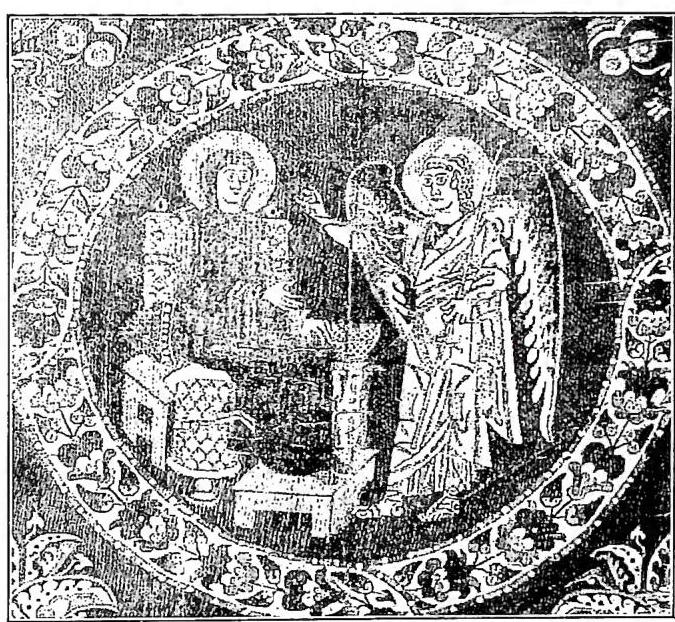
In Christian funerary art, the only image of the A. is painted on the vault of a cubiculum in the cemetery of Priscilla on the Via Salaria; the BOSONE (v.), but was recognized as a scene of the A. Bottari (v.). Before the seated Virgin stands a young man in tunic and pallium, with his right arm extended; the painting is now greatly deteriorated and can be dated to between the end of the 2nd and the beginning of the 3rd century. Also in Rome, in the mosaics of the triumphal arch of S. Maria Maggiore (432–40), the scene of the A. is inspired by the Protoevangelium of James: from above the dove descends, while the archangel Gabriel flies toward the seated Madonna, who is intent on spinning purple wool for the Temple of Jerusalem; around them are three winged angels. The scenes depicted on the side of a sarcophagus in Ravenna and in the mosaic of the cathedral of Parenzo (6th century) are likewise inspired by the same Protoevangelium. The A. is also found several times in miniatures,as in the Gospel books of Etschmiadzin and Rabula; in ivories, such as the cathedra of Massimiano in Ravenna, the Murano diptych, the binding of the cathedral treasury, and the Trivulzio collection in Milan; in the civic museum of Bologna; and on textiles, mostly of Alexandrian or Syrian origin, donated by the popes between 750 and 860 to churches in Rome and mentioned in the Liber Pontificalis no fewer than six times, in addition to the textile found in the treasury of the Sancto Sanctorum, now in the Museo Sacro of the Vatican Library.
4. NELL'ARTE
Mentre le prime figurazioni dell'A. si limitano a rappresentare l'Angelo e la Vergine con atteggiamento e attributi tratti fedelmente dal racconto di S. Luca, del V sec. in poi, la rappresentazione si arricchisce di altri elementi, derivati o dalla fantasia stessa dell'artista od anche dai vangeli apocrifi di Giacomo e dello pseudo-Matteo e dal «Libro della Natività diMaria». Queste fonti forniscono i seguenti temi iconografici: una prima A. presso la fontana alla quale Maria soleva attingere acqua; una seconda nella casa di Maria, dove l'Angelo, in sembianza di giovane di incomparabile bellezza, appare alla Vergine intenta a filare la lana purpurea per il Tempio di Gerusalemme; la Vergine, come già in S. Luca, dapprima si turba, e poi, rasserenata dalle parole dell'Angelo, accetta umilmente l'annuncio. Il «Libro della Natività» ci mostra la Vergine nella sua cameretta, che «per nulla atterrita dalla vista dell'Angelo, come colei che era usa a vederne spesso», apre le braccia e leva gli occhi al cielo, pronunciando l'«Ecce Ancilla Domini».
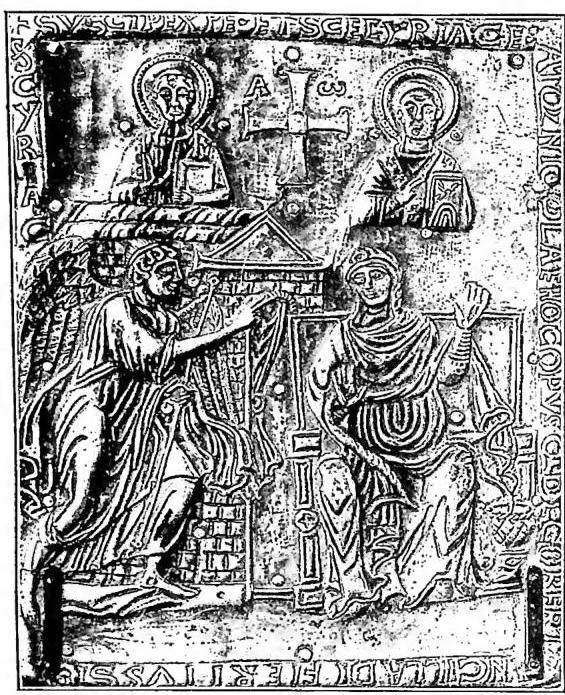
L'episodio della fontana s'incontra abbastanza frequentemente all'inizio e si fa poi sempre più raro (avorio del V sec. nel tesoro del duomo di Milano, musaico del XII sec.
(fot. Sansalini)
ANNUNCIATION – Silk textile of Byzantine art (8th century). Sacred Museum of the Vatican Library.
ANNUNCIATION - Cover of an Evangelary in repoussé silver (11th century) - Rome, Treasury of S. Maria in via Lata.
in S. Marco in Venice); at times it is joined to the scene inside the house (homiliary of Giacomo monaco in the Bibliothèque Nationale of Paris). More common is the scene of Mary engaged in spinning, or having placed the spindle in the basket beside her (mosaic of the triumphal arch of S. Maria Maggiore of the 5th century, fresco in S. Maria Antiqua of the 6th century, etc.).
The Virgin is normally situated on the right; the position on the left is always rather rare, even in the oldest representations, although it persisted for a long time in the schools of Cappadocia and in Syrian milieus. Probably the position of the Virgin on the right was reinforced, until it became almost constant, by the tradition according to which people wished to recognize in the sanctuary of Nazareth the precise positions of the angel and the Virgin, positions still marked today by two columns, that of the Virgin (currently suspended from the vault of the chapel) being situated on the right (cf. Daniel Abbas, 1106–1107, in B. de Khitrovo, Itinéraire russes en Orient, Geneva 1889, p. 69; and, in general, writers later than the Crusades).
The iconographic current of anecdotal taste spread in both East and West and was destined for further development, especially as a “story” linked to others from the life of Mary; it in fact almost invariably precedes the Visitation or Nativity (e.g. in the fresco of the church of Appiano, 12th century, or in the pulpit of the cathedral of Cagliari by Guglielmo) and is also found connected with the Tree of Jesse, as on a page of the Bible of the British Museum.
Iacopo Torriti in S. Maria Maggiore (1295), with the Madonna standing, framed by a richly ornamented throne.
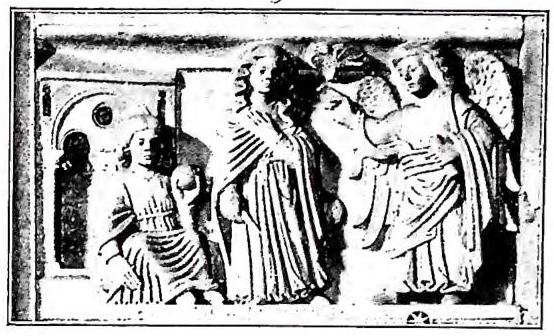
Given the immediate comprehensibility of the subject, encouraged by the very abundant repetitions and by the simplicity of the essential, readily identifiable figurative elements, the representation of the Annunciation could be reduced to extreme simplifications (sometimes, even when forming part of a narrative of the life of Mary, any environmental definition or allusion is entirely absent, as, for example, in the architrave of S. Giustina in Padua [12th century], where the figures, according to French models, are fully sculpted against a smooth background); it thus lent itself to being composed according to aims that were more decorative than strictly illustrative. Indeed, the angel and the Madonna are often represented separately on the corbels of triumphal or apsidal arches (12th-century mosaic in the cathedral of Torcello); and even when other attributes of the Annunciation appear at the apex of the arch, forming an ideal link between the two figures (12th-century mosaics of the Martorana and the Palatine Chapel in Palermo), it is clear that in these cases the composition is subordinated to a decorative aim of abstract symmetry. Singular is the Annunciation of S. Vincenzo al Volturno (826–53), where the Angel and the Virgin are separated by a window and are conceived, pictorially, in antithetical fashion: the Angel flies tumultuously, while the Madonna, by contrast, is enthroned and surrounded by a triple halo.
Following this iconographic scheme, which is merely allusive to the Gospel narrative and instead resolved decoratively, the two essential figures came to be represented as completely separate (in the 13th-century relief of the cathedral of Spalato, for example, a third arch occupied by an altar is interposed between the two arches containing the Angel and the Virgin); later, the figures would be enclosed in independent frames, even as half-length figures, in accessory panels of polyptychs, on the doors of tabernacles, and in the pinnacles of altarpieces; this occurred especially among the Sienese painters of the 14th and early 15th centuries, who were particularly receptive to decorative taste (polyptych at the Pieve of Arezzo by P. Lorenzetti, panels and polyptychs by A. Vanni, Paolo di Giovanni Fei, Taddeo di Bartolo, Sano di Pietro, Sassetta, etc.). The two figures, independent of one another, are in any case already found in the 12th and 13th centuries, such as those inserted among the meanders of a Romanesque capital in S. Andrea at Pistoia; and often on the façades of Gothic churches (cathedral of Reims) in the form of isolated statues aligned with others of an entirely unrelated subject.
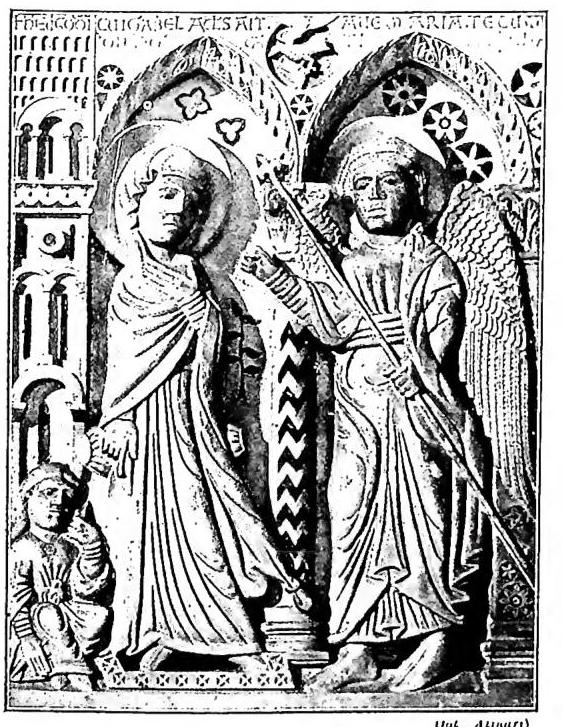
The narrative taste, however, never disappears and, indeed, from antiquity onward enriches the representation with ever-new elements: for example, the maidservant seated apart, spinning, lifting the curtain, or listening from an adjoining room, who is already found in Carolingian ivories and later in Rome at S. Urbano alla Caffarella (11th century), in Pistoia on the pulpit of Guido da Como (where the Madonna is on the left), in Benevento on the bronze door of the Cathedral (13th century), on the pulpit of the cathedral of Barga (13th century), and again in the Annunciation by Barna da Siena at S. Gimignano (1381). The introduction of this figure may be due to the Gospel of pseudo-Matthew, which recounts that five maidens lived with Mary and vindicated her before Joseph; but it appears above all to have been suggested by the human delight in anecdote, which increasingly emphasizes the scene’s character of secluded intimacy.
The transformation of the architectural setting likewise responds to this same need; indeed, in the series of Annunciation scenes represented outdoors, the oldest have a basilica as their background, in which a documentary or topographical intention must be recognized, since this basilica is meant to be that of Nazareth (built over the grotto of the Annunciation), which, through a literal interpretation of the periegetic texts, was identified with Mary’s house (“Domus sanctae Mariae basilica est.” Anon. Placentinus, in P. Geyer, Itinera Hierosolymitana socculi III-VIII, Vienna 1898, p. 161). Very soon the basilica was reduced to a portico along a nave (cathedral of Parenzo, 6th century), then to an isolated portico and finally to a canopy (which
ANNUNCIATION — Detail of the pulpit of the cathedral of Barga (13th century).
ANNUNCIAZIONE – Detail of the pulpit of Guido da Como (13th century) – Pistoia, church of S. Bartolomeo in Pantano.
which long persisted, as is shown, for example, by the panel of Bonanno’s door of the cathedral of Pisa, 12th century, remarkable also for the position on the left of the standing Madonna, for a hint of naturalistic landscape beside the baldachin, and for the words of the salutation, which occupy much of the smooth background); between the 9th and 11th centuries it was transformed into a house, only to reappear in the 12th (mosaic of the cathedral works in Florence); but perhaps it is still suggested, in the 13th century, by the grandiose building occupying the background of certain A., such as that by the Master of the Magdalene (13th century, Paris, Museum of Decorative Arts) and the aforementioned one by the author of the stories of s. Pietro.
But the preference for narration, consistently marked by motifs of intimacy and gentleness, led artists more often to combine the interior of the house with an exterior in which the Angel could stand out prominently; thus the house contracts into a loggia or becomes a shrine, a pergola, a portico, or is reduced to an atrium through which other rooms, rich in household utensils and furnishings, can sometimes be glimpsed, while the exterior is adorned with greenery and later takes concrete form as a landscape and even as a view (at the beginning of the 16th century, Bonifacio Veronese placed, between the two celestial figures, the Piazza di S. Marco, reserving it for the apparition of the Eternal: a fragmentary canvas in the galleries of the Accademia in Venice).
During the evolution of the setting, which, for its part, did not depart substantially from the iconographic tradition until the 15th century, the figures’ attitudes varied with ever greater freedom and their attributes changed. The Angel gradually lost the primitive character of his attire (which was Greek in style, with pallium and cothurns, and was completed by a stephane on his head), following the evolution of costume; at first he held the herald’s staff or sceptre; then the staff became flowering, and finally was transformed into a lily. Noteworthy as evidence of this transition are the 14th-century A. by the Master of the codex of S. Giorgio (Stoclet Collection, Brussels) and that of slightly later date by Orcagna in Orsanmichele, in which the lily has corollas that are respectively slight and still closed, and therefore closely resembles a sceptre. The olive branch also became common (Lippo Memmi in the Uffizi, Taddeo di Bartolo at the Accademia of Siena), as did the palm (A. Lorenzetti at the Accademia of Siena), according to the tradition accepted by Dante (« Perch'egli è quegli che portò la palma - Giù a Maria »: Par., XXXII, 112). The very frequent motif of the lily, moreover, which recalls s. Bernardo’s « inviolabile castitatis lilium », is often replaced or repeated by a vase of flowers, placed on the ground between the Angel and the Virgin; it was adopted especially by Sienese painters (the foremost example being Simone Martini’s A. in the Uffizi), in keeping with their ornamental taste. Lippo Vanni (14th century) depicts the Angel offering the Virgin a flower-filled basket.
The vase of flowers also serves to establish a separation between the two figures, accentuating the Virgin’s untouchability; this separation, realized naturally in scenes with the Angel alone in the open air, is often deliberately achieved by other means as well (e.g. a column, a piece of furniture, etc.: A. by A. and P. Lorenzetti in the Pinacoteca of Siena; by Lorenzo Monaco at S. Trinita in Florence).
In the 11th century a new element entered the iconographic tradition: the book, open or closed, in the Madonna’s hands or on her knees, on a lectern or another piece of furniture, replacing the distaff and spindle; this motif is likewise derived from the apocryphal Gospels, where it is related that Mary spent part of her day reading. The book is more often open and bears the words of Isaiah: «Ecce virgo concipiet et pariet filium». This corresponds well to the purpose of religious painting, especially medieval painting, which is to illustrate and make evident the meaning of the representation; for the same reason, from the 14th century onward, it became very common to write the words of the salutation either on a scroll held by the Angel or in a breath issuing from his mouth toward the Madonna (A. by Simone Martini), and likewise in a breath the Madonna’s reply (A. by Ambrogio Lorenzetti). Later the words were transferred to the nimbi or the frames.
In general, as time passed, new mystical and allegorical elements appeared in ever greater numbers, deriving also from the syncretism of the «legendae» (e.g. the Legenda aurea) and from other literature.
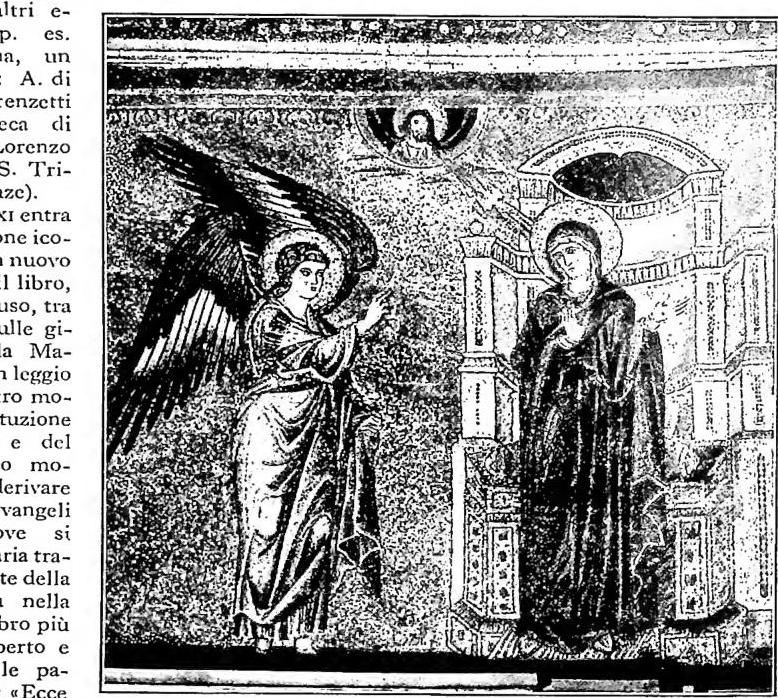
at times the Redeemer is represented as he gives Gabriel the divine message (A. by Spinello Aretino in S. Francesco at Arezzo, where, however, the bust of the Eternal still remains in the baldachin covering the Virgin, dominating the event). Subsequently, the detail of the dove also tended toward greater realism, and it was therefore represented flying through an open window or perching on Mary’s shoulder. At times the ray proceeding from the Father and reaching the Virgin extends as far as her ear; this mystical motif signifies the spirituality of Christ, who, as the «Verbum», is thereby received. Exceptional is the representation of a winged point that darts down from above, setting the dove in motion (Spinello Aretino, church of the S. ma Annunziata in Arezzo); this seems to herald the late motif of the infant Jesus proceeding along the usual ray, carrying the cross on his shoulders (A. by Giovanni dal Ponte in the Vatican Pinacoteca, by Giovanni Santi at Brera, by Domenico Panetti in the Pinacoteca of Ferrara, by Hans Baldung in the museum of Kolmar); this strange iconographic innovation was condemned by s. Antonino da Firenze («quasi non esset ex substantia Virginis corpus eius assumptum», Summ. hist., III, tit. 8, 4, 11), and Pope Benedetto XIV prohibited it as a heretical expression.
From the 14th century onward the scene became more complex with other representations; for example, that of Adam
In Germanic countries, together with that of the A., one often finds the representation of the unicorn (v. ANIMALE), which sometimes replaces the Angel (antiphonary of the convent of Einsiedeln); alternatively, the two representations are merged, and Gabriel takes on the appearance of a hunter, accompanied by four dogs symbolizing the four virtues: justice, mercy,
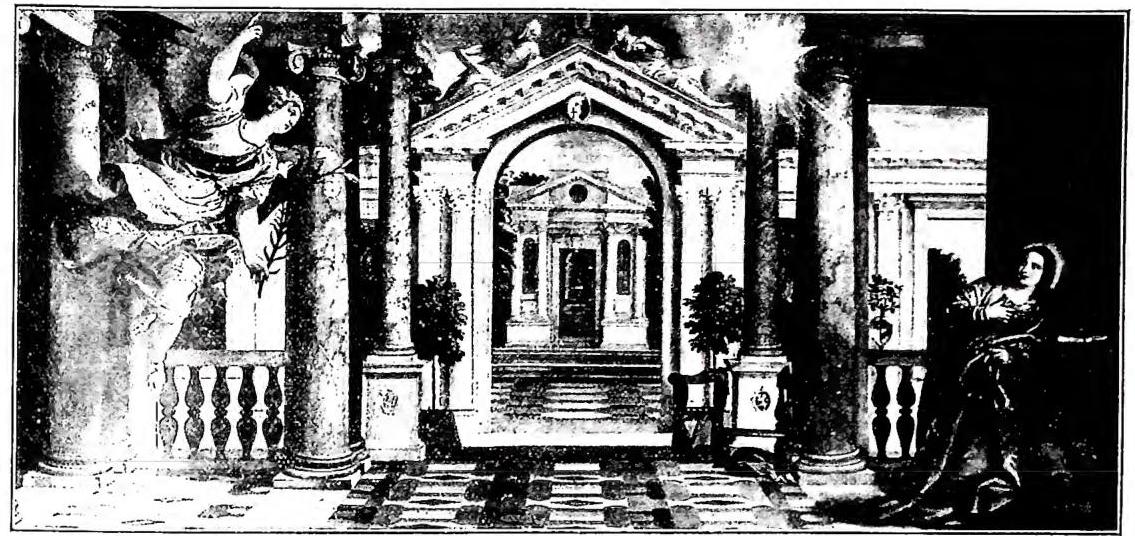
ANNUNCIATION – Canvas by P. Veronese – Venice, Galleria dell’Accademia.
(Alinari photograph)
truth and peace (“retablo” in the Gothic cathedral of Lübeck, altarpiece in the Weimar Museum, ca. 1410), under the influence of popular sacred plays.
It is obvious that a figurative theme so dear to artists and so frequently repeated should not only possess a complex iconographic tradition, but also offer broad possibilities for free interpretation: thus the attitudes of the figures and the expression of their feelings vary in such a way as to elude any genuine iconological classification. When, moreover, the subject is treated by artists of exceptional creative power, the figurative schemes appear overwhelmed by their personalities and in any event undergo profound and sometimes radical deviations, destined either to alter and nourish the tradition or to remain isolated cases. This process of escape from, or deviation from, iconographic currents was furthered by art’s gradual loss of the intention to illustrate Sacred Scripture and to instruct—a purpose proper to it in the Middle Ages and one that disappears altogether after the Renaissance (reference is therefore made to the entries on individual artists or artistic periods).
Thus, among innumerable examples, Giovanni Pisano, in the pulpit of S. Andrea in Pistoia (1290–1301), while harking back in its general arrangement to Nicola (pulpit of the baptistery of Pisa, 1260)—that is, placing the Angel, the dove, and the Virgin against an architectural background (the basilica?) amid the multitude of figures from the other stories of the Madonna—gives the scene a dramatic character, exalting his own unmistakable style. And almost contemporaneously Giotto (first five years of the 14th century), who places the Virgin and the Angel on the corbels of the arch of the Scrovegni Chapel in Padua, accentuates the abstract demand for symmetry by giving the two figures identical architectural backgrounds and balancing their masses; but he certainly cannot be included in the so-called courtly current or linked to Byzantine modes, since every element is resolved into the concrete massiveness so typically Giottesque, which confers, especially upon the Virgin’s purely human femininity—kneeling and holding her head high—incomparable monumentality. Inimitable, although slavishly reproduced by imitators (Taddeo Gaddi in S. Croce in Florence), these figurative types elude any classification, whereas the A. by Simone Martini in the Uffizi, which is perhaps the most celebrated, while constituting the quintessence of the Master’s style, establishes, especially through the Sienese painters, an abundant iconographic series.
Angelico too, whose A. are among the best known, invests the traditional elements with astonishing and inimitable innovations, especially when, after the panel in Cortona (with the progenitors in the background) and that of the corridor of the museum of S. Marco in Florence (in which the typological elements of the Angel amid the flowering greenery of a garden and the Madonna intent on reading beneath a Brunelleschian portico are formally given substance through typically humanistic spatial and perspectival investigations), he makes the sacred scene take place between the bare walls of a convent cell (this A. is in fact frescoed in a cell of the convent of S. Marco), without any ornament, entrusting all the lyricism of the subject to the highly measured attitudes of the figures and to the sense of proportion that renders the atmosphere spacious and rarefied, almost as if in a moment of self-satisfied ecstasy, made evident also by the contrast provided by a Dominican figure appearing on the threshold.
In the same way Botticelli (A. in the Uffizi) draws upon the Angel’s descent and the Virgin’s agitation to express the tormented movement of the linearism that defines his style, complicating the garments and breaking up the forms, while at the same time displaying the new achievements of aerial perspective in the landscape extending beyond the open window in the background.
In the same century A. Della Robbia (Sanctuary of La Verna), in keeping with the popular tone of his art and the technique of his school, adheres to convention—while placing the Madonna on the left—depicting the kneeling Angel, the intervening vase of lilies, the dove among light clouds, and the Eternal amid the angels.
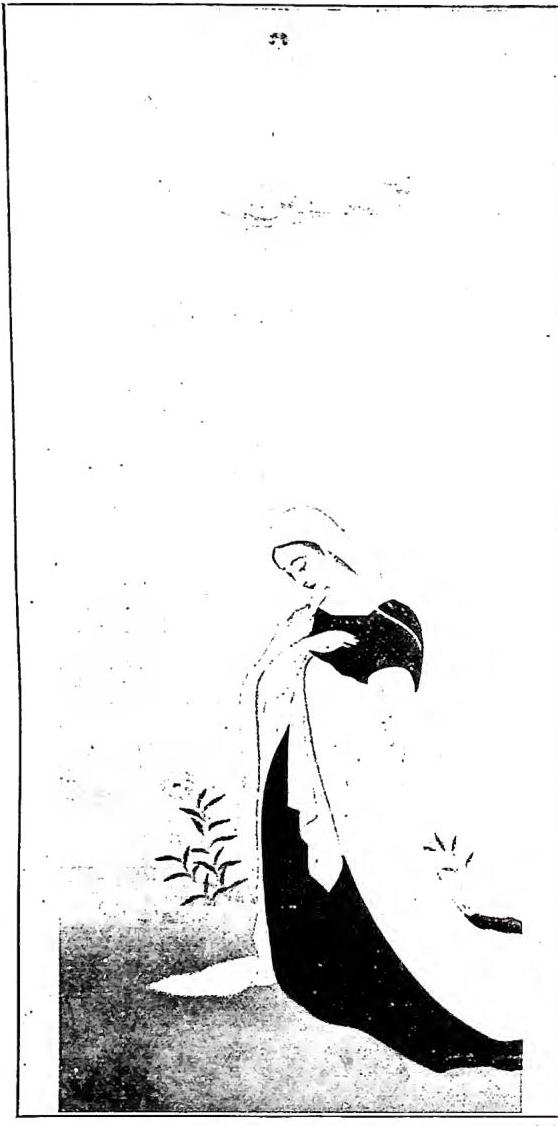
ANNUNCIAZIONE - Painting on silk by Takahiro Toda, exhibited at the exhibition of gigoponesi artists, Tokyo 1934.
of arches, balustrades, and spiral columns, in a prodigious vision of “from below upward”: the Angel descends, hovering over the cornices, while the Madonna, shown in bold foreshortening, seems to rise upward by virtue of the broad gesture resembling that of Titian’s Assumption.
During the seventeenth and eighteenth centuries, representations of the Annunciation became increasingly rare, owing to a taste that preferred pictorial occasions suited to the depiction of complex and fanciful scenographies. This taste indeed dominates the Annunciation by Mochi, which is generally regarded as the beginning of the Baroque (Museum of the Opera of Orvieto: the Angel is sculpted upon a mound of clouds, with a striking effect of freedom from matter), as well as those by Guido Reni and Gentileschi; and also the much less interesting examples of the eighteenth century.
Thus one arrives at the few nineteenth-century examples among which, apart from the pointless academic exercises, Rossetti’s Annunciation is celebrated. It is wholly marked by human characteristics and sentiments, avoiding any sacred intention; hence the title Annunciation is above all an example of that profane aestheticism, steeped in an external mysticism, which characterizes the manner of the Pre-Raphaelites (v. PRERAFFAELLISMO). Contemporary art, while not renouncing the peculiarities of present-day figurative taste, seems, in the very few examples worthy of mention, to return in some way to traditional iconography (see, for example, the Annunciation by Ceracchini, a cartoon for the church of Segozia).