
MASSIMIANO, archbishop of RAVENNA, saint. — Deacon of the Church of Pola, b. in 498, d. at Ravenna on 21 February 556. From his native Istria he went to the court of Constantinople. On 14 October 546, at Patras in Achaea, he was consecrated bishop of Ravenna by Pope Vigilius, at the behest of Justinian. Before this date, the little that is known of his life is interwoven with legend. Agnello of Ravenna inserted in his Liber pontificalis a few lines concerning M., which are all that remains of his writings; he also recalled a mission undertaken by him to Alexandria, before he became a bishop, perhaps to settle disputes and theological questions.
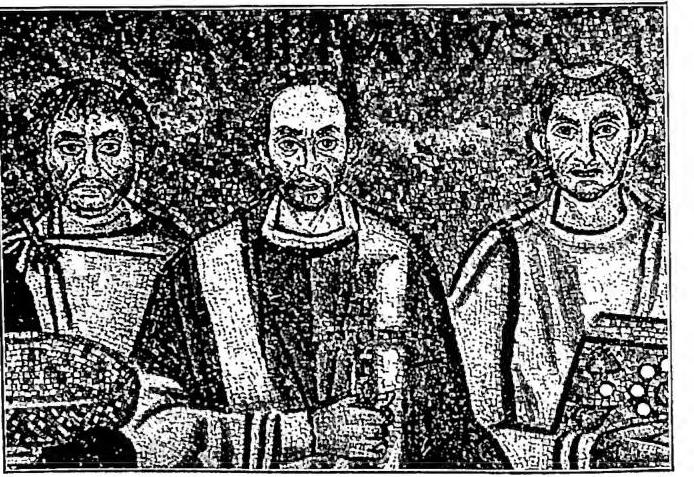
But at Ravenna M.’s personality lives on in the ecclesiastical history and monuments of the city. At first disliked by the clergy and the people, who in the struggle over the “Three Chapters” had almost unanimously sided with the schismatic party and therefore saw in M. the shepherd imposed by the Byzantine court to crush this schismatic attitude, M. succeeded in his purpose, so that he was later regarded as the ideal bishop. The only metropolitan in Italy faithful to Vigilius, his work went beyond the boundaries of his Church and his province, extending into the territories of the ecclesiastical provinces of Milan and Aquileia, with incursions also into the territory under Roman metropolitan jurisdiction. He was the first in the West to assume, after 549 and before 554, the title of archiepiscopus, with a meaning far broader than that of today: not merely a metropolitan, but the head of a group of metropolises. To him is owed the consecration of the celebrated basilicas of S. Vitale and S. Apollinare in Classe at Ravenna, which he adorned with splendid mosaics. In the former, in the great historical panel on the left, beside Justinian, one can still admire the figure of the bishop “tall in stature, slender of body and emaciated, with the few hairs forming a crown around his head,” who looks with “glaucos eyes,” as Agnello describes him. In Ravenna, at his behest, the basilica in honor of the protomartyr Stephen was also built; in it he deposited relics of its patron and of twenty other saints, and he had the basilica of S. Andrea Maggiore renovated: both have now disappeared. In Pola, the basilica of S. Maria Formosa remained famous; today very little of it survives.
His munificence is attested by the famous ivory cathedra, which bears the monogram interpreted as Maximianus episcopus. He initiated that Istrian patrimony which in subsequent centuries made the Church of Ravenna on the eastern shore of the Adriatic famous and wealthy. One little-known and still insufficiently studied activity of M. is that recalled by Agnello, concerning the sacred liturgy.
his name is entered in the Roman Martyrology on 21 February.