
APOLLINARE, bishop of RAVENNA, saint. – He was the first to occupy the episcopal see of Ravenna; the presence of his eleventh successor at the Council of Sardica in 342 suggests that he lived toward the end of the 2nd century. He is venerated as a martyr by all hagiographical sources later than the 7th century; but Pietro Crisologo (Serm. 128: PL 52, 552), while asserting that he was a martyr, indeed the only martyr of the Church of Ravenna, acknowledges that tradition venerates him only as a confessor: a tradition, however, which, as Pietro himself observes, knows of persecutions and tortures endured by him, through which fundebat saepe sanguinem suum, and as a result of which he succumbed.
This therefore is not a case of merely moral martyrdom, to which the eulogistic writings of the period so often appeal, but rather of a simple translation into post-Constantinian language of the ancient term confessor, and one considerably more exact, moreover, than in the case of other “martyrs” who died in peacetime, such as s. Felice di Nola. It would then be Roman sources (Registernis Greg., V, 11; VIII, 36) that would most explicitly recognize A. as a martyr, whereas among the Ravennate texts only the Passione would take up the theme. Buried in the midst of his Church, as Crisologo also reports, he was commended to the devotion of the faithful by a modest shrine situated in the cemetery area of Classe, not far from the well-known cemetery of the Basilica Probi, until the middle of the 6th century.
The Passio Sancti Apollinaris (BHL 623), to which great antiquity and authority had already been attributed—it was regarded as the work of his immediate successor—indeed asserts that it was s. Pietro himself who sent him to Ravenna. Criticism has, however, demonstrated that the writing is no older than the 7th century and reflects polemical motives connected with the struggle for autocephaly (666). It nevertheless seems that relations between A. and Pietro were already presupposed somewhat earlier by the Liber Pontificalis of Rome itself (ed. Duchesne, I, 2nd ed., Paris 1886, p. 323). A similar reference to the Apostle in a polemic by Crisologo (Serm. 175) against Milanese jurisdiction, and the fact that the proto-bishops of Arles and Aquileia (raised to metropolitan status in the years of Milan, like Ravenna) were likewise said to be disciples of s. Pietro, would suggest that the legend originated in anti-Milanese designs much older than 666 and in an environment other than Ravenna.
The customary date of s. A., celebrated at Ravenna with great solemnity (Reg. Greg., V, 11), is recorded by the Martir. geronimiano on 23 July; it does not appear in the Leonine, Gelasian Regin. 316, or Gregorian Pad. 42 Sacramentaries (the Hadrianic recension knows a Statio ad S. Apollinarem, but for the fifth Thursday of Lent); it is included in the Würzburg lectionary, which already assigns to it the polemical-sounding pericope Lc. 22, 24-30, and in the post-Carolingian liturgical books. His cult, widespread throughout the territory subject to the Byzantines, also spread to Lombardy, France, and above all the Rhineland. In Rome Pope Simmaco (498-514) dedicated an oratory to him in the Rotonda di S. Andrea (Lib. Pont., ed. Duchesne, I, p. 261), and Onorio (635-38) a basilica at the Vatican, at the same time decreeing that a procession should set out from it every Saturday for S. Pietro (Lib. Pont., ed. Duchesne, I, 323). The basilica of Campo Marzio appears only in the 8th century, in the biography of Pope Adriano and in the Itinerario di Einsiedeln.
The great basilica of Classe, the center from which the cult radiated so widely, was begun by Bishop Ursicino and consecrated by Massimiano on 9 May 549.
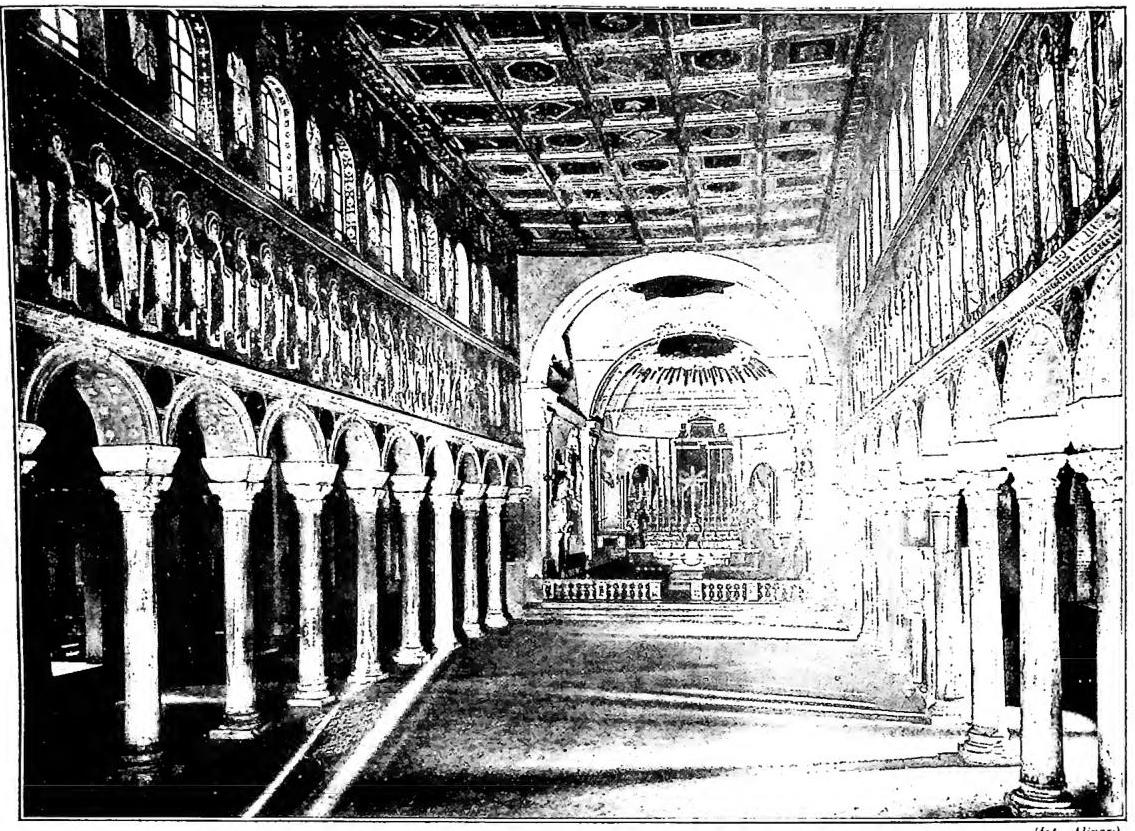
APOLLINARE, bishop of RAVENNA, saint – Interior of S. Apollinare Nuovo (6th century) – Ravenna.
(Int. Alimeri)
dicate its translation, by which the basilica itself was consecrated. Such a singular eccentricity in the building’s position with respect to the relics may perhaps be due to the intention of erecting it on high dunes in order to protect it from the waters. Preceded by a quadriporticus of different periods, the basilica (55 × 30 m.) has three naves, with a prothesis and diaconicon, supported by 24 splendid columns of marble from Imetium. The different levels on which these rest, as well as the various types of masonry in the central nave, bear witness to the work of troubled restorations. Only the presbytery, approached by the broad staircase of 1723, preserves all the ancient splendor in its mosaics. In the uppermost part of the apse basin, the Transfiguration of Christ is symbolized; in the lower register, the majestic figure of s. A. stands in the attitude of an orans, with six sheep on each side. Below, on one side are represented the sacrifices of Abel, Melchisedech, and Abraham, and on the other the granting of privileges to the Church of Ravenna by Costantino IV. Four archbishops of Ravenna are depicted between the windows. At the center of the triumphal arch is Christ among the symbols of the evangelists, with the apostles represented as sheep emerging from Jerusalem and Bethlehem. In other panels below are depicted two palms, the two archangels Michele and Gabriele, and the evangelists Matteo and Luca.
The location of the Saint’s relics became the subject of passionate debate in the late Middle Ages. To evade the threat posed by raiders infesting the undefended coast, they had been carefully hidden in the 9th century; but where? A Historia translationis Sancti Apollinaris (Acta SS. Iulii, V, Paris 1868, p. 374), written in the 12th century by monks of S. Apollinare Nuovo, related that Bishop Giovanni (VII?, 850-78) had transported them into the city, to the ancient palatine basilica of Teodorico, reconciled to Catholic worship in the 6th century under the name of S. Martino in Ciel d’Oro.
The monks of Classe disputed this account, maintaining instead that the body had been found at Classe in 1173, as related by a Tractatus de inventione Sancti Apollinaris (Rerum Ital. Script., I, 2, p. 538). The controversy remained very lively. It is now recognized that the relics did in fact remain for some time in S. Martino, giving rise, from at least the 9th century, to a third name for it, S. Apollinaris in Novo (S. Apollinaris in Veclo already existed in the city), in a circular crypt excavated for the purpose and recently identified; but from there they soon returned to Classe, where they were found in 1173. The basilica of S. Apollinare Nuovo also has three naves (42 × 21 m.), still covered with Theodoric and Byzantine mosaics. Scenes from the life and passion of Christ above, and prophets and apostles below, belong to the first period; the processions of confessors and virgins offering their crowns to Christ belong to the second.
Studies. – More recent works, with bibliography: F. Lanzoni, pp. 724-39; H. Delehaye, L'hagiographie ancienne de Ravenne, in Anal. Bollardiana, 47 (1929), pp. 1-30; E. Will, St. Apollinaire de Ravenne, Strasbourg 1936; G. Lucchesi, Note agiografiche sui primi vescovi di Ravenna, Faenza 1941. Giovanni Lucchesi