
PRERAFFAELLITI and PRERAFFAELLISMO. - These are the terms by which the followers of a particular aesthetic doctrine and the doctrine itself are designated, which became established in England in the middle of the last century.
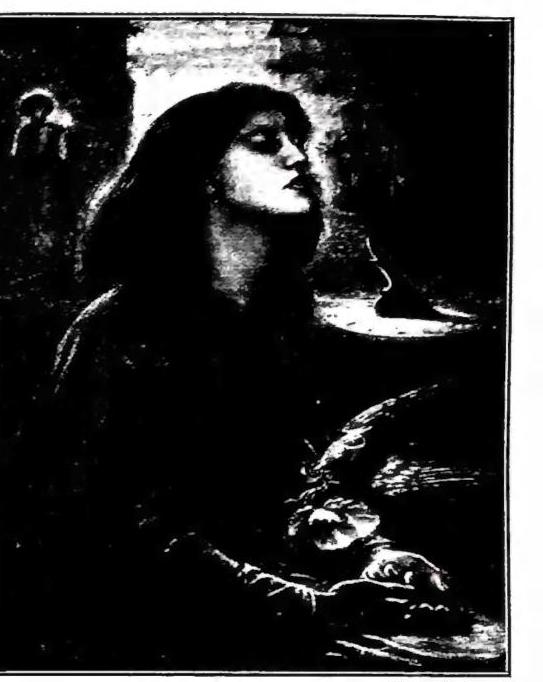
PRERAFFAELLITI E PRERAFFAELLISMO - Beata Beatrice. Painting by Dante G. Rossetti - London, Tate Gallery.
a sense behind those Nazarenes (v.), purism (v.), INGRES, JEAN-AUGUSTE-DOMINIQUE (v.) and his followers. But above all they primarily looked to Ingres and the purity of his drawing. As always happens in similar circumstances, the Pre-Raphaelite theory signified something when it served to define the stylistic terms of authentic works of art, and little or nothing in other cases.
The group of the p., whose members gave it the name of “brotherhood,” included—and these were the first to champion the principles of its theories—Dante Gabriele Rossetti (1828-82), the painters Holmann Hunt and I. Everet Millais, and the sculptor Thomas Woolner. Later James Collinson joined them, while F. N. Brown also came into contact with them. Burne-Jones, a follower of Rossetti, and many other English painters of the mid-century are also defined as P., although they never actually belonged to the “brotherhood,” which, moreover, was soon dissolved. Rossetti was undoubtedly the group’s leading personality and, in a certain sense, the only one who remained faithful to its initial theories, making no concessions to realism in his effort to express the mystery of the human soul by treating historical or biblical subjects derived from poems and legends.
The movement brought together for only a short time the highly diverse individuals who represented it, and the journal they founded, The Germ, had an ephemeral existence. The mystical foundation of their art, too, became clouded by sensuality, to the point that they became associated with the paganizing and “satanic” Swinburne, and in 1871 were violently attacked by a critic under the designation The fleshy school of poetry. Having begun with the defense of an ethical and social art inspired by the Middle Ages, and consequently supported and defended by Ruskin, in opposition to the industrialism of the age, they ultimately abandoned their theoretical premises, supporting and nourishing a sort of mysticism of art for art’s sake. The symbolism of their works was reduced to a mystifying aestheticism or to a mannered exoticism; it embraced currents and incorporated demands at odds with the ethical and religious premises from which they had originated. Unlike French Impressionism, the movement had no significant resonance in continental Europe.