
REIMS, ARCIDIOCESI of — Archdiocese and chief city of the department of the Marne, on the right bank of the Vesle; it is surrounded by hills planted with vines.
The archdiocese corresponds partly to the department of the Marne and partly to that of the Ardennes, with an area of 5,423 sq. km. It has a population of 429,477 inhabitants, of whom 322,107 are Catholics, distributed among 614 parishes served by 456 diocesan priests and 66 religious priests; it has a major and a minor seminary; 13 male and 81 female religious communities (Ann. Pont. 1952, p. 337). Its suffragan sees are the dioceses of Châlons, Soissons, Amiens, and Beauvais. The patron of the archdiocese is St. Remigius. The church of St. Remigius was raised to the rank of minor basilica by Pius IX on 28 June 1870; the basilica of St. Clotilde by Pope Leo XIII on 10 March 1902 and incorporated into the Lateran Archbasilica; Pope Pius XII raised the basilica of Notre-Dame de l'Espérance at Mézières to the rank of minor basilica on 15 Aug. 1946.
Its ancient name was Durocortorum, as is read on a milestone; in the 3rd or 4th century it was called Remi or Remes. In the Roman period it was the metropolis of Gallia Belgica; the kings of France were consecrated in its Cathedral. The building suffered greatly from bombardment during the 1914–18 war, as did most of the civil and religious buildings and dwellings; it also sustained considerable damage between 1939 and 1945. The Baptism of Clovis took place on 25 Dec. 496 in the Cathedral built by St. Nicasio. The King, and later Charlemagne, left the government of the city to the archbishops, but in the 12th century the Chapter also took part in II. Archbishop William Biancamano of the counts of Champagne granted a municipal charter in 1182. Following the marriage of Henry V to the daughter of Charles VI, the house of Burgundy occupied the city, expelling Archbishop Reginald of Chartres, who later returned there. No catalogue of the archbishops of R. earlier than the 11th century is known. The oldest, extending to Archbishop Gervasius (1055–67), is a liturgical book from Arras, now in the Library of Boulogne (no. 92), where another manuscript, also originating from Arras (no. 42), is preserved; the latter extends to Archbishop Rodulf le Vert (1106–24), as does ms. 4280 of the National Library of Paris; while two manuscripts in the Library of Troyes (nos. 620 and H 186, now at Montpellier) continue to Henry of France (1162–75); the collection of Robert of Torigni extends to William Biancamano (1176–1202); Paris. 8865 ends with Henry of Dreux (1227–40). The first two catalogues give the title of saints to the bishops Sixtus, Sinicius, Donatianus, Viventius, Nicasio, Remigius, Nivardus, Rieul, and Regnobertus. Hincmar (Opuscula: PL 126, 334) mentions the church dedicated to the two first holy bishops, Sixtus and Sinicius, celebrated on 1 Sept. Imbetasius took part in the Council of Arles in 314; Maternianus is commemorated on 30 Apr.; Nicasio fell victim to an invasion by the Vandals in 407 or by the Huns in 451. Flodoard knew the testament of Bishop Remigius, in which his predecessor Barnabas is also mentioned. Remigius, praised by Sidonius Apollinaris (Epist., IX, 7) and by Gregory of Tours (Gloria confertorum, 78), baptized King Clovis on 25 Dec. 496. He wrote letters to fellow bishops (Ep., 1–4 in MGH, Epistolae, III, pp. 113–16). The Hieronymian Martyrology commemorates him on 1 Oct. Flavius was at the Council of Auvergne in 535; Mappinius wrote to St. Nicasius of Trier (548–555); Aegidius was deposed at Metz in 590 and exiled to Strasbourg (Gregory of Tours, Historia Francorum, V, 18). Somnatius was at the Council of Paris in 614 and at Clichy in 627; Lando was a contemporary of Sigebert III (634–56). Nivardus or Nivo died in 673; Reolus, formerly count of Champagne, was archbishop between 674 and 689; Rigobert, at the beginning of the 8th century, was for a time exiled to Gascony; Abel obtained the pallium from Pope Zachary and is called archbishop in Pepin’s capitulary of 744. He was succeeded by the monk Tilpin (748–94), who attended the Council of Rome in 769 and received assignments from Pope Hadrian I. His epitaph was composed by Hincmar. Vulfarius succeeded him after nine years; he signed Charlemagne’s testament, presided over the Council of R. in 813 and that of Noyon in 814; he died shortly after the consecration of Louis the Pious, carried out at R. by Pope Stephen IV in Oct. 816. He was immediately succeeded by Ebo, who after various vicissitudes became bishop of Hildesheim in 847; meanwhile, from the Council of Thionville (835), R. was governed by Fucius (d. in 843) and Notho, abbots of St. Remigius. Then came: Hincmar (845–82), Fulco (883–900), Heriveus (900–22). Later, Aclaldus (925–62), Adalberon (969–89), Gerbert (991–998), who later became Pope Sylvester II (999–1003), Gervasius (1055–67); then Reginald of Fellay (1083–96), Henry of France (1162–75), Cardinal William of Champagne (1176–1202), Aubry de Humbert (1206–18), William de Joinville (1219–86), John of Courtenay (1266–70), Humbert (1352–55), Simon de Gramaud (1409–13), Reginald of Chartres (1414–44), William Briçonnet (1499), A. Barberini (1657–71), C. M. le Tellier (1671–1710), A. de Talleyrand Périgord (1777–1801), C.-M.-J. Gousset (1840–66), J.-B. Landriot (1867–74), B.-M. Langenieux (1874–1905), L.-H. Luçon (1906–1930).
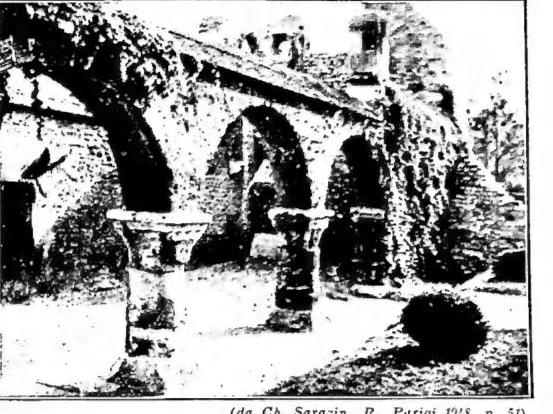
(from Ch. Sarazin, R., Paris 1934, p. 51)
The Cathedral of Notre-Dame, begun in 1211, was completed approximately a century later, except for the towers, which were finished in 1480. Its architects were Jean d'Orbais (1211–31), Jean La Loup (1231–47), Gaucher de R. (1247–55), Bernard de Soissons (1255–90), Robert de Coucy (1291–1311), and later Collard, Gilles, Jean de Dijon, and Colard de Givry. On 24 July 1481 it was devastated by fire. It was restored in the 17th–19th centuries and bombarded from 4 Sept. 1914 to July 1918. The windows of the great rose window, with the history of the Blessed Virgin, called that of the Consecration (late 13th–14th centuries), have been restored using the ancient fragments. The central nave has ten bays; in the sixth pillar on the right is the capital known as «des Vendanges». The episcopal throne comes from the church of St. Nicasio, demolished during the Revolution. The western façade is a Gothic masterpiece of the 13th century and has recently been consolidated and restored with great care. The lower level has five sections, with three portals. The central one is dedicated to the Madonna and presents scenes from her life; the right-hand portal to the triumphant Redeemer, and the left-hand one to the Crucifixion. Above the central portal, in the great rose window, is the combat between David and Goliath. Above it is a gallery called that of Glory, with the Baptism of Clovis; around it are the galleries of the kings, with royal figures. Of the eight bells in the north tower, six were destroyed; in the south tower, the bell called Charlotte, donated by the Cardinal of Lorraine in 1570, weighs 11,500 kg. The Treasury of the Cathedral preserves a chasuble from the 13th century with the Tree of Jesse; vestments for the consecrations of Kings Louis XIII, XIV, and XVI and Charles X; Byzantine crosses and processional crosses from the 12th century; objects removed from the tombs of Bishops Adalberon (d. in 988) and Gervasius (d. in 1067); several ivories; a 14th-century diptych with scenes of the Blessed Virgin; the so-called St-Remy chalice, in gold, enamel, filigree, and precious stones, from the end of the 12th century; and notable reliquaries, such as those of the Holy Thorn (1458), in crystal; of the Resurrection, from the 15th century, offered by Henry II; of St. Samson, from the 12th century; and of St. Ursula, from the beginning of the 16th century, offered by Henry III.
The ancient Episcopal Palace was destroyed by the fire of 19 September 1914; the Library and an Ethnographic Museum also burned. A Lapidary Museum is now being established on the site, where fragments from the cathedrals and from the churches of S. Nicasio and S. Remigio are being assembled. Near the archbishop’s residence, the Carnegie Library was built and inaugurated in 1928. In the exhibition hall one may admire precious manuscripts, such as a Gregorian Sacramentary of the ninth century, two Evangeliaries of the ninth century and one
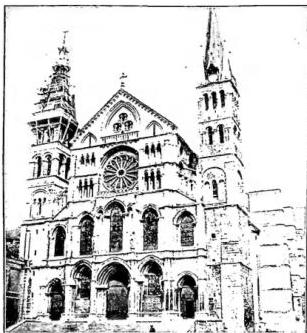
The church of S. Remigio belonged to one of the most flourishing abbeys in France and originated as a small chapel dedicated to s. Cristoforo, where s. Remigio was buried in 533. Recent excavations have brought to light a church with two opposing apses, perhaps the one described by a historian of R. as completed in 852. The Romanesque church was built by Abbot Teodorico in 1039 and consecrated on 2 October 1349 by Pope Leone IX. Of the building, the nave and transept remain. Abbot Pietro di Celles, later bishop of Chartres, built the choir with ambulatory and chapels between 1162 and 1181; the work was completed in 1190; in 1506 Abbot Roberto di Lenoncourt, later archbishop of R., built the façade of the southern transept, mutilated by bombardment. The building, restored between 1838 and 1842, suffered enormously in 1914 and partly collapsed in 1920; but everything was restored. The western façade, less damaged, retains its Romanesque character; of the two towers flanking it, the southern still dates from the eleventh century, while the northern is from 1845. The interior is more than 121 m. long, with vaults rising to 24 m.; the central nave has 13 bays, while the side naves are much lower; the choir is Gothic, and the cathedra is modern; a stone slab lists the princes and dignitaries buried in the church from the age of Charlemagne onward. Behind the choir is the tomb of s. Remigio, erected in 1847 by Cardinal Gousset, but with statues belonging to the preceding mausoleum; the relics are deposited in a gilded-bronze sarcophagus decorated with enamels. The treasury contains Carolingian sculptures; a fragment of the tomb of Abbot Oddone from the twelfth century; remains of a ninth-century mosaic; Limoges enamels; and a polychrome head of King Lotario from the twelfth century, discovered in 1919.
The church of S. Giacomo was begun at the end of the twelfth century and completed at the beginning of the twelfth century; it was subsequently rebuilt in the fourteenth to sixteenth centuries. The three-portal façade from the thirteenth century remains; it has three naves (thirteenth–fourteenth centuries); the choir is from the sixteenth century, with two lateral chapels; the beautiful sixteenth-century stained-glass windows were destroyed between 1914 and 1918, when the building also suffered greatly and was subsequently restored.
The church of S. Maurizio is already mentioned in the testament of s. Remigio, but the present building, which was joined to the Jesuit College, dates from the Renaissance; the façade and bell tower were rebuilt in 1867; it suffered a fire in 1943. Following demolitions, the remains of the church of S. Giuliano (eleventh century) came to light. The church of S. Andrea was partly rebuilt between 1925 and 1929; the church of S. Giovanni is also modern. The basilica of S. Clotilde in the suburb of Flechambault is likewise modern.
A Christian hypogeum was discovered in 1738 beneath the tower of the parish church of S. Martino: it was reached by a staircase and decorated with paintings representing the sacrifice of Abraham and the paralytic. This hypogeum, situated beside the ancient road called Caesarea in the interpolated testament of s. Remigio, is now destroyed (E. Le Blant, Inscriptions chrétiennes de la Gaule, I, Paris 1856, pp. 448–50).
In the crypt of S. Nicasio, the sarcophagus known from a drawing found among Peiresc’s papers and published by E. Le Blant (Sarcophages chrétiens de la Gaule, Paris 1886, p. 17) was discovered, bearing scenes of Moses receiving the law, the Lord delivering the law to s. Pietro, and Job; a fragment of the sarcophagus is now in the British Museum (L. Demaison, Bas-relief du sarcophage de St-Nicaise, in Bulletin de la Société des Antiquaires de France, 1926, pp. 124–36).
The museum of old R. is housed in the former Le Vergeur mansion, which preserves a Gothic hall from the thirteenth century. It contains documents relating to the Cathedral, the abbeys of S. Remigio, S. Nicasio, and S. Dionigi, the Jesuit College, and the city’s ancient palaces. It is also the seat of the «Société des Amis du vieux R.». The Musée des Beaux-Arts occupies the site of the abbey of S. Dionigi, rebuilt under Luigi XV, later the Grand Seminary, and since 1908 a municipal building. It houses a precious collection of tapestries from the fifteenth century to the middle of the seventeenth; a series of painted canvases from the fourteenth to the sixteenth centuries; portraits of the two Cranach; and the French school from the seventeenth century to the present day.
The following Synods were held at R.: in 627–30; in 1813; in 991; in 1049; in 1119; in 1148; in 1408; in 1564; and a provincial Council in 1857. - Vedi tav. XXXV.