
GOLIA (Hebr. Goljath). — Philistine hero, defeated and killed by David (I Sam. 17). GATH (v.), but the ending of his name would suggest that he was neither Canaanite nor Philistine by origin; perhaps he was descended from the ‘Anāqim, exterminated by Joshua (Ios. 11:21).
He was of gigantic stature, measuring “6 cubits and 1 span” in height (approx. 2.90 m); he was armed with a helmet, a coat of scale armor (weighing about 40 kg), and greaves, all of bronze; he wielded a spear with an iron point (weighing 5 kg), carried a strong sword at his side, and, slung between his shoulders, a bronze javelin. His shield-bearer went before him, covering his entire body with the large shield. G. took part in a campaign against Saul in the land of Judah (“valley of the terebinth,” today Wādi es-Sanṭ) and, since the two armies could not bring themselves to attack, repeatedly challenged an Israelite hero to single combat: their duel would put an end to the war. David (v.), who had happened to arrive there, heard the challenge amid the universal trembling (which was not overcome by Saul’s generous promises), accepted it outright, and went to meet him with his shepherd’s staff: Saul’s weapons had proved cumbersome to him. But the staff was a pretext: in his bag he had five stones, and in his left hand, concealed, the sling. While G., angered by what he regarded as a joke, advanced unprotected against the shepherd, he received a sling-stone to the forehead that killed him. The victor was convinced that this had been retribution by “the Lord of hosts, God of the armies of Israel,” challenged by the worshiper of idols. David later brought his head to Jerusalem as a trophy. The sword, first hung as an ex-voto in the Tabernacle, would later be taken by David in flight (I Sam. 21:8 ff.). Gino Bressan
ICONOGRAPHY. — In ancient Christian funerary art the giant does not appear in painting, but on sarcophagi, which represent the combat between him and David. The first example is provided by the lid of the sarcophagus of Ancona, in which the two antagonists are preparing for battle; David holds the sling in his right hand and the shepherd’s crook in his left; G. is dressed as a Roman soldier (Wilpert, Sarcofagi, II, p. 264, pl. 14, 3).
The other sarcophagi are all from Gaul; that of Reims is known from a copy by Peiresc (Wilpert, ibid., p. 18, fig. 5 and p. 264); in the Museum of Vienna there are two examples on two lids (ibid., p. 264, pl. 194, 1; p. 265, pl. 194, 2); both on these and on the destroyed sarcophagus of Marseille (ibid., fig. 24, pp. 57 and 264), David is assisted in the combat by the angel. On the sarcophagus of Marseille, however, on the right side, the sole scene was represented in which the young David brings King Saul the severed head of G.
In a basilica in Spain, perhaps Saragossa, at the beginning of the fifth century, David killing G. was represented. Its memory is preserved in the couplet describing the scene, composed by the poet Prudentius (Dittochocon, no. 19). The combat between David and G. is also carved on the ivory capsella of Brescia (J. Kollwitz, Die Lipsaenothek von Brescia, Berlin 1933, pp. 24, 62, pl. 3); and on marble rims for basins: one from Cyprus, now in the Louvre Museum; a second found at Sbeitla, now in Tunis, in the Bardo Museum; a third in the Hermitage Museum in Leningrad (E. Michon, Rebords de bassins chrétiens ornés de reliefs, in Revue biblique, new series, 13 [1916], p. 128).
The scene is also found in the Greek Psalter 139 of the tenth century in the Bibliothèque nationale of Paris (H. Omont, Fac-similes des plus anciens manuscrits grecs de la Bibliothèque nationale, Paris 1902, pl. 4, 7).
The ordo commendationis animae preserves the invocation “deliver, O Lord, the soul of your servant, as you delivered David... from the hand of G.” — Vedi tav. LXII.
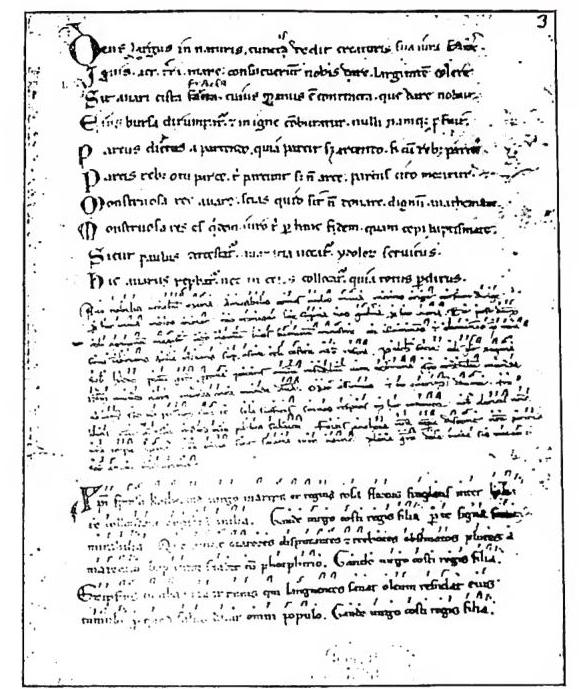
(from W. Meyer, Carmina Burana, Berlin 1881, bas. 5)
GOLIARDI – Carmina Burana: hymn against avarice, hymn to Mary, hymn to St. Caterina (12th–13th century) – Munich, Library, cod. 1847, fol. 3.