
SBEITLA. – Sufetula in Byzacena, today S. in Tunisia, was a notable Roman city, attested from the time of Vespasian onward (CIL, VIII, no. 23216); later becoming a municipium and a colony (ibid., no. 11340), it began to decline under Vandal rule.
It was conquered from the Byzantines by Belisarius in 533; governed by John Troglita in 546; and chosen in the following century by the patrician Gregory as his capital. But it was besieged, captured, and sacked by the Arabs in 647 (Ch. Diehl, L'Afrique byzantine, Paris 1896, pp. 370, 557 ff.). No fewer than seven Roman roads led to or terminated at S.; of these, two connected it with Carthage, two with Theveste, one with Thysdrus (today el-Djem), one with Thenac (today Thina), and one with Tacape (today Gabes). Among the bishops of S. are known Privatianus in 256, also mentioned in the Hieronymian Martyrology under 7 May; Jucundus, who was present at Carthage at the Conference of 411 and the Council of 419; and Praesidius, mentioned in 484 by Victor of Vita (Persecut. Vandal., II, 16).
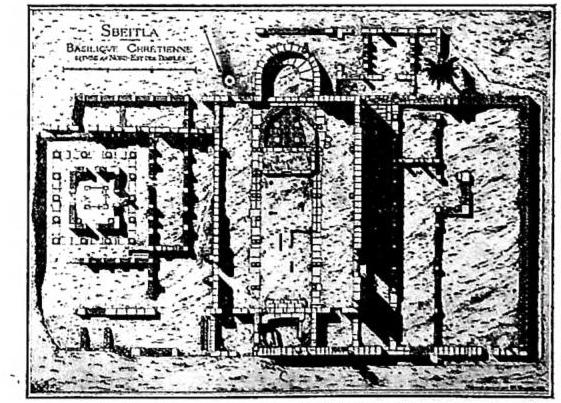
The ruins of the Capitolium of S., with its three temples (A. Merlin, Forum et églises de Sufetula, Paris 1912), as well as those of the triumphal arch and the city’s insulae, are imposing. As early as 1883, remains of Christian buildings came to light; on an architectural fragment discovered at that time one reads: « Hic domus + oratio[nis] » (CIL, VIII, no. 11414). It must have stood at the entrance to the basilica known as that of the presbyter « Serbus », with three naves divided by columns, whose ruins were identified by A. Merlin between 1907 and 1909. In the presbytery, tombs and four sarcophagi in local stone were found, bearing epigraphic fragments (CIL, VIII, no. 23230, b); another fragment refers to a presbyter « [qui fuit in presbiterio anis X » (ibid., no. 23230, c), while a third inscription belonged to a « Natalika fidelis ».
Particularly noteworthy is the inscription of the presbyter Serbus, preceded by a monogrammatic cross set within a garland (A. Merlin, op. cit., p. 30, fig. 4). The remains of the altar and of the marble chancel screens surrounding it were also found. Attached to the building was a quadrangular baptistery with a hexagonal interior; two stairways of two steps each led down to a platform, from which, by means of four steps arranged in the form of a cross, one descended into the circular basin. To the northwest stood another structure, perhaps the consignatorium.
Northeast of the three Capitoline temples, A. Merlin discovered in 1907 a church divided by double columns into three naves (35 × 15.60 m); columns were also set against the perimeter walls. The many remains found showed that it was covered by a tiled roof, while the floor in the presbytery was decorated with mosaic; the entrances
Dietro il Battistero si trovò un'epigrafe con: « Urbanus sacerdos donum fecit ». Dieci frammenti di marmo bianco di una marzella presentano Adamo ed Eva, la scena di Noè nell'arca, Elia rapito al cielo, David e Golia, la risurrezione di Lazzaro. Presso l'anfiteatro si rinvennero i resti di una piccola chiesa a tre navate e di un'altra maggiore, pure a tre navi con pavimento a musaico con le scene delle stagioni (A. Merlin, in Bull. archéol. du Comité, 1910, pp. 196-98). L. Poinsot rinvenne presso la linea ferroviaria per Henchir-Souatir gli avanzi di una cappella a tre navate con colonne binate; rimanevano le quattro basi di un altare formanti un
rettangolo di m. 1 × 1,30, con un musaico rappresentante la ♗ tra due festoni di fiori. Anche in musaico era il pavimento delle navi; nel coro era in musaico l'iscrizione « Sanctus Honorius episcop(us) vixit in pace an. LXXX, m. V. deposi(t)us die i(dus) o(ct)obr » (L. Poinsot, La chapelle de l'évêque Honorius [environs de S.], in Bull. arch. du Comité, 1932-33, pp. 783-800). Gli scavi hanno offerto nomi di altri vescovi: di S., Amacus, Bellator, Urbano, Onorio. S. aveva ancora il vescovo all'inizio del sec. VIII (A. Gelzer, in Byzantinische Zeitschrift, 2 [1893], p. 26); inoltre si sono accertati i nomi dei presbiteri Serbus, Vitale, Cresconio (A. Merlin, Inscriptions latines, ecc., n. 377) e Rustico (ibid., n. 378); di un « Pompeianus magister militum fidelis in Christo » (CIL, VIII, n. 23230), di due militi e di molti fedeli.
Nella parte meridionale della città presso due castelli bizantini, in parte forse adibiti a monasteri, si è trovato un blocco calcareo appartenente alla porta d'uno di detti edifici, su cui si legge la seguente dedica, parte in versi, attribuiti al VI sec.: « ♗ qui celat secreta regis quam mundus adorat / hic requies (h)abet et hic pax a(eterna) moretur / ♗ Domus D(e)o miserante villatici biri togati pr(a)efactorii Eidor(i) ». Inoltre sono apparsi i resti di una chiesa in cui un'epigrafe marmorea della stessa età della precedente ricorda la deposizione di reliquie (brandea) dei ss. Protasio, Gervasio e Trifone (G.-C. Picard, Rapport sur l'archéologie romaine en Tunisie dans le second semestre 1948, in Bull. archéol. du Comité, 1949, pp. xv-xvi; id., S. Fouilles et découvertes, in Fasti archaeol., 3 [1948, edito nel 1950], p. 461 sgg.).