
SANTIAGO (SAN GIACOMO) DI COMPOSTELLA (DI GALIZIA), ARCIDIOCESI of. — City and archdiocese of Spain, situated in the extreme northwestern part of Galicia, comprising almost the whole civil province of Coruña, including its capital, a large part of that of Pontevedra, likewise including its capital, and three parishes of that of Orense; it borders the dioceses of Mondonedo, Lugo, Orense, and Tuy, which, together with Oviedo, are its suffragans.
It has an area of 8,336 sq. km., with a population of 1,154,000 inhabitants, of whom 1,153,000 are Catholics, distributed among 1,021 parishes served by 931 diocesan priests and 156 religious; it has two seminaries, 20 male and 88 female religious communities (Ann. Pont. 1952, p. 365).
About the year 830, in the territory of Amaca (diocese of Iria Flavia), a Roman-period tomb was discovered and believed to be that of the apostle s. Giacomo maggiore. A star was said to have indicated the place, Campus stellae, whence the name which, later joined to that of s. Giacomo under Urban II (1095), formed the new name of the diocese and city. It was said that the saint had appeared in the battle of Clavijo in 834 and had put the Moors to flight; he was therefore identified as the knight «matamoro», slayer of the Moors. The scallop of s. Giacomo was said to have become the badge of pilgrims, according to the legend deriving from those shells (pectén jacobens) which supposedly covered a knight of the Pimentel family and his horse as they crossed a stretch of sea near Comiña, when the body of the Apostle was being transferred. In 1175 Pope Alexander III confirmed the statutes of the military Order of Santiago. Santiago is the patron of the Spanish nation; and the war cry of the Spaniards was once Santiago!
S. di C. is the oldest and most celebrated pilgrimage center in all Spain. The cult of s. Giacomo developed increasingly in the 10th century and grew enormously in the 12th, after the Cluniac abbots had organized the great pilgrimages to Galicia; along the principal roads leading there, hospices and erabri dedicated to the Apostle arose. Even today the influx of pilgrims is considerable, especially during the second half of July and above all when 25 July (the Apostle’s feast) falls on a Sunday, on which the jubilee indulgence may be gained. Among the pilgrims was also s. Francesco d’Assisi, who has a church dedicated to him in S., with three naves, erected in 1742 by S. Rodriguez; the adjoining convent of S. Francesco was founded by the Saint himself and contains the tomb of its builder Cotalay (d. 1238), a disciple of the Saint; today it is used as a Seminary for the Missions of the Holy Land and Morocco; a monument in honor of s. Francesco stands in the square bearing his name.
The diocese was created in the 9th century and was raised to metropolitan rank by Pope Callistus II in 1120, with Merida also united to II.
The present Cathedral, which replaces the ancient one, sacked and burned by the Saracens of Almanzor (1997), was begun in 1073 by Bishop Diego Pelaez, and its high altar was consecrated in 1105. It is in the form of a Latin cross, with three naves in Byzantine-Romanesque style; it is 97 m. long and 20 m. wide. Not all its parts are ancient, since over the course of time several additions were made, though they did not alter the principal lines. The architects were Bernardo Gutierrez, treasurer of this Cathedral and chancellor of King Alfonso VII, Roberto, and Matteo. The architecture as a whole strongly recalls S. Sernin of Toulouse. One part of the basilica was consecrated by Archbishop Diego Gelmirez in 1105; the entire building in 1211. The titular is the apostle s. Giacomo; his feast is on 25 July for the translation, and on 23 May for the apparition. The dedication of the Cathedral (the last, in 1211) is commemorated on the Monday after Low Sunday.
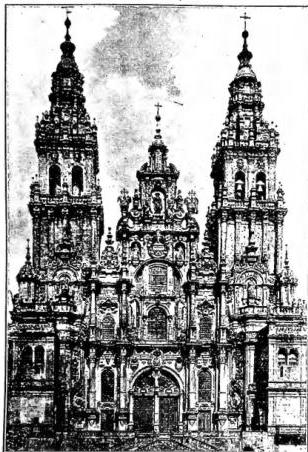
SANTIAGO DI COMPOSTELLA, ARCIDIOCESI of — Façade of the Cathedral (1738–47) — Santiago.
(phot. Reinio)
The western façade, the work of F. Casas y Novoa, called that of the Obradoro (1731), is preceded by a great double-flight staircase of 1606 leading to the portico (de la Gloria), the work of Maestro Matteo (1168–83), adorned with lightly polychromed reliefs added in 1651; the three great arches represent the Catholic Church, that « ex gentibus », and that « ex circumcisione ». At the center is the group of s. Giacomo between two kneeling kings, followed by the statues of his disciples Atanasio and Teodoro, with other statues at the sides; then comes the capilla del Dean, whose tympanum presents the Adoration of the Magi (14th century). On the south side is the doorway called « de las Platerias », from the 11th century, which leads into the transept. It is decorated with statues of prophets and saints, works by a sculptor from Toulouse of the late 11th century. At the southeast corner rises the clock tower, 72 m. high, begun in 1316 and completed in 1680; the largest bell has a diameter of 2.50 m.
The eastern façade contains the « puerta Santa », which opens during jubilee years, flanked by 24 granite statues of prophets and saints; to its left is the « puerta Real » in classical style (1606). To the north opens the « puerta de la parroquia » or « de la Azabacheria », the work of V. Rodriguez (1765–70); by means of great arches it communicates with the Archbishop’s Palace.
The « capilla mayor » was rebuilt in the 17th century; it contains a seated statue of s. Giacomo, whose pilgrim’s cape is made of silver encrusted with diamonds and precious stones (1765); another wooden group represents the Apostle with four kneeling kings, the work of P. Del Valle (1667); there is also the equestrian statue of the Apostle by M. De Prado (1677), which is often carried in procession. Around this chapel are several others, such as that of the Pilar (1691–1726), with the tomb of Archbishop F. A. Monroy (1721); the « capilla del Espiritu Santo », with the tombs of Archbishop A. de Moscoso (1383) and Cardinal Pedro Varela (1574); the « capilla de la Corticela », the former parish of foreigners, with the tomb of Cardinal Eanes (1342); the chapel called « de la Comunion », with the tombs of Archbishops Lope de Mendoza (d. 1451) and Rajov (d. 1772); and the chapel of the « Cristo de Burgos », with the tombs of its founder, Archbishop Carrillo (1667), and Cardinal García Cuesta (1873). Near the transept is the magnificent cloister, forming a quadrilateral 39 m. on each side; it was erected between 1521 and 1580 by J. De Alava and G. de Hontañon in the Flamboyant Gothic style.
This church has a very rich treasury of relics, images, and vestments: the gilded silver statue of its patron (15th century) and the reliquary bust of the same Saint (16th century); precious silver antependia from the high chapel of Solitude; a very tall silver monstrance set with precious stones; several crosses from the 13th century; and images, likewise of silver, of s. Peter and s. Paul. In the Chapel of the Relics, the skull of the apostle s. James the Less is venerated, and the tombs of the sovereigns Ferdinand II, Berenguela, Alfonso VII, and Alfonso IX are preserved. The well-organized Chapter Archive contains diplomas of almost all the Spanish sovereigns from the time of Alfonso II the Chaste, as well as of several Roman pontiffs.
To the west of the Cathedral and beneath the steps stands the « Catedral Vieja », contemporary, however, with the other building, since it was begun at the end of the 11th century and strengthened to support the Portico of Glory of Maestro Mateo. It is in the form of a cross, with arches supported by great pillars whose capitals are richly decorated. To the north stands the archiepiscopal palace, built in the 18th century on the site of the ancient palace of Gelmirez, the first archbishop of Compostella (1120-49), whose majestic remains (12th and 13th centuries) constitute a major monument of Spanish civil architecture. The archaeological museum attached to the Basilica contains fragments of architecture and sculpture from the demolished sections, as well as 108 precious remains.
Other notable churches are: the church of S. Maria del Camino, from the 18th century; the church of S. Felix de Solovio, which preserves its 12th-century portal and the tomb of Cardinal Lopez Gonzalez from the 15th century, while the remainder dates from the 18th century. The church of S. Martino, erected in 1590 by M. Lopez, is adorned with 15 statues and preceded by a flight of steps; the interior, with three naves, was completed in 1647 by M. De Prado. The church of S. Agostino dates from 1648; it has three naves and a dome, with a neoclassical façade. The church of S. Maria Salomé dates from the 12th century, with a 15th-century façade. The church of S. Susanna dates from the 12th century; that of the Pilar from the 17th century.
The Seminary was founded in 1829 by the archbishop Fr. Raffaele Veles, a Capuchin. It had been established in the college erected by Archbishop Giovanni di S. Clemente in the 16th century; but, since this was insufficient, Cardinal García Cuesta transferred it in 1868 to the Benedictine monastery of S. Martino Pinaris, and it is truly imposing. It is governed by the Constitutions given to it by Cardinal Herrera on 8 July 1827. It is pontifical.
The « Colegio de S. Jeronimo », now a teacher-training school, was founded in 1501 and rebuilt in 1665; a cloister is attached to II. The « de Fonseca » College (1544), with a tower dating from 1601, now houses the Faculty of Pharmacy. In the « de los Remedios » College, the chapel of 1671 contains the tomb of Cardinal Martin de Herrera. The « de Sanclemente » College was founded by the archbishop of that name in 1601; it is now occupied by the School of Arts and Crafts. The convent of S. Domingo, now converted into a hospice, has an attached three-naved church from the 14th century. The « Hospital Real » was commissioned by the Catholic Monarchs for pilgrims between 1501 and 1511; it is the work of E. de Egas, but the façade was rebuilt in 1678; the precious chapel is in ogival style, with a dome. The « Hospital de S. Roch », likewise for pilgrims, dates from the 16th century. In the suburb called « de Horres » stands the church of S. Maria del Real de Sar, from the 12th century and formerly belonging to the Templars. The original façade was replaced in 1732; its Romanesque portal remains, while the exterior buttresses also date from the 18th century. The interior has three naves and a triple apse; the sumptuous attached cloister, attributed to Maestro Mateo, has paired columns and pillars with rich decoration. It contains the tombs of the priors from the 13th to the 15th century and a monolithic granite baptismal font (C. Sanchez Rivera, La Iglesia de Santa Maria la Real de Sar, Santiago 1920). On the road between S. and Orense stands the monastery of Osera, founded by the Cistercians in 1135; it was destroyed by fire in 1552 and rebuilt in the following century; it was called the Escorial of Galicia. The church has a classical façade with Baroque towers; it has three naves and preserves a Romanesque dome and apse, remains of mural paintings, and historiated capitals.
In the diocese are the distinguished collegiate church of the city of Coruña and the former collegiate church of S. Maria Iria Flavia. The church of the Incarnation in Madrid, belonging to the Royal Patronage, depends upon this diocese; it was founded in 1611 by Queen Margaret of Austria, wife of Philip III, together with a monastery of Augustinian nuns. Spiritual jurisdiction belongs to the archbishop of S.
Very many prelates, distinguished for virtue, lineage, and letters, have brought glory to this see of Compostella; among them were not a few cardinals.