
SANTIAGO DE CUBA (SAN JACOBUS), DIOCESE of. - In the easternmost part of the island of that name in the Antilles, at the entrance to the Gulf of Mexico.
It has an area of 37,000 sq. km., with a population of 1,500,000 inhabitants, of whom 1,475,000 are Catholics, distributed among 30 parishes served by 37 diocesan and 51 regular priests; it has a seminary, 13 male and 23 female religious communities (Ann. Pont. 1952, p. 366). The diocese was created by Pope Adriano VI on 28 Apr. 1522 and was raised to metropolitan rank by Pope Pio VII on 24 Nov. 1803. Its suffragans are the dioceses of Camagney and Cienfuegos.
The island was discovered by Cristoforo Colombo on his first voyage, on 27 Oct. 1492. Occupied by Governor Ocampo in 1508, it was organized politically and religiously three years later; the first bishop was the Franciscan Giovanni de Ubita, who was succeeded in 1537 by M. Rodriguez de Salamanca. It remained the sole diocese until 1787, when the westernmost part of the island, namely Havana, was detached from II. The Cathedral, one of the island’s most ancient churches, does not display the proportions and beauties corresponding to its importance; its style is the usual one of Spanish colonial architecture, with two quadrilateral towers.
It has had a succession of distinguished bishops, among whom, from 1831, was the Franciscan C. Alameda y Brea, later a cardinal, and his successor in 1850, s. Antonio M. Claret, founder of the Claretiani, recently canonized.
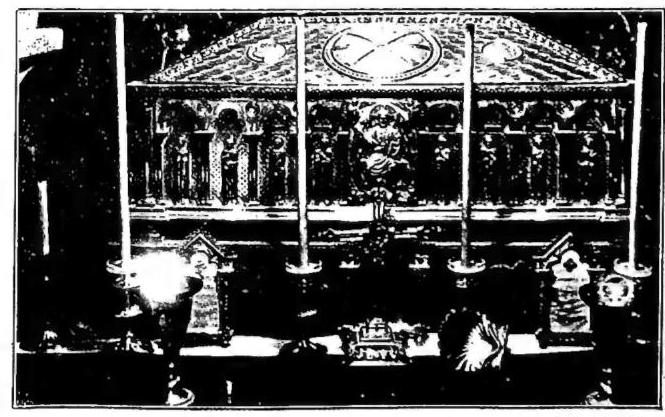
(photo Gerraballa)