
CISTERCIANS (SACRED CISTERCIAN ORDER). — This name derives from Cistercium (Citeaux), where on 22 March 1098 St. ARDIGO, ROBERTO (v.), abbot of Molesme (1075–98), founded the first abbey of the Order (although G. Müller, Der Grundr. d. Abtei Citeaux, in Cist. Chronik., 10 [1898], p. 105, and J.-O. Ducourneau, Les orig. cisterc., Ligugé 1933, deny him this merit); nevertheless, ALBERIGO (v.), second abbot of Citeaux (1099–1109), and his successors deserve the credit for carrying out the reform, while St. Stefano Harding deserves that for giving it its definitive organization. A contemporary account of the origins has come down to us in the Exordium Cisterciensis coenobii, which intended to explain « quam canonice, quanta auctoritate, a quibus personis, quibusque temporibus coenobium et tenor vitae illorum exordium sumpserit ». After an initial period of difficulty, thanks above all to the entry into Citeaux of St. Bernardo di Fontaines and his thirty companions, the mother abbey had its first « four daughters »: the monasteries of La Ferté (1113), Pontigny (1114), Clairvaux, and Morimond (1115); thus there arose the mother abbeys which, with their abbates primarii, maintained primacy over all the monasteries subsequently founded by them, directly or indirectly.
Those first foundations arose with the purpose of observing the Rule of St. Benedetto in its original
Those first foundations arose with the purpose of observing the Rule of St. Benedetto in its original
and austere form, eliminating the usages introduced into many monasteries; hence the first Charta caritatis speaks of the « rectissima via sanctae Regulae » (J. Turk, Charta carit. prior, in Analecta S. O. Cister., 1 [1945], p. 31). Indeed, the first organizers insisted that, in monastic observance, primary attention should be given to the purity of the Rule, upon which the blessed Alberico had particularly insisted in the Instituta monachorum Cisterciensium de Molismo venientium; and to freedom from every ecclesiastical and secular interference, as had been assured to the first C. by the Privilegium Romanum of Pasquale II on 19 October 1100. The Exordium magnum S. O. Cist., from the end of the twelfth century, gives its precise formulation: « notum fiat posteris nostris, quantam statim in initio fundationis suae ab Apostolica Sede gratiam, favorem et libertatem Cisterciensis ecclesia promeruit ». This was the beginning of the exemption which, initially still relative, increased with the confirmation of the first Charta caritatis by Callisto II on 23 December 1119, until it became absolute with the bull of Lucio III of 21 November 1184. Unity among the various monasteries of the Order rests upon the uniformity of observances: « una caritate, una regula similibusque vivamus moribus » (Charta caritatis, I, chaps. 53, 35). Recently J. Turk rediscovered the first Charta caritatis, published and commented upon in the Analecta cited above (p. 11 ff.); on p. 50 he states: 1) The first Charta caritatis was compiled in 1118. 2) It was modified in 1134–52, but probably not long before 1 August 1152. 3) The reasons for this modification were changed circumstances, such as the progress and development of the Order and the aspiration of the « abbates primarii » to greater independence in their relations with the abbot of Citeaux and with the General Chapters themselves
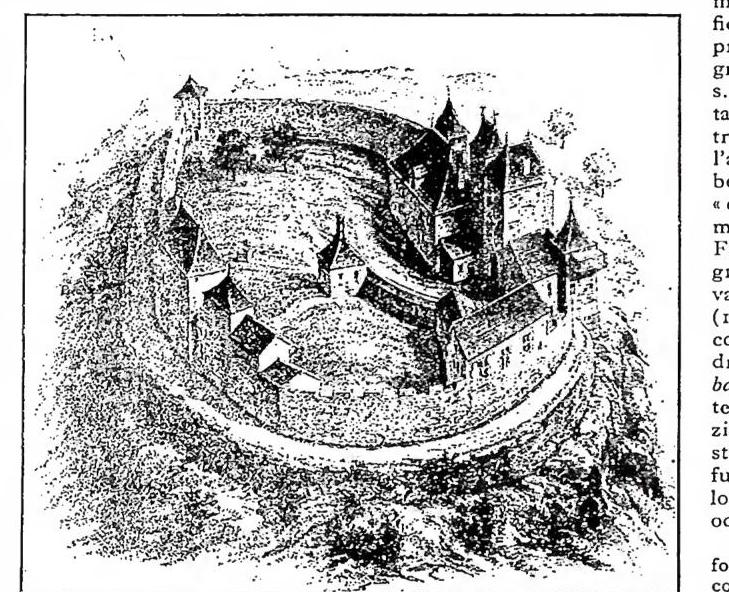
Subsequently, the statutes of the C. were established in the Libelli definitionum of 1256, 1316, and 1350. The «rectissima via sanctae Regulae» perfectly harmonized among themselves the Opus Dei (the Divine Office), spiritual reading, and manual labor, thus nourishing body and soul in the natural and spiritual orders, according to each one’s portion. Abelardo had already understood all this well when he wrote to St. Bernardo (PL 178, 340): «Institutio Regulae novum opus de veteri facere compellit». In fact, guided by this principle and with regard to «rectitudo» according to the Rule, the first C. established and reformed first of all the manner and order of divine service, entirely in accordance with the traditions of the Rule, completely omitting the additions to the psalms, prayers, and litanies which less discerning fathers had introduced on their own authority.
In the Cluniac liturgy solemnity and pomp prevailed; in that of the C., simplicity, as a manifestation of the interior life. In obedience to the truth, the first C. undertook the correction of the Bible and the reform of Gregorian chant. Cistercian architecture is a demonstration of this spirit. Spiritual reading, however, was held in high regard: it occupied the first place after the Divine Office and before manual labor, except during the summer season. Time was devoted to reading not only Sacred Scripture, but also the Fathers and other authors who contributed to a better understanding of monastic life. Particularly in the twelfth century, illustrious writers of ascetical and mystical works flourished among the C. Especially noteworthy in this field are the commentaries on the Contico dei Contici and the treatises De anima. From reading there arose a profound…
devotion, cultivated by many monks and in many ways, toward the Passion of Jesus, the Sacred Heart, the Most Holy Eucharist, and the Madonna. Among the ancient C. there were also distinguished historiographers, such as Ottone di Frisinga; many annalists and chroniclers, such as Elinando di Montefreddo and Alberico delle Tre Fontane, the authors of the Chronicon Villariense and the Annales Waverleenses. The C. were also compilers and disseminators of legends, such as the Collectio miraculorum Ioannis prioris Clarendalesis (1179), the Liber miraculorum
Herberti (1178), the Liber miraculorum Goswini (before 1200), and the Exordium magnum S. Ord. Cist. by Corrado di Eberbach (before 1221). The influence of the Eucharistic piety of the C. is also perceptible in the famous Queste dou Graal (cf. P. Browe, Die eucharistischen Wunder des Mittelalters, Breslavia 1938, pp. 22–23, 102–106). Not a few C. were good theologians. To promote study, many colleges were founded in France, Germany, England, and Spain. The college of S. Bernardo, founded in Paris around 1242 on the initiative of Abbot Stefano Laxington, is famous. Manual labor, in accordance with chap. 48 of the Rule of s. Benedetto, was held in high esteem, and through it social life also received vigorous impetus. Prompted by b. Alberico, the first C. established in the Statuta that, with the bishop’s permission, they would receive laymen with beards and treat them as their equals, with the exception of monastic life, and would also take in laborers, because they knew that without their collaboration it would not be possible always to observe the precepts of the rule. Thus, in the Middle Ages, they became good farmers and made a notable contribution to civilization, especially in the northern regions, in Bohemia, and in Hungary. As appears from the statutes of the General Chapters, the C. were excellent organizers who promoted the draining of marshes in Italy and Holland, the clearing of the great forests in France, Germany, and Bohemia, and also the exploitation of the iron and coal mines of the Pennines (H. C. Darby, An historical geography of England before 1800, Cambridge 1936, pp. 243 and 257).
The harmony established between the Opus Dei, spiritual literature, and manual labor, regulated by the Consuetudines and confirmed by the General Chapter of each year, but much more the personality of s. Bernardo, the illustrious glory of the Order, caused it to spread wonderfully. At the death of s. Stefano in 1134, there already existed 80 monasteries, of which 55
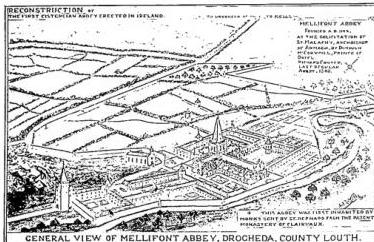
(from J. Luddy, Life and teaching of st. Bernard, Dublin 1857, p. 546) CISTERCENSI — General view of Mellifont Abbey. The first Cistercian abbey in Ireland, founded in 1142.
The year before the death of s. Bernardo (1152), there were 339 monasteries of monks, and by the end of the Middle Ages approximately 750, in all the countries of Europe.
Those deserving well of the Church included not only s. Bernardo, but also many monks and lay brothers: three popes, Eugenio III, formerly abbot of Tre Fontane, Celestino IV, and Benedetto XII, abbot of Font Froid in France; 44 cardinals, among them Giacomo da Pecorara (1244) and Giovanni Bona (1647), an illustrious writer on asceticism and liturgy; and approximately 580 bishops (cf. G. Willi, Cist. Päpst. Kardinäle u. Bischofe, in Cist. Chron., 23 [1911], pp. 255 ff.). Many lay brothers regularly served the Roman Curia as sealers. Abbots and monks also went among the Muslims and the Albigensians to preach the Gospel.
Many monasteries were attracted to the Order of the C. by the good reputation it enjoyed: thus, in 1147, the General Chapter incorporated the Congregation of Savigny, with 28 monasteries, and that of Obazine, with 3 monasteries; in 1162, the monastery of Dalon, together with its dependent houses. Some military orders also joined the Order, such as that of Calatrava in Spain.
For the services it rendered to the Church, the Order received many privileges. From Innocent III, that of exemption from tithes, later modified by Adrian IV, Alexander III, and the Fourth Lateran Council. Lucius III granted the privilege of exemption; Innocent VIII (bull Exposcit tuae devotionis), although some question its authenticity, granted the abbot general the power to confer the subdiaconate and diaconate, to consecrate chalices and patens, and to bless abbots (cf. T. Abele, Die Erteilung der Subdiakonats- und Diakonatsweihe durch den Abt von Citeaux und die Primaräbe, in Cist. Chron., 37 [1925], pp. 169 ff.).
The 12th and 13th centuries were the golden age of the Order, but it is easy to understand how, among so great a number of monasteries and religious, weaknesses and errors were not absent. In the 12th century, some monasteries acquired, contrary to the statutes of b. Alberico, the right to tithes; and, since they could no longer work the fields directly because of their great extent, they ceded part of them in return for the payment of rents, so that the observance of the rules and customs suffered serious harm. With the abandonment of manual labor, the harmony created between the Divine Office and spiritual reading was broken. In many monasteries study was abandoned and the Office was lengthened, with further innovations contrary to the statutes of the Order. Nevertheless, some monasteries remained faithful for a long time to the teaching of the Fathers, such as that of S. Urban in the 16th century. Through the intervention of the Roman pontiffs and the care of the General Chapters, many attempts were made over the centuries to restore discipline, as witnessed by the constitution of Clement IV, Pareus fans, of 9 July 1265, commenting on the Charta caritatis; that of Benedetto XII, Fulgens sicut stella, of 12 July 1335, on the reform of the Order; the definitions of the General Chapter of 1601 for the reform of the Order and of its members; and the constitution of Alexander VII of 19 April 1666 for a general reform of the Order and to settle the disputes that had arisen between the Strict and Common Observance (its text still forms the basis of the statutes of the Augiense Congregation).
To rekindle the spirit of the Fathers, some monasteries tried other means, among them the formation of Congregations. Some of these remained closely united to the mother house of Citeaux, while others separated from II. First was the General Congregation of the reformer Martino di Vargas, founded in 1425 (the Congregation of Mount Zion, or of the Regular Observance of Spain); then the Congregation of S. Bernardo in Italy, namely the Lombard-Tuscan Congregation of 1497, the Lusitanian Congregation of 1567, and the Fuliensian Congregation founded by Giovanni de la Barrière in 1589. These, together with the Aragonese Congregation, the Roman Congregation of 1613, and the Calabrian-Lucanian Congregation of 1633, introduced practices foreign to the Order, whereas the Congregation of Upper Germany, founded in 1595, remained faithful to the principles and to the abbot of Citeaux. Thus the Order, once so united and glorious, became divided, but the spirit of the Fathers lived on in many monasteries, with excellent results. In the 18th century the way of life of the C. was still identical with that of the Reformed C., except for perpetual silence, complete abstinence, and manual labor. Various circumstances favored this dissolution of the Order, such as in France the Hundred Years’ War (1339–1453), epidemics, and the famous «commendams», which, especially in the monasteries of France and Italy, where it was possible to support only a small number of religious, damaged regular observance and the customs of the Order. Many abbots did not attend the General Chapter, which consequently could no longer be held regularly; to this must be added the persecutions of the Hussites in Bohemia, Silesia, and Austria. Through the force and violence of the laity, but also because of the weakness of the monks, the Protestant Reformation extinguished the life of the C. in all the monasteries of England, Scotland, Scandinavia, Holland, and Hungary, and in not a few of those in Germany and Switzerland. In Austria many abbeys were closed by Giuseppe II; in France and Belgium suppression was universal, carried out by the Revolution. In 1803, with the dissolution of the German Empire, many monasteries were suppressed, with the exception of some houses of nuns; in 1810 all the abbeys of Prussia, Poland, and Silesia; in 1830–35 all those of Portugal and Spain; and in 1841–48 all the monasteries of Switzerland were likewise suppressed. Some monasteries survived by emigrating, such as the C. of the Strict Observance (Trappists). The convent of S. Bernardo at Scaldin and that of Stella Maris at Wettingen were also able to survive.
At present the Order consists of 8 Congregations: 1) Sacred Heart of Jesus (Austria); 2) Augiense (Mehrerau, formerly Elveto-Germanic); 3) Italica; 4) Belga; 5) Gallica; 6) Ungarica; 7) Most Pure Heart of Mary in Bohemia; 8) Casamari. Some monasteries do not belong to any Congregation. Today, 1,500 religious live in 63 monasteries.