
CUORE DI GESÙ. - I. CULTO DEL SACRO C. DI G. - 1. History. The constituent elements of the worship of the S. C. di G. are essentially contained in Revelation. The Holy Fathers insistently exhorted the faithful to respond to the Savior’s love for the human race; nor are reflections on Christ’s pierced side lacking. Yet in the tradition of the first ten centuries there are no references to worship of the fleshly heart as a symbol of love.
Beginning in the eleventh century, the elements of this devotion began to develop in the writings and piety of the faithful; it was elaborated within the Church, under the influence of the Holy Spirit, through the collaboration of chosen souls. Much was contributed by the atmosphere of intense spirituality that arose around St. Bernard.
Through the opened side one reaches the heart, and an association begins to be established between the heart and the love of Jesus. In the material wound one sees the wound of love. Passages attributed to St. Anselm and St. Bernard allude to the symbolism of the heart pierced for love, but it is uncertain whether the fleshly heart is meant. The doubts cease from the middle of the twelfth century, as the texts become more frequent and clearer; but, with the exception of a few passages by William of St-Thierry (d. ca. 1150) and Guerric of Igny (d. ca. 1160), no true traces of devotion appear. It is affirmed as a distinct devotion—in its object, end, spirit, and practices—in the Vitis mystica attributed to St. Bonaventure. In the works of St. Matilda (d. 1298) and St. Gertrude (d. 1302), the devotion is enriched with exercises and practices, but remains the privilege of mystical souls.
In the following centuries it spreads without developing. Progress is made in the sixteenth century with the venerable Lanspergius (d. 1539; v.), the Carthusian of Cologne, and with Louis of Blois (d. 1566), Benedictine abbot of Liessies. Through prayers, exercises, and practices, they give concrete form to and facilitate the devotion, making it popular. Their influence was decisive in the propagation of the devotion, which entered Christian asceticism and permeated the schools of spirituality, so that it commonly recurs in the ascetical works of the seventeenth century.
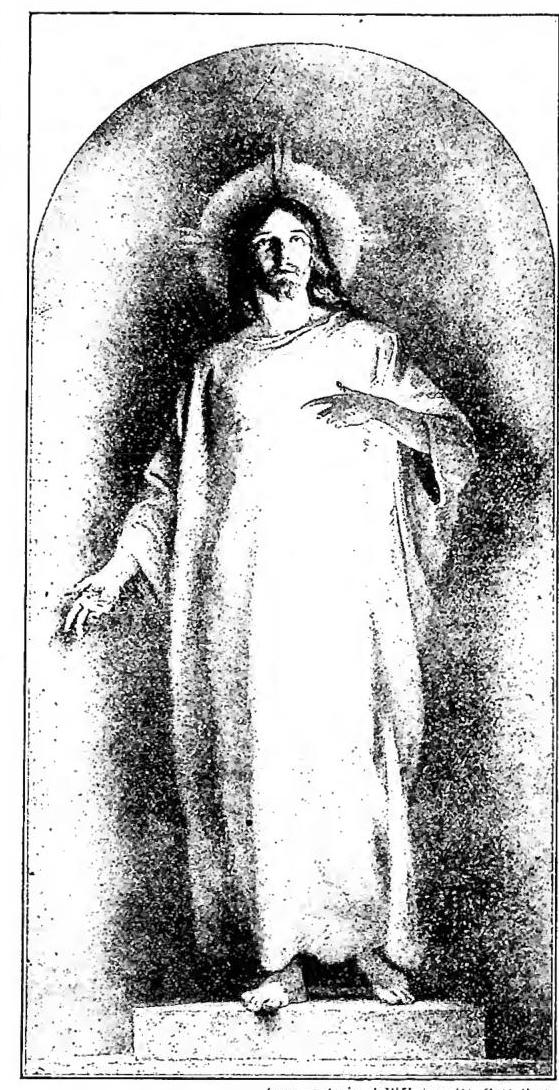
(by courtesy of the Catholic University)
CUORE DI GESÙ — Painting by L. Pogliaghi — Milan, Università Cattolica del S. Cuore, chapel.
He infused his sentiments into the Visitandines and bound the Congregation to the S. C. di G. (cf. the letter of 10 June 1611 to s. Giovanna di Chantal). Thus, in the Visitation, down to s. Margherita M. Alacoque, there was a continual flowering of fervent devotees endowed with special graces. In the Society of Jesus, the indefatigable fathers L. Lallemand (d. 1635) and V. Huby (d. 1693) distinguished themselves. Despite this diffusion, the devotion remained purely private. S. G. Eudes (d. 1680) was the initiator and apostle of the liturgical cult of the SS. Hearts of G. and Mary (cf. the decree on the heroic nature of his virtues, 6 January 1903; Acta Sanctae Sedis, 35 [1902–1903], pp. 378 ff.). In the beatification brief (11 April 1909; AAS, 1 [1908], pp. 477–82), he is called “the father, doctor, and apostle of this devotion.” He consecrated his Congregation of priests to the SS. Hearts of G. and Mary and had their feast celebrated. He prescribed special exercises and composed the Office and Mass, which were approved by several French bishops. Confraternities arose and were approved by Alexander VII and Clement X.
In s. G. Eudes, devotion to the S. C. di G. was initially morally united with devotion to the Heart of Mary, but later became distinct from II. Indeed, he composed a special Office and Mass of the S. C. di G. Probably on 20 October 1672, the first feast of the S. C. di G. was celebrated in various places in France. The Office and Mass greatly promoted this cult, and s. Giovanni Eudes was the direct precursor of s. Margherita M. Alacoque (d. 1690). In addition to visions concerning her private devotion, the saint received important revelations for the spread of public worship. In the first great apparition (27 December 1673?), Jesus revealed to her the love of his Heart and chose her as an instrument for carrying out the design of saving mankind through his Heart. Subsequently, she was instructed concerning the object, practices, and spirit of the devotion, which thus received its final formulation. The fleshly heart, surrounded by a crown of thorns and surmounted by a cross, is the symbol of Jesus’ love: a despised love that seeks love and reparation. In the apparition of 1675, Jesus requested public worship, with the institution of a reparatory feast, and indicated to the saint as a collaborator p. Claudio de la Colombière (d. 1682). In the Society of Jesus, he gathered around himself fervent apostles, such as the fathers G. de Gallifet and G. Croiset, who continued his work. The cult spread widely, immediately opposed by the Jansenists and by some poorly informed Catholics.
In 1726, the king of Poland, several bishops, and the Visitandines sent a petition to Benedict XIII for the institution of the feast, through the postulation of p. Gallifet. To avoid a refusal, the response was deferred, since, as the promoter of the faith, Prospero Lambertini, pointed out, the petition spoke of the heart as “the co-sensible principle of all virtues and affections and the center of all intimate joys and sorrows.” When, however, the petitioners persisted, the Congregation of Rites responded negatively on 30 July 1729.
Clement XIII, in response to innumerable petitions, among which was a memorial from the Polish episcopate expressed in clear and precise terms, had the examination of the case resumed. On 25 January 1765, the S. Congregation of Rites issued the decree of approval. The object of the cult was expressly determined as the heart, symbol of love. On the basis of this clarification, the Jansenists concluded that the heart in question was metaphorical, not real. The contrary, however, is evident from the petition and from the decree, which approved and extended the cult without changing II. The worship of the fleshly heart was consequently accused of idolatry. Pius VI, however, rejected the error, observing that the heart is adored but “inseparably united with the Person of the Word” (cf. the bull Auctorem fidei, 1794; Denz-U, nos. 1562–63).
Pius IX extended the feast to the universal Church with the rite of double of the second class, later raised by Leo XIII to double of the first class, who also approved the litanies. In the encyclical Annum Sacrum (25 May 1899), he ordered the consecration of the human race to the S. C. di G. on 11 June of that same year. Shortly thereafter, he urged the bishops to develop the cult through the practice of the first Friday and the month of the S. C. di G. Pius X ordered that the act of consecration be renewed every year. Benedict XV approved the cult of the Eucharistic S. C., granting the proper Mass and Office to Ordinaries who requested them (decree of the S. Congregation of Rites, 9 November 1921). Pius XI, in the encyclical Miserentissimus (8 May 1928), developed the doctrine of devotion to the S. C., dwelling particularly on consecration and reparation for offenses, and raised the feast to the rite of double of the first class with a privileged octave of the third order.
2. Doctrine
The revelations to s. M. Margherita Alacoque, however, constitute only the occasional cause of the approval, since the Church, setting aside their truth, based its decision on doctrinal reasons. The cult is justified in itself and has its theological foundation in the Catholic doctrine of the adoration of Jesus’ humanity.In Christ there is one person, the divine person of the Word, and two natures, the divine and the human. The one and same adoration owed to the divine person must be attributed to that which subsists in it and through II. Honor, in fact, refers to the whole, that is, to the person, even when it is attributed to a part (s. Tommaso, Sum. Theol., 3°, q. 25, a. 1–2). Therefore Christ’s humanity, not in itself or considered separately, but insofar as it is united to the Word, is worthy of true latreutic worship. This worship is direct and absolute, since Christ’s human nature is adored not on account of the dignity of a different and distinct person, but on account of the excellence of the person in whom it subsists and with whom it constitutes a single whole.
This applies to each part of Christ’s humanity. His heart, therefore, considered as united to the divine person, is worthy of adoration, which terminates in Jesus’ own person. Every form of worship has as its ultimate and complete object Jesus Christ in his entirety, but the various devotions have a proximate, proper, and specific object. In the cult of the S. C. di G., this is Jesus’ physical heart, that is, his living and animate fleshly heart, not merely as the noblest part of Christ’s body, but especially as the symbol of his love.
The proper object of the cult, therefore, is neither only the physical heart nor only love, but the physical heart as the symbol of love, that is, the S. C. di G. burning with love (cf. the decree of the S. Congregation of Rites, 1765, and the letter of Pius VI to Scipione Ricci, 29 June 1781). This is the reason for the special cult of the S. C. di G. The heart, in fact, has always been taken as a symbol of love; nor is it a purely conventional sign, but a natural sign, because of the real relation between the heart and love, since love and the other affections rooted in it reverberate in the heart. The cult of the S. C. di G. sets aside the physical and psychological question of whether the organ of sensible affections is the heart, as the ancients held, or the brain, as moderns maintain. Certainly, the affections are experienced as having an effect on the movements of the heart, which, although it is not the eliciting organ of these affections, nevertheless manifests them. The physical heart and the love it symbolizes must not be regarded as distinct and separate: they are one single and adequate object of worship. These two elements constitute one thing, like soul and body; and just as the soul has supremacy over the body, so love has supremacy over the physical heart.
The theologians call the heart the proximate material object and the divine and human love of Jesus the formal object. Similarly, they agree that the object of the cult is the heart, symbol not only of love but of the whole inner life of Jesus—that is, of all his affections, sorrows, sacrifices, joys, sufferings, virtues, and sensible feelings. All these, in fact, are reflected in the heart. Therefore, the expression Sacred Heart of Jesus is commonly used to signify the whole person of Jesus, considered in his inner, affective, and moral life. From this derives the pre-eminence of this devotion over others, since it synthesizes the whole life of Christ in love, the cause of the wonders of the Redemption, making it easier for man to attain intimate knowledge of and consequently love for the Redeemer.
Rationalism has classified this devotion as a form of tender and superficial piety. When examined closely, however, it proves solid and vigorous, engaging man in the practice of virtue.
The purpose of this cult is to kindle in the faithful love, in order to correspond to that of Jesus. For this reason, the personal and collective consecration to the Sacred Heart of Jesus is strongly recommended in pontifical documents (cf. encyclicals Annum Sacrum and Miserentissimus) and in the writings of s. Margherita M. Alacoque; and since the love of Jesus is despised and neglected, consecration must be followed by reparation.
Devotion to the Sacred Heart of Jesus has exercised a beneficial influence on the life of the Church. Deism and Jansenism had sought to distance God from man, denying or substantially altering Christian Revelation; devotion to the Sacred Heart of Jesus unites the soul to God through the bonds of love and Grace, revealing to man the intimate and true character of Christianity. Amid the darkness of rationalistic criticism, the cult of the Sacred Heart of Jesus has been a powerful radiance of light. The souls who understood this devotion felt the need for union with Jesus, and thus began the religious revival, to which the development of Eucharistic piety is connected.
II. CULT OF THE EUCHARISTIC HEART OF JESUS
Devotion whose purpose is to honor the act of love by which Jesus instituted the Eucharist. It is a natural development of the cult of the S. C. di G., whose origin is not connected with any revelation. Arising in France in the second half of the nineteenth century, it immediately found the support of Mgr. De Ségur, Blessed Eymard, and St. Giovanni Bosco. By 1890 it was already widespread in more than 35 nations, where numerous confraternities canonically erected in honor of the Eucharistic Heart were to be found. There was no lack of opposition, provoked by the indiscreet zeal of some who wished to represent the S. C. di G. in the midst of the Host. The Holy See, while disapproving these exaggerations (27 May 1891: in L'ami du clergé, 36 [1914], pp. 675–76; 15 July 1914: AAS, 6 [1914], p. 382), declared, in subsequent decrees, that it did not intend to prohibit the new cult, by then «positively recognized» (3 Apr. 1915: AAS, 7 [1915], p. 205). In an apostolic brief of 16 February 1903 (Leonis XIII Pont. Max. Acta, XXII, Rome 1903, pp. 307–10), by which Leo XIII raised to the rank of archconfraternity the association already existing in Rome, the object of the new cult was clearly specified. On 9 November 1921 Benedict XV crowned the numerous petitions that had reached Rome from every part of the world with a solemn decree, by which he granted a feast and proper Office in honor of the Eucharistic Heart of Jesus, to be celebrated on the Thursday after the octave of Corpus Christi (AAS, 13 [1921], p. 545).Revelation and theology, in their constant affirmation of the cause-and-effect relationship between the S. C. di G. and the Eucharist, show the fittingness and appropriateness of the new cult. Many prophecies of the Old Testament announce that streams of grace and rivers of living water must gush forth from the Messiah (Is. 12:3; 55:1; 48:21; Zach. 12:10). St. Paul presents the Messiah as the miraculous rock that gives the Jews refreshing water in the desert (I Cor. 10:4). St. John emphasizes that rivers of living water must flow from the depths of the Humanity of Jesus (Io. 7:37), and points to the fulfillment of the prophecies in the open wound in the side of the Savior (Io. 19:34).
The alert and devout thought of the Fathers discovers and comments upon this reality: the side is compared with the rock of the desert, Longinus’s lance with the rod of Moses, the wound with the cleft in the rock, and the flowing water with the Eucharistic mystery. According to St. John Chrysostom, who recalls the thought of tradition, the Christian must sit at the Eucharistic banquet and bring his lips to the chalice as though drawing the precious Blood from Christ’s side: «Hinc initium mysteria sumunt, ut cum ad tremendum poculum accessoris sic veniss ac si ex hoc latere potaturus esse» (Hom. 85 in Io.: PG 59, 463).
According to the mystical vision of the Fathers, the Eucharist came forth from the real heart of Jesus as the most precious gift of his love. Already in the Old Testament the Psalmist, reflecting upon the gift of manna, exclaimed: «Cogitationes cordis eius in generationem et generationem... ut alar eos in fame» (Ps. 32:11, 19). In the New Testament the Eucharist, as the fruit of loving reflection, is present in that fervent utterance: «Desiderio desideravi hoc Pascha manducare vobiscum» (Lc. 22:15), and the mysterious Johannine expression «in finem dilexit» (Io. 13:1) echoes in the moved thought of the Fathers: «Cum esset omnipotens plus dare non potuit, cum esset sapientissimus plus dare nescivit, cum esset ditissimus plus dare non habuit» (a celebrated text attributed to St. Augustine).
Cause and effect, intimated in Scripture and illustrated in Tradition, are summed up in the theological synthesis of St. Thomas. Through the Humanity of Christ, the instrument of the Word, pass all the omnipotent power and all the supernatural life of man (cf. Sum. Theol., 3e, q. 62, a. 5): this instrumental activity and this divine energy flow from the S. C. di G., together with the Blood poured out as the price of Redemption. The wound in the side and heart was the divinely established condition for the streams of grace hidden in the Humanity of the Word to be able to flow forth: «Ut apertum cor, divinae largitatis sacrarum, torrentes nobis funderet miserationis et gratiae» (Preface of the feast of the Sacred Heart). The first and most exalted grace is the Eucharist, as the realization and compendium of Jesus’ human-divine (theandric) love for man; a love expressed in the ardent desire to remain always with the beloved person and to be united with him in a mysterious unity: «This most divine gift came forth from the depths of the heart of that Redeemer who ardently longed to establish this marvelous union with men» (encyclical Migne charitatis [28 May 1903], in Leonis XIII Pont. Max. Acta, XXII, Rome 1903, pp. 115–36). — Vedi tav. LXVIII.